

Approximately 60% of restaurants fail within their first year, often because the owners lacked a roadmap for long-term stability. While acquiring an established location reduces some of the risk, the stakes remain high when you're trying to secure financing for a high-value transaction. You aren't just selling a vision; you're selling a transition. Learning how to write a business plan for buying a restaurant requires a shift in focus from creative concepts to hard historical data.
It's natural to feel uncertain about how to present a seller's financial history or how to justify a purchase price to a skeptical lender. We'll show you exactly how to bridge the gap between the seller's past and your future. This guide provides the specific framework required to build a lender-ready document and a clear strategy for your first 90 days of ownership. We will explore how to analyze Seller’s Discretionary Earnings, navigate lease assignments, and project growth in an industry market expected to reach $1.55 trillion by 2026. By the end of this article, you'll have the confidence to justify your valuation and the technical knowledge to satisfy any commercial underwriter.
Key Takeaways
- Understand why lenders prioritize historical financial performance over conceptual vision when evaluating an acquisition business plan.
- Learn how to present Seller’s Discretionary Earnings (SDE) to justify your purchase price and provide transparency to financial institutions.
- Master the specific framework for how to write a business plan for buying a restaurant that includes a robust 90-day transition strategy.
- Discover the critical steps for managing a restaurant lease assignment to ensure operational continuity and legal security from day one.
- Leverage professional valuation services to establish the third-party credibility required to satisfy strict lender underwriting in 2026.
Distinguishing an Acquisition Plan from a Startup Plan
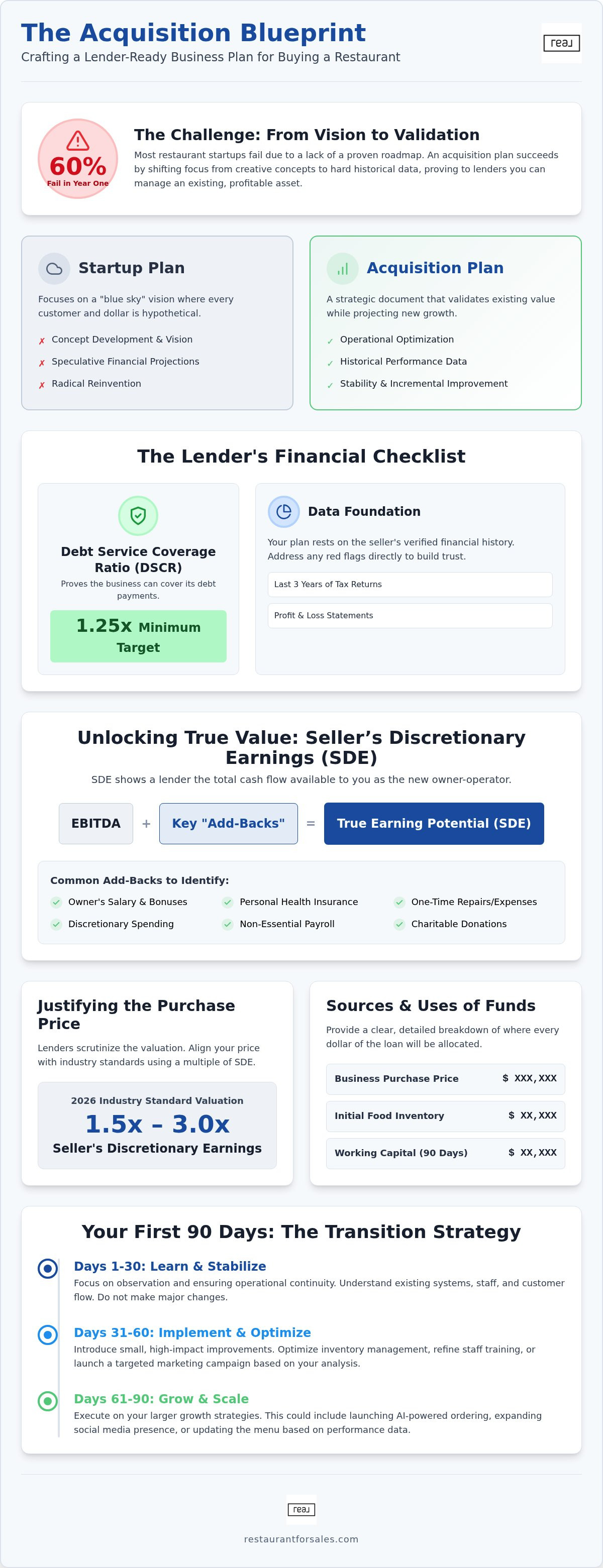
A traditional business plan typically focuses on a "blue sky" vision where every customer and dollar remains hypothetical. When you learn how to write a business plan for buying a restaurant, you must flip this script. An acquisition plan is a strategic document that validates existing value while projecting new growth. It's less about "what could be" and more about "what is" and "how you'll make it better." Lenders in 2026 prioritize historical performance over conceptual vision because the risk is lower when there's a proven track record of profitability.
Your primary goal is to prove you can maintain or exceed the current cash flow. This requires shifting your narrative from "Concept Development" to "Operational Optimization." In a market where SBA 7(a) loan interest rates can range from 9.75% to 13.25%, lenders aren't looking for creative flair. They want to see that you understand the mechanics of the existing business and have a disciplined approach to managing its transition. You're making a case for stability and incremental improvement rather than a radical reinvention.
The Role of Historical Data
The foundation of your plan rests on the last three years of tax returns and profit and loss statements. Lenders use these documents to establish a baseline for debt service coverage. If the restaurant shows a Debt Service Coverage Ratio (DSCR) of at least 1.25x, you're in a strong position. Use this past performance to set realistic future benchmarks. If you see red flags in the seller's history, such as a temporary dip in revenue, don't ignore them. Address them directly. Explain the external factors involved and outline how your management will prevent a recurrence. This transparency builds trust with underwriters.
The "Why This Restaurant" Section
Lenders want to know why this specific establishment is a sound investment. Move beyond subjective statements like "I've always wanted to own a bistro." Instead, focus on untapped market potential. Perhaps the current owner hasn't utilized AI-powered ordering or has a limited social media presence. Analyze the existing customer base and the local competition to show you've done your homework. Detail the specific synergies between your professional background and the business model. Knowing how to write a business plan for buying a restaurant means proving you aren't just buying a job; you're acquiring an asset you're uniquely qualified to grow.
Analyzing Historical Financials and Justifying the Purchase Price
When you are determining how to write a business plan for buying a restaurant, the financial section acts as the backbone of your entire proposal. Unlike a startup, an acquisition allows you to base your arguments on verified performance rather than speculation. Lenders require a clear justification for the purchase price to ensure the asset can support the debt you're taking on. This requires a deep dive into the seller's past three years of tax returns and profit and loss statements to establish a baseline of profitability.
Transparency is key when presenting these figures. You must distinguish between EBITDA (Earnings Before Interest, Taxes, Depreciation, and Amortization) and Seller’s Discretionary Earnings (SDE). While EBITDA is often used for larger corporate entities, SDE is the standard for small to mid-sized restaurants. Seller’s Discretionary Earnings (SDE) is the total cash flow available to a single owner-operator. Highlighting these "add-backs," such as the owner's salary, personal health insurance, or one-time repairs, allows the lender to see the true earning potential of the business. Utilizing professional restaurant valuation services helps you normalize these financials to ensure the price is fair.
Every professional plan must include a "Sources and Uses of Funds" table. This breakdown tells the lender exactly where the capital is going. You might allocate a portion to the business purchase, another to initial food inventory, and a specific amount to a cash reserve for the first 90 days. This level of detail shows you have a disciplined grasp of the transaction's mechanics.
Valuation Methods in Your Plan
Lenders will scrutinize the multiple of earnings used to reach the asking price. Most independent restaurants in 2026 are valued at 1.5 to 3 times their SDE. You should reference a 2026 restaurant valuation guide to support your figures and show that the price aligns with national averages. Don't forget to break out the value of tangible assets like Furniture, Fixtures, and Equipment (FF&E) versus intangible goodwill. If the equipment is nearing the end of its life, your plan should account for future replacement costs.
Pro-Forma Projections Based on Reality
Your Year 1 projections should reflect a realistic transition period rather than immediate, explosive growth. It's common to see a slight dip in the first quarter as you implement new systems. Justify any projected revenue increases through specific operational changes. For instance, if you plan to add a delivery platform or extend weekend hours, use local market data to support the expected lift. This aligns with the SBA guide to writing a business plan, which emphasizes grounded financial forecasting. Ensure your Debt Service Coverage Ratio (DSCR) remains at 1.25x or higher to satisfy underwriting requirements.
Crafting the Operations and Transition Strategy
Success in a restaurant acquisition often hinges on what happens during the first few weeks of new ownership. While financial data justifies the price, your operations strategy proves you can actually run the business. Learning how to write a business plan for buying a restaurant requires a dedicated section on continuity. Lenders and landlords want to see a "Day One" strategy that ensures a seamless experience for both customers and staff. If the transition is jarring, you risk losing the very goodwill you just paid for.
Staff retention is a cornerstone of this section. You should explicitly address how you plan to retain key personnel, such as the Head Chef or Floor Manager, whose institutional knowledge is invaluable. Propose individual meetings with every employee within the first week to build rapport and share your vision. If you plan to make changes to the menu, branding, or physical space, detail these as a gradual evolution rather than a radical overnight shift. This measured approach reassures stakeholders that you won't alienate the existing customer base while pursuing new growth.
The 90-Day Transition Roadmap
A structured timeline demonstrates professional discipline. Your business plan should outline a clear 90-day roadmap to guide the transition:
- Month 1: Observation and Audit. Focus on staff interviews, workflow observation, and a full systems audit. Avoid major changes during this period to maintain stability.
- Month 2: Incremental Efficiency. Implement minor tweaks to the POS system, inventory tracking, or staff scheduling based on your initial findings.
- Month 3: Strategic Launch. Introduce your first major marketing initiatives or menu updates once the staff is comfortable with your leadership style.
Lease and Asset Management
The physical and legal foundation of your restaurant is its location. Your plan must summarize the terms of the existing lease, including remaining time, options to renew, and any scheduled rent increases. Navigating a restaurant lease assignment is a critical hurdle that requires landlord approval. Detail your strategy for this transfer and include a plan for any deferred maintenance or equipment upgrades identified during due diligence. Finally, outline the process for transferring essential permits, liquor licenses, and health department certifications to ensure you stay compliant throughout the change of hands.
Key Sections Lenders Look for in a Restaurant Acquisition Plan
Lenders prioritize cash flow stability above all else. When you're determining how to write a business plan for buying a restaurant, you must treat the Executive Summary as a high-level investment pitch. It should clearly state why this acquisition is a low-risk, high-reward opportunity. Don't just list the physical features of the building. Instead, emphasize the historical Debt Service Coverage Ratio (DSCR) and the established customer loyalty that comes with an existing brand. This summary is often the only section a busy loan officer reads in its entirety, so it must be punchy and data-driven.
The Market Analysis section needs to be grounded in 2026 realities. With industry sales projected to reach $1.55 trillion this year, you need to show exactly where this specific restaurant fits into the local landscape. Discuss consumer shifts toward experiential dining and health-conscious menus that are currently driving growth. Finally, the Financial Appendix serves as your "proof" section. It must contain the last three years of tax returns and current year-to-date P&Ls. This documentation transforms your projections into a credible financial roadmap that banks can underwrite with confidence.
Proving Management Capability
Proving you can handle the daily grind is essential to securing a loan. Your Management Team Bio must prove you have the experience to run this specific type of establishment. If you're buying a sushi bar but your background is in pizza, you'll need to explain how you'll bridge that gap. If you are a first-time buyer, detail how you'll leverage the existing team’s expertise during the first six months. Referencing a professional acquisition guide can help you structure your management approach to mitigate lender concerns about operational risk.
Marketing and Growth Strategy
A successful acquisition plan identifies immediate opportunities for growth. Learning how to write a business plan for buying a restaurant involves more than just looking at the past; it's about projecting a more profitable future. Start by analyzing the current "as-is" marketing spend and its effectiveness. You might find "low-hanging fruit" like a neglected email list or a lack of social media engagement. In 2026, a robust digital strategy is non-negotiable. This includes AI-powered ordering systems and aggressive online reputation management to maintain high ratings on review platforms. Identifying these gaps shows lenders you have a proactive plan to increase the business's value. Before you finalize your strategy, review our current restaurant brokerage listings to find a location that aligns with your growth goals.
Leveraging Professional Brokerage for a Successful Purchase
Knowing how to write a business plan for buying a restaurant is one thing; having the verified data to fill it is another. Professional brokers act as the bridge between the seller's raw data and your structured proposal. They provide sanitized financial statements and detailed offering memorandums that serve as the primary source material for your plan. This professional oversight ensures that the numbers you present to a lender have been reviewed for accuracy and normalization. Without this intermediary, buyers often struggle to obtain the granular detail needed to satisfy modern underwriting standards in 2026.
Banks often view buyer-generated valuations with skepticism. Investing in professional restaurant valuation services provides a third-party seal of approval that carries weight during underwriting. This establishes a baseline of credibility that can speed up the approval process for SBA 7(a) or 504 loans. Additionally, the role of a restaurant broker in your business sale or purchase includes the complex negotiation of lease assignments. Their expertise ensures that the operational foundation described in your plan is legally sound and landlord-approved, preventing last-minute deal-killers at the closing table.
Using Broker Data to Build Your Plan
When you understand how to write a business plan for buying a restaurant using professional comps, you eliminate the guesswork from your financial modeling. A broker provides access to market comparables that are otherwise difficult for the general public to obtain. These comps allow you to justify your purchase price by showing how similar establishments have performed in the current market. Brokers facilitate the flow of information, ensuring you get answers to specific due diligence questions without creating friction with the seller. This data allows you to refine your as-is analysis and your growth projections with precision.
Next Steps: From Plan to Closing
Your business plan shouldn't be static. View it as a living document that evolves as you move from a signed Letter of Intent (LOI) through final due diligence. Once the LOI is in place, finalize the plan with the most current year-to-date figures before presenting it to SBA lenders or private equity partners. This final version should reflect any discoveries made during the equipment inspection or financial audit phases. Accuracy at this stage is what separates a successful closing from a rejected loan application. If you're ready to move from theory to execution, start your journey by browsing our national restaurant listings to find the right opportunity for your next venture.
Securing Your Future in the 2026 Restaurant Market
Writing a business plan for an acquisition is a disciplined exercise in data validation. Success requires shifting your focus from abstract concepts to the stability of historical cash flow. By prioritizing Seller's Discretionary Earnings and a robust 90-day transition strategy, you demonstrate the operational maturity lenders demand. Mastering how to write a business plan for buying a restaurant is the final step toward transforming a listing into a profitable legacy.
A professional plan is only as strong as the data supporting it. Our national network of professional restaurant brokers provides the market comps and sanitized financials needed to build a lender-ready document. We offer expert valuation services to back your business plan; this ensures your acquisition price is grounded in market reality. Since we operate on success-based commissions, our goals remain perfectly aligned with your success at the closing table.
Find your next acquisition on our Restaurant For Sale Marketplace and move forward with the backing of industry experts. The 2026 dining landscape offers significant rewards for those who lead with clarity and professional precision.
Frequently Asked Questions
Do I need a business plan if I am buying a restaurant with my own cash?
Yes, you should still develop one to ensure operational discipline and long-term profitability. While you aren't trying to satisfy a lender's underwriting criteria, a plan helps you define your 90-day transition goals and sets benchmarks for your return on investment. It acts as a primary tool for holding yourself accountable to the financial targets you established during due diligence. Without a structured roadmap, cash buyers often overlook hidden operational inefficiencies.
How long should a business plan for a restaurant acquisition be?
A professional acquisition plan typically ranges between 15 and 25 pages, including the financial appendix. Lenders value clarity and precision over sheer volume. Focus on high-impact sections like the executive summary, historical financial analysis, and the transition strategy. If the document is too long, critical data points like your Debt Service Coverage Ratio (DSCR) might get lost. Keep the narrative concise and use bulleted lists to make the technical details easy to scan.
What is the most important financial metric lenders look for in a restaurant plan?
The Debt Service Coverage Ratio (DSCR) is the most critical metric for any acquisition. Lenders use this to determine if the restaurant's cash flow can comfortably cover the annual loan payments. In 2026, most SBA lenders require a minimum DSCR of 1.25x. This means the net operating income must be 25% higher than the total debt obligations. Proving this through Seller’s Discretionary Earnings (SDE) is essential when learning how to write a business plan for buying a restaurant.
Can I use the seller’s old business plan as a template?
You should avoid using the seller’s original plan as a primary template. Their plan was likely written for a startup phase that no longer reflects the current market or the established business model. Your plan needs to focus on the future transition and your specific management style. While you can reference their historical data, your document must address the 2026 dining landscape and the specific operational optimizations you intend to implement after the change of hands.
How do I account for a decline in the seller’s recent revenue in my plan?
Address any revenue decline with total transparency to build trust with lenders. Identify the specific causes, such as deferred maintenance or a lack of digital marketing, and outline your corrective actions. Your plan should demonstrate how your expertise will reverse the trend. For instance, if the decline was due to outdated technology, explain how your new POS system and loyalty program will recapture lost market share. This turns a red flag into a growth opportunity.
Should I include a SWOT analysis in an acquisition plan?
Yes, a SWOT analysis is a valuable tool for identifying internal and external factors that could impact your success. In an acquisition context, focus your "Strengths" and "Weaknesses" on the existing staff and physical assets. Use the "Opportunities" and "Threats" sections to analyze the 2026 market trends and local competition. This helps you develop a proactive strategy for the first year. It also shows lenders that you have a realistic understanding of the business's current standing.
What role does the lease play in my business plan for buying a restaurant?
The lease is the legal foundation of the restaurant's value. Your plan must detail the remaining term, renewal options, and the process for a lease assignment. Lenders won't approve a loan if the lease term is shorter than the loan amortization period. Understanding how to write a business plan for buying a restaurant includes proving you have a path to long-term site control. You should summarize the key terms and any landlord requirements for the transfer of the premises.
How much detail should I provide about my personal finances in the plan?
If you're seeking financing, you must provide a high level of detail regarding your personal financial standing. Lenders require a Personal Financial Statement (PFS) to assess your global cash flow and liquidity. They want to see that you have enough post-closing liquidity to handle unexpected repairs or a slow first quarter. While the business plan focuses on the restaurant, your personal financial health serves as a secondary guarantee for the loan. This transparency is standard for high-value commercial transactions.


