

A buyer signs the final paperwork on a new bistro, only to discover a week later that they are liable for the previous owner's undisclosed tax liens. You've worked hard to reach the closing table, but the excitement of acquisition often masks legal vulnerabilities hidden in the fine print. It's natural to feel anxious about inheriting hidden liabilities, such as non-compliance with 2026 PFAS disclosure requirements, or facing lease assignment hurdles. Mastering the key clauses in restaurant purchase agreement documents is the most effective way to protect your interests.
This guide ensures you understand the critical legal provisions needed to shield your capital and facilitate a smooth transfer of operational assets. We provide a comprehensive checklist of essential clauses, from robust indemnification protections to clear equipment condition warranties. This information provides the technical foundation required to finalize your 2026 acquisition with confidence and precision.
Key Takeaways
- Identify the strategic differences between asset and stock sales to choose the structure that best minimizes your financial risk and tax liability.
- Learn how to draft key clauses in restaurant purchase agreement documents that specifically address equipment warranties and inventory valuation at the moment of transfer.
- Establish clear operational contingencies for lease assignments and liquor license transfers to prevent the deal from closing without the legal right to operate.
- Utilize robust indemnification and non-compete clauses to shield your new business from the previous owner's debts and future competitive actions.
- Define precise terms for the training and transition period to ensure a professional handover of staff, systems, and vendor relationships.
The Anatomy of a Restaurant Purchase Agreement (RPA)
The Restaurant Purchase Agreement (RPA) serves as the primary legally binding roadmap for the acquisition of a dining establishment. It's a specialized form of a Purchase and Sale Agreement tailored to the unique complexities of the hospitality industry. This document outlines every obligation, timeline, and contingency required for a successful closing. The RPA is the document that transfers ownership of physical assets, goodwill, and operational rights. Identifying the key clauses in restaurant purchase agreement documents is essential for protecting your capital in the 2026 market.
Every agreement begins with the Preamble and Recitals. The Preamble identifies the legal entities involved, ensuring the buyer and seller are correctly named as the parties responsible for the transaction. The Recitals, often beginning with the word "Whereas," explain the intent behind the deal. These sections provide the necessary context that courts use to interpret the rest of the contract if a dispute arises regarding the parties' original goals.
Asset vs. Equity Sales in 2026
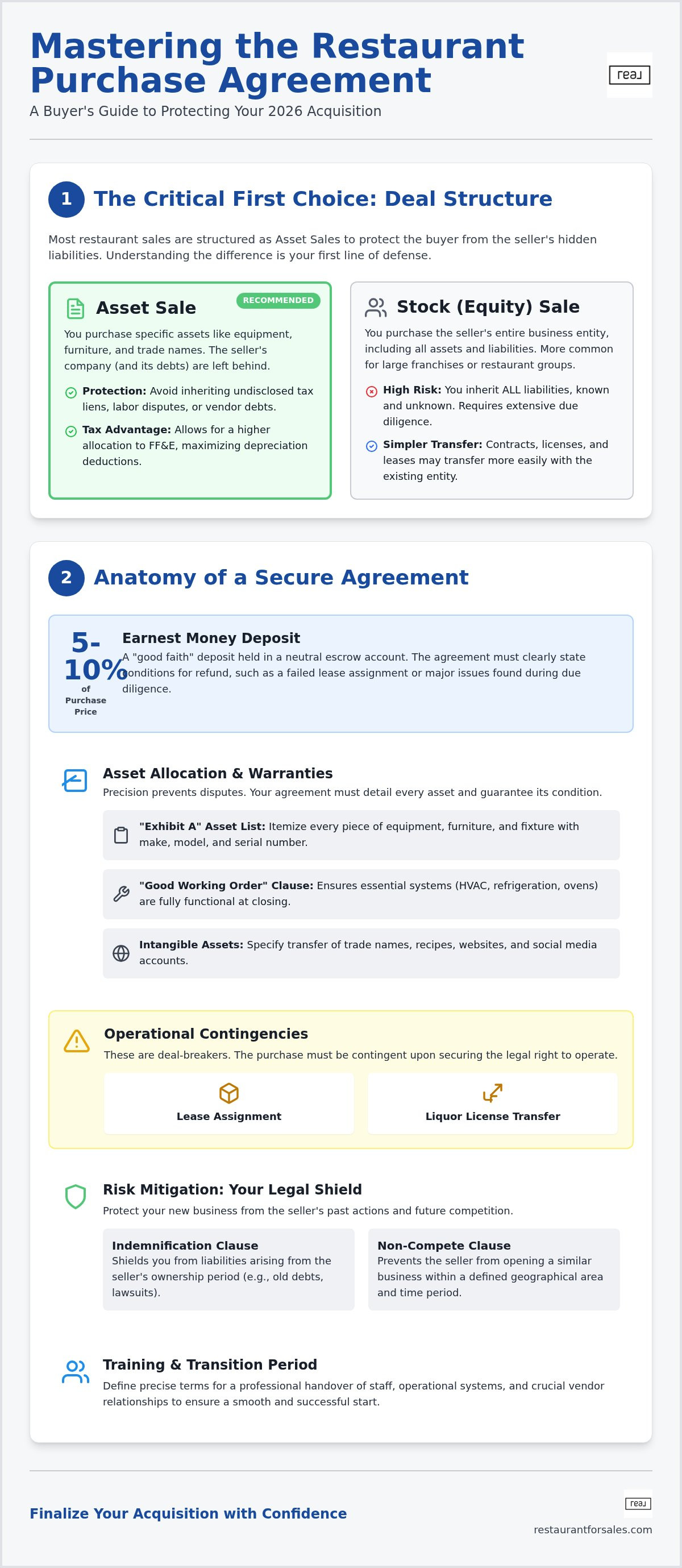
Most hospitality transactions are structured as asset sales. In this model, the buyer acquires specific items like kitchen equipment, furniture, and trade names without assuming the seller's corporate entity. This structure is preferred because it allows the buyer to avoid inheriting hidden liabilities, such as past labor disputes or unpaid vendor bills. An "Excluded Assets" clause is vital here; it lists items the seller keeps, such as personal memorabilia or specific proprietary software. Conversely, equity or stock sales are more common for large restaurant groups or established franchises where maintaining the existing corporate structure and contracts is more efficient than transferring individual assets.
The Role of the Earnest Money Deposit
The earnest money deposit acts as a "good faith" gesture from the buyer to show they are serious about the transaction. These funds are typically held in a neutral third-party escrow account rather than being paid directly to the seller. In the 2026 national market, standard deposits range from 5% to 10% of the total purchase price. The agreement must clearly define when this money becomes non-refundable. Common conditions for a refund include a failed lease assignment or a significant issue discovered during due diligence. Once these contingencies are cleared, the deposit is usually applied to the final purchase price at closing.
Asset Allocation and Inventory Clauses
Precision is the hallmark of a secure transaction. A detailed "Exhibit A" is perhaps the most critical attachment in the entire deal. This exhibit must list every piece of kitchen equipment, furniture, and fixture included in the sale, preferably with make, model, and serial numbers. Relying on a general description often leads to disputes if the seller replaces a high-end range with a budget model before closing. When reviewing Key Legal Considerations in a Restaurant Purchase, it's evident that clarity regarding physical assets protects the buyer's initial investment. Furthermore, the agreement should include a "Good Working Order" clause. This ensures that essential systems like refrigeration, HVAC, and specialized ovens are fully functional at the time of transfer.
Beyond physical tools, the RPA must address intangible assets. These include trade names, proprietary recipes, website domains, and social media accounts. In 2026, a restaurant's digital presence and reputation are often as valuable as its physical kitchen. Transferring these rights requires specific language to ensure the buyer has full legal authority to use them post-closing. Understanding these key clauses in restaurant purchase agreement documents prevents the loss of brand equity during the transition.
Defining the Purchase Price Allocation
The purchase price isn't just a single number; it's a sum of several parts. For tax purposes, this price is split between Furniture, Fixtures, and Equipment (FF&E), Goodwill, and Inventory. Buyers and sellers often have conflicting interests here. Buyers typically prefer a higher allocation to FF&E to maximize depreciation deductions. Sellers often favor an allocation toward Goodwill to benefit from capital gains tax rates. Utilizing a professional 2026 restaurant valuation before finalizing these figures ensures that the allocation is defensible to the IRS and fair to both parties. Consulting with professional restaurant brokerage services can help facilitate these negotiations effectively.
Inventory Count and Valuation Procedures
Inventory on hand, including food, liquor, and paper goods, is usually valued separately from the base purchase price. The agreement should establish a specific "Inventory Audit" date, typically the night before or the morning of the closing. This audit involves a physical count performed by both parties. Clauses must specifically exclude "Dead Stock," such as expired food or damaged goods, from the final tally. For liquor, it's standard practice to value sealed cases at the current invoice price, while open bottles are either excluded or valued at a flat percentage to simplify the process. This methodical approach ensures the buyer only pays for usable, profit-generating stock.
Operational Contingencies: Leases and Licenses
The physical assets of a restaurant hold little value if the buyer lacks the legal right to occupy the space or serve the public. Operational contingencies are the safeguards that ensure the transaction only proceeds if the buyer can actually run the business. These Sample Purchase Agreement Clauses illustrate how seasoned professionals structure these protections. Integrating these key clauses in restaurant purchase agreement documents prevents a buyer from being stuck with a kitchen full of equipment but no storefront. Additionally, for franchise acquisitions, the agreement must account for the franchisor's "Right of First Refusal" (ROFR), which allows the parent company to match the buyer's offer and take over the location themselves.
Mastering the Lease Transfer Clause
The lease is often the most valuable asset in a restaurant deal, yet it's the one the seller has the least control over. A "Lease Assignment" contingency makes the entire purchase dependent on the landlord's written consent. Landlords typically require a review of the buyer's financial standing and operational experience before approving a transfer. It's also vital to verify the "use clause" within the existing lease. If the buyer intends to change the menu or concept, the lease must explicitly permit that specific type of food service. For a deeper look at this process, see our guide on understanding restaurant lease assignments. Without this approval, the buyer risks a default notice the day they take over.
Permit and License Contingencies
Transferring the right to operate involves more than just a signature; it requires clearance from multiple regulatory bodies. The RPA should include a due diligence period to verify that all current health, fire, and building permits are valid and in good standing. In some jurisdictions, the Health Department requires mandatory upgrades, such as the installation of modern grease traps or updated ventilation systems, before a new permit is issued to a buyer. The agreement must state which party bears the cost of these required improvements.
Liquor licenses present an even greater challenge due to lengthy state processing times. Effective key clauses in restaurant purchase agreement drafts often include provisions for an "interim management agreement." This allows the buyer to operate under the seller’s license for a limited window while the official transfer is pending. This prevents a "dark period" where the restaurant cannot serve alcohol, which would severely impact revenue during the critical first weeks of ownership. Ensuring these permits are handled correctly is a core component of professional restaurant lease assignments and brokerage services.
Risk Mitigation: Indemnification and Restrictive Covenants
Buying a restaurant involves taking over a living entity with a complex history of financial and legal obligations. The indemnification section is one of the most critical key clauses in restaurant purchase agreement documents because it allocates financial responsibility for past actions. It effectively shields the buyer from the seller’s pre-closing debts, such as unpaid sales taxes, overdue vendor invoices, or pending labor disputes. Without strong indemnification language, a new owner could be held liable for the previous operator's negligence. This protection is usually backed by "Representations and Warranties," which are formal promises made by the seller regarding the accuracy of financial statements and the absence of litigation. If these promises prove false, the indemnification clause provides the buyer with a legal path to recover losses.
Beyond financial debts, risk mitigation must also address the protection of the restaurant’s human capital and market share. Non-solicitation clauses are essential to prevent the seller from poaching experienced chefs or managers for their next venture. In an industry where staff consistency directly impacts guest experience, losing a key kitchen team can be devastating to a new owner's success. Ensuring these safeguards are negotiated fairly is a core part of professional restaurant brokerage services.
Drafting an Effective Restaurant Non-Compete
A non-compete agreement prevents the seller from opening a competing concept that would immediately drain the customer base of the business they just sold. To be enforceable, these must be reasonable in scope. Standard restaurant non-competes typically cover a geographic radius of 5 to 10 miles and last for a duration of 2 to 5 years. It's vital to define the "Restricted Business" narrowly. For example, a seller of an "Italian Fine Dining" establishment should be restricted from opening another Italian upscale spot, but perhaps not a casual pizza shop. First-time buyers should consult our guide on how to buy a restaurant to understand current market standards for these boundaries.
The 'Basket' and 'Cap' in Indemnification
Indemnification isn't an unlimited safety net; it's often governed by "Baskets" and "Caps." A "Basket" acts as a deductible, establishing a minimum claim amount that must be reached before the seller is required to pay. This prevents either party from being bogged down by minor, immaterial disputes. Conversely, a "Cap" sets the maximum total liability the seller can face, often tied to a percentage of the purchase price. Finally, the agreement must specify "Survival Periods." These define how long after the closing date the buyer can still file a claim, with 12 to 24 months being common for standard operational issues, while tax or environmental claims may survive longer.
The Closing, Training, and Transition Period
The closing date is not simply the end of a transaction. It marks the beginning of an operational hand-off that requires technical precision. Transitioning from owner to owner is a delicate phase that requires specific legal structures. The proration clause is a vital component of this process. It establishes a clear financial cut-off, typically at midnight on the day of closing. This ensures that utility bills, rent, and property taxes are split fairly between the parties. It prevents the buyer from inadvertently paying for the seller's final days of operation.
Another critical area involves the treatment of the existing workforce. Most key clauses in restaurant purchase agreement drafts include an employee re-hiring provision. This clause states that the buyer is not legally obligated to retain any of the current staff. It gives the new owner the flexibility to build their own team or re-interview existing employees while ensuring they don't inherit previous labor liabilities or wage disputes. This separation is essential for a clean break from the seller's management style and history.
Structuring the Seller Training Clause
A successful handover depends on a well-defined seller training clause. This section should specify the exact number of hours or days the seller must remain on-site to assist the buyer. The scope of training usually covers proprietary recipes, POS system management, and introductions to key vendor contacts. It's standard to define this as uncompensated for a set period, such as the first 14 days. If the buyer requires additional support beyond the initial window, the agreement should outline a pre-negotiated consulting fee to avoid future conflict over the seller's time.
The Closing Checklist for Restaurant Buyers
A comprehensive checklist protects the buyer at the final hour. This includes obtaining clearance letters from state tax authorities to confirm the seller has no outstanding tax debt. The buyer must also verify the successful transfer of utility accounts and POS software ownership. A final walkthrough is the last mandatory step. It ensures that every item identified in the equipment list is still on the premises and in the condition promised. The deal is finalized when the Bill of Sale and the Assignment of Intangibles are signed, officially transferring the business's physical and digital assets to the new owner.
Finalizing Your Restaurant Acquisition with Precision
Successful transactions in 2026 require more than just a handshake; they demand a rigorous contractual framework. By prioritizing key clauses in restaurant purchase agreement documents, such as lease assignment contingencies and robust indemnification, you protect your capital from undisclosed liabilities and operational disruptions. A well-structured agreement ensures that the transition of assets, from physical kitchen equipment to digital brand equity, is transparent and legally binding.
Navigating these complexities alone can lead to costly oversights. Our team provides specialized expertise in complex restaurant lease assignments and utilizes comprehensive valuation tools to ensure every deal is balanced and fair. We operate on success-based brokerage commissions, aligning our goals directly with your professional success. Whether you are buying your first location or selling a multi-unit group, the right legal safeguards provide the stability needed for long-term growth.
View Active Listings and Get Expert Brokerage Support
Frequently Asked Questions
What is the most important clause in a restaurant purchase agreement?
While every deal is unique, the Indemnification clause is often considered the most vital for risk management. This provision protects the buyer from the seller’s past liabilities, such as unpaid sales taxes or vendor debts. Other key clauses in restaurant purchase agreement documents include lease assignment contingencies and equipment warranties. These ensure the buyer has a legal right to the space and functional tools to generate revenue from day one.
Can I back out of a restaurant purchase agreement after signing?
You can generally only withdraw from the agreement if a specific contingency has not been satisfied. Common exit points include the buyer failing to secure financing, the landlord refusing a lease assignment, or the discovery of undisclosed issues during due diligence. If you attempt to back out without a valid contractual reason, you risk losing your earnest money deposit and may face legal action for breach of contract.
How do I handle the transfer of employees in the purchase agreement?
Most agreements specify that the seller must terminate all employees on the closing date, allowing the buyer to re-hire them as new staff members. This structure prevents the buyer from inheriting past labor claims, such as unpaid overtime or existing worker's compensation issues. It's standard for the buyer to re-interview the team to ensure each individual aligns with the new management's culture and operational standards before extending offers.
What is an 'Earn-Out' clause and should I use one?
An earn-out clause makes a portion of the purchase price contingent on the restaurant's future financial performance, such as reaching specific revenue targets post-closing. This tool helps bridge the gap when a buyer and seller disagree on the business's current valuation. While it reduces the buyer's initial capital risk, it requires precise legal drafting to define accounting methods and operational control to avoid future disputes over how profits are calculated.
Who typically pays for the drafting of the purchase agreement?
The party initiating the offer, which is typically the buyer, usually pays their own attorney to draft the initial document. The seller then pays their own legal counsel to review the language and suggest revisions. In many transactions, a professional broker assists in preparing the standard contract framework, but each party remains responsible for their individual legal costs. This ensures that the key clauses in restaurant purchase agreement drafts are reviewed by independent experts.
How does a liquor license contingency work in an asset sale?
This contingency makes the entire transaction dependent on the successful transfer or issuance of a liquor license to the buyer. Since state agencies can take several months to process these applications, the agreement often includes an interim management provision. This allows the buyer to operate under the seller's license during the transition period. If the license is ultimately denied by the state, the contingency allows the buyer to cancel the deal without penalty.
Is a non-compete clause legally enforceable in the restaurant industry?
Non-compete clauses are generally enforceable if they are reasonable in their geographic radius and duration. Courts typically uphold restrictions that prevent a seller from opening a similar concept within a five to ten mile radius for a period of two to five years. If the restriction is too broad, such as banning the seller from the entire hospitality industry nationwide, a judge may rule it unenforceable or significantly narrow its scope to protect fair competition.
What happens to the restaurant lease if the landlord refuses the assignment?
If the landlord refuses to approve the lease assignment, the purchase agreement typically allows the buyer to terminate the transaction and receive a full refund of their deposit. The lease is a fundamental contingency because the business cannot operate without a physical location. To prevent this, buyers should provide the landlord with a comprehensive financial package and a solid business plan early in the process to demonstrate their reliability as a future tenant.


