

Your letter of intent to purchase a restaurant business is not just a preliminary price tag; it's the strategic blueprint that determines whether your deal survives the landlord's scrutiny or collapses during due diligence. You've likely spent months scouting the perfect location and analyzing menu costs, but the transition from interested buyer to owner is where most entrepreneurs feel the most pressure. It's natural to worry about missing critical equipment in the asset list or getting tangled in a lease transfer that the landlord won't approve.
This guide provides the clarity you need to draft a professional offer that protects your interests while signaling to the seller that you're a serious, prepared buyer. We'll break down the essential components of a 2026 restaurant LOI, provide a template-style roadmap, and explain exactly how to move from this initial offer to a successful final sale. By understanding which clauses are binding and how to handle the landlord early, you can secure your acquisition and ensure a smooth transition to your new venture.
Key Takeaways
- Understand how a well-structured LOI acts as the essential bridge between the initial site tour and the final Asset Purchase Agreement.
- Identify the critical components of a letter of intent to purchase restaurant business, including purchase price, payment terms, and seller financing.
- Distinguish between binding and non-binding clauses to protect your interests through exclusivity and confidentiality agreements.
- Learn how to leverage preliminary financial data to draft a professional offer that sellers will take seriously.
- Follow a clear roadmap from the signed offer through the complexities of due diligence and lease assignment management.
The Strategic Role of a Letter of Intent (LOI) in Restaurant Sales
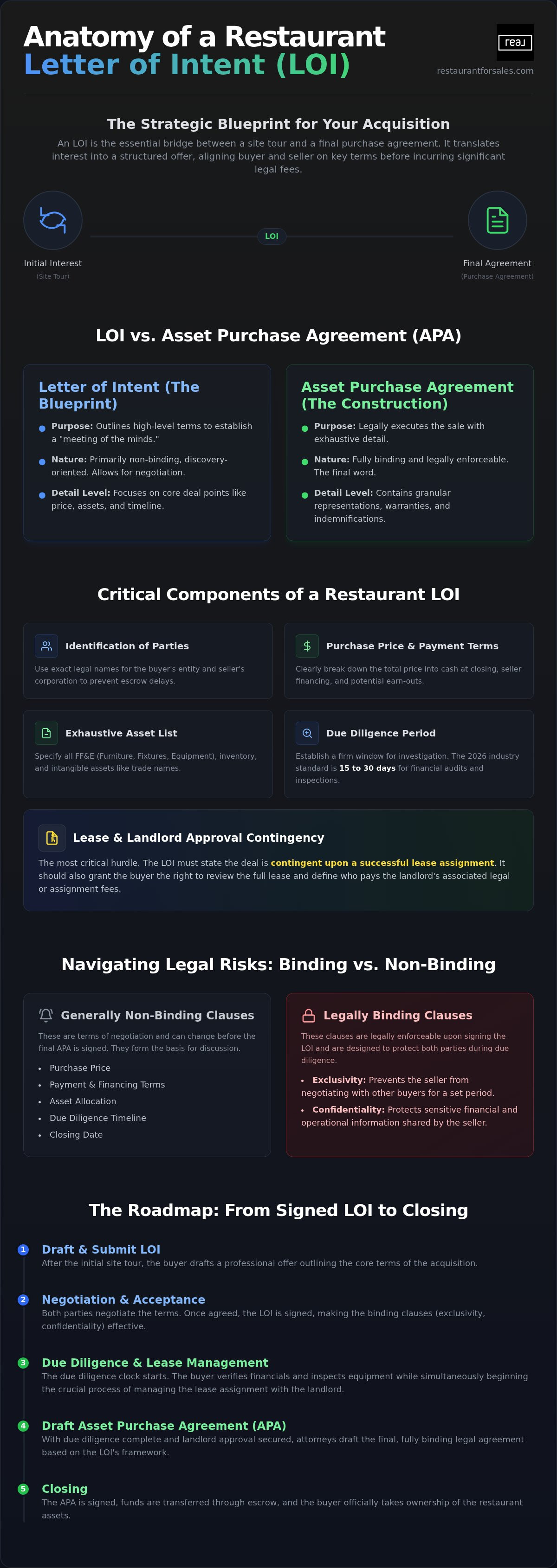
A Letter of Intent (LOI) serves as the foundational document in a commercial transaction. It's a formal, preliminary proposal that outlines the primary terms under which a buyer intends to acquire a business. In the context of the hospitality industry, this document acts as the critical bridge between the initial site tour and the execution of a final Asset Purchase Agreement (APA). While a tour provides a physical sense of the space and operations, the LOI translates that interest into a structured business offer. It moves the conversation from casual inquiry to a professional negotiation, ensuring both parties are aligned on the "big picture" before they incur significant legal or accounting fees.
Why an LOI is Essential for Restaurant Buyers
For a buyer, submitting a letter of intent to purchase restaurant business is a strategic move to manage risk. It clarifies the "meeting of the minds" on price and terms, ensuring you don't waste time on a deal where the seller's expectations are unrealistic. Crucially, a well-drafted LOI prevents the seller from shopping the deal to other parties while you conduct your investigation. This exclusivity is vital when you're learning how to buy a restaurant in a competitive market. Once signed, it starts the due diligence clock, giving you a protected window to verify financials, inspect equipment, and review lease assignments without fear of being outbid.
Sellers also gain substantial stability from a formal LOI. It functions as a vetting mechanism to confirm the buyer's financial capability and operational experience. By requiring a signed document, a seller can filter out casual inquiries and focus on serious prospects who've committed to a specific timeline. It establishes a roadmap for the transaction, detailing milestones for financing and lease approvals that keep the deal moving toward a successful closing.
Key Differences Between an LOI and a Purchase Agreement
Understanding the distinction between these two documents is vital for any entrepreneur. A letter of intent to purchase restaurant business focuses on high-level terms, such as the purchase price, the allocation of assets, and the transition period. It's primarily discovery-oriented. In contrast, the Asset Purchase Agreement (APA) is a granular legal document that includes exhaustive representations, warranties, and indemnifications. While the APA is fully binding and legally enforceable, most terms in an LOI are non-binding. The LOI serves as the blueprint; the APA is the finished construction. This separation allows parties to negotiate the core deal points quickly before committing to the exhaustive legal drafting required for a final sale.
Critical Components of a Restaurant Purchase LOI
Drafting a letter of intent to purchase restaurant business requires more than just a price point; it needs a detailed framework of the transaction's mechanical parts. It begins with the precise identification of the parties. You must use the exact legal names of the buyer's entity and the seller's corporation rather than just individual names. This ensures that the eventual Asset Purchase Agreement (APA) aligns perfectly with the preliminary offer, preventing delays during the escrow process.
The financial section should break down the purchase price into specific payment terms. Clearly outline the cash due at closing, any proposed seller financing, and potential earn-outs based on future performance. You also need an exhaustive asset list that includes Furniture, Fixtures, and Equipment (FF&E), current food and beverage inventory, and intangible assets like trade names or recipes. Finally, establish a firm due diligence period. In 2026, a 15 to 30 day window is the standard for national restaurant sales, allowing you enough time for financial audits and physical inspections.
Addressing the Lease and Landlord Approval
The lease is often the most significant hurdle in any hospitality deal. Your offer should explicitly state that the transaction is contingent upon a successful restaurant lease assignment. You need the right to review the existing lease and any amendments before moving to the APA stage. It's also vital to define who covers the landlord’s assignment or legal fees; these are typically paid by the seller or shared between both parties. If you're unsure about current market rates for similar spaces, a professional restaurant broker can provide the valuation data needed to support your proposal.
Permits, Licenses, and Contingencies
When you submit a letter of intent to purchase restaurant business, you must account for industry-specific regulatory requirements. Include contingencies for the transfer of health department permits and liquor licenses. If a liquor license cannot be transferred or obtained, the buyer typically requires an exit clause from the deal. You should also schedule specialized inspections for the hood systems, grease traps, and walk-in refrigeration units to avoid unexpected repair costs after closing. Finally, address the employee transition. State whether you intend to re-hire the existing staff, as this impacts operational continuity and the seller's communication plan with their team.
Binding vs. Non-Binding Clauses: Navigating Legal Risks
A letter of intent to purchase restaurant business is a hybrid document that balances flexibility with legal protection. While the proposed purchase price and specific deal terms are typically non-binding, the administrative clauses must be legally enforceable. This distinction allows you to negotiate the final price based on what you discover during due diligence without being prematurely locked into a contract. However, without binding administrative terms, the document lacks the "teeth" necessary to protect your time and financial investment during the discovery phase.
Confidentiality is the seller's primary concern. It ensures that sensitive financial data, trade secrets, and the very fact that the business is for sale remain private. This clause must be binding and survive the termination of the LOI. On the other hand, termination rights allow either party to walk away if the deal's foundations crumble. If your inspections reveal structural issues or undisclosed liabilities, you need a clear, non-litigious path to exit the negotiation.
The Exclusivity Period (No-Shop Clause)
The "No-Shop" or exclusivity clause is the buyer's most vital protection. In 2026, the standard duration for this period in restaurant acquisitions is 30 to 60 days. This binding agreement prevents the seller from entertaining other offers or shopping your bid to competitors while you spend capital on professional restaurant valuation methods and mechanical inspections. If a seller breaches this exclusivity, they're often liable for the buyer's out-of-pocket due diligence costs. It's a necessary safeguard that justifies the expense of a deep-dive investigation.
Good Faith Negotiations
Both parties enter the LOI with a legal obligation to negotiate in good faith. This means you can't use the letter of intent to purchase restaurant business as a tool to stall a competitor or drive down price without cause. If the seller meets all stated conditions, you're expected to move toward a final agreement. However, your offer should include a provision for a "material adverse change" (MAC) discovered during the inspection window. In the context of a 2026 restaurant sale, a material adverse change is defined as a documented decline in gross revenue or net operating income exceeding 15% compared to the same period in the previous fiscal year. If such a decline occurs, the buyer is typically released from the obligation to proceed under the original terms.
The Drafting and Negotiation Process
Drafting a letter of intent to purchase restaurant business isn't a task for guesswork. It requires a disciplined approach to data collection before you ever put pen to paper. You need to gather at least three years of profit and loss statements, tax returns, and current year-to-date financials. This preparation allows you to justify your offer price with hard numbers rather than emotional appeals. Your initial draft should be direct and authoritative. It's a professional business proposal, not a casual inquiry. Keep it concise; a two to three-page document is usually sufficient to outline the core deal points without getting bogged down in the granular legalities that belong in the Asset Purchase Agreement.
Determining the Right Offer Price
Establishing a fair valuation is the most critical step in the negotiation. Engaging a restaurant broker is essential here to help you analyze Seller's Discretionary Earnings (SDE) and EBITDA. In 2026, single-unit independent restaurants typically sell for 1.5x to 3.0x SDE. However, you must adjust this multiple for deferred maintenance. If the walk-in cooler or the HVAC system is nearing the end of its life, those costs should be deducted from the offer. Conversely, a below-market lease or grandfathered permits that are difficult to obtain today can add significant value to your bid.
Expect a counter-offer. Sellers often push back on the amount of seller financing or the length of the non-compete radius. Friction frequently arises when a buyer requests a large "holdback" for potential undisclosed liabilities. To move past these hurdles, focus on the logic behind your requests. If you're asking for seller financing, frame it as a way for the seller to demonstrate their confidence in the business's continued success. Once you reach a consensus, move quickly to the signature stage. Signing the LOI "locks up" the business, triggering the exclusivity period and allowing you to start your formal inspections. Before you submit your offer, you can consult with a specialist restaurant broker to verify that your terms are competitive and fair for the current market.
Negotiating the Non-Compete Agreement
The non-compete is a standard but vital protection. You don't want the seller opening a similar concept across the street two months after you take over. A standard radius for a restaurant non-compete is five miles for a duration of three years. Be specific about the "concept." If you're buying a pizza shop, the non-compete should cover any Italian or pizza-focused establishment. Finally, ensure the agreement applies to the owners personally. If the non-compete only binds a corporation that is being dissolved after the sale, it offers you zero protection.
Next Steps: From Signed LOI to the Closing Table
Once the letter of intent to purchase restaurant business is signed, the transaction moves from negotiation to execution. This phase begins with the formal due diligence period, where you verify the financial, legal, and operational claims made by the seller. You'll examine point-of-sale (POS) data, tax filings, and payroll records to ensure the Seller's Discretionary Earnings (SDE) align with the initial valuation. Simultaneously, you must open escrow and deposit your Earnest Money Deposit (EMD). This capital is typically held by a third-party escrow agent or an attorney's trust account, providing security for both parties as you finalize the deal.
The signed LOI serves as the essential blueprint for the Asset Purchase Agreement (APA). While the LOI outlined the broad strokes, the APA is the definitive legal document that transfers ownership. If you're acquiring a branded concept, you must also initiate the franchise resale approval process. This involves submitting your financial profile and operational experience to the franchisor for vetting. In 2026, franchisor approval timelines can range from 30 to 60 days, so starting this process immediately after the LOI is signed is critical to maintaining the closing schedule.
The Role of Professional Advisors
A successful closing requires a coordinated effort between specialized advisors. You'll need a restaurant-specialized attorney to draft the APA, ensuring that industry-specific protections like equipment warranties and non-compete clauses are legally sound. Your broker acts as the project manager, facilitating communication between you, the seller, and the landlord to ensure the lease assignment stays on track. Finally, coordinate with your accountant to handle the tax allocation of the purchase price. Correctly filing IRS Form 8594 is vital to ensure both buyer and seller report the asset values consistently for depreciation purposes.
Closing Contingencies and Final Walkthrough
Before the final signatures, you must satisfy all closing contingencies. The night before the transfer, conduct a physical inventory count of all food, paper goods, and liquor. This inventory is usually valued at cost and paid in addition to the business purchase price. Perform a final walkthrough to confirm that all equipment is in "working order" as specified in the letter of intent to purchase restaurant business. Check that the hood systems, refrigeration, and grease traps are operational. Once the landlord provides the final sign-off on the lease assignment and all permits are ready for transfer, the escrow agent can release the funds and complete the sale.
Securing Your Future in the Restaurant Industry
Transitioning from a prospective buyer to a restaurant owner requires a disciplined approach to documentation. A well-crafted letter of intent to purchase restaurant business is your most effective tool for locking in a deal and protecting your initial investment. By clearly defining purchase price terms, exclusivity periods, and lease assignment contingencies, you move toward the closing table with confidence. This document ensures that both parties remain aligned throughout the rigorous due diligence phase, preventing deal-killing surprises before the final Asset Purchase Agreement is signed.
As national experts in restaurant brokerage and valuation, we understand the complexities of high-value commercial transactions. Our team has a proven track record in managing complex lease assignments and facilitating smooth transitions for both independent and franchise acquisitions. When you're ready to take the next step, browse our current restaurant listings and start your acquisition journey. We act as your knowledgeable guide and proactive partner in every stage of your professional journey. Success in the hospitality market starts with a strong offer; we're ready to help you execute yours.
Frequently Asked Questions
Is a letter of intent to buy a restaurant legally binding?
A letter of intent to purchase restaurant business is typically non-binding regarding the final sale price and structure. However, specific administrative clauses like confidentiality and exclusivity are legally binding. This structure allows both parties to negotiate the finer details without the risk of a premature legal commitment. It's essential to clearly state which sections are non-binding to avoid potential litigation if the deal does not proceed to a final Asset Purchase Agreement.
How long should the due diligence period be in a restaurant LOI?
In 2026, the standard due diligence period for national restaurant sales ranges from 15 to 30 days. This timeframe provides enough room for a buyer to conduct financial audits, equipment inspections, and health department reviews. If the transaction involves a complex franchise resale or real estate acquisition, this period may be extended. Setting a firm deadline ensures that both the buyer and seller remain focused on moving the transaction toward a successful closing.
Can I back out of a restaurant purchase after signing an LOI?
Yes, a buyer can generally back out of a restaurant purchase after signing an LOI if the document is structured with non-binding deal terms. Most LOIs include contingencies that allow the buyer to withdraw if due diligence reveals material adverse changes or undisclosed liabilities. While you can walk away from the purchase itself, you must still adhere to any binding confidentiality or exclusivity agreements. These protections ensure that neither party is unfairly penalized during the discovery phase.
What is an "Exclusivity Clause" in a restaurant offer?
An exclusivity clause, also known as a no-shop clause, is a binding agreement that prevents the seller from entertaining other offers for a specific period. This protection is vital when you submit a letter of intent to purchase restaurant business, as it justifies the time and capital spent on inspections. Typically lasting 30 to 60 days, this clause ensures you aren't outbid while performing your due diligence. It provides the stability needed to finalize the deal.
Do I need a lawyer to write a letter of intent for a restaurant?
While a restaurant broker often facilitates the initial draft of an LOI, engaging a specialized attorney is recommended for reviewing the final document. The LOI sets the legal framework for the Asset Purchase Agreement, so ensuring the language is precise is crucial. A lawyer can help clarify binding versus non-binding terms and protect your interests in complex areas like lease assignments. Professional guidance helps prevent costly disputes that could arise from vague or poorly defined offer terms.
What happens to the employees after the LOI is signed?
Employees are typically not notified of a potential sale immediately after the LOI is signed to maintain operational stability. The LOI should outline the buyer's intention regarding the existing workforce, such as whether they will be re-hired or if the seller is responsible for termination. Confidentiality is paramount during this stage. Most buyers prefer to meet with key staff only after the due diligence is nearly complete and the deal's closing is highly probable.
Should I include the inventory in the purchase price of the LOI?
Inventory is traditionally handled as a "plus cost" item at the time of closing rather than being included in the initial purchase price. This is because food and beverage stock levels fluctuate daily during normal operations. The LOI should specify that a physical count will be conducted the night before closing, with the buyer paying the seller the cost value of the usable inventory. This approach ensures that the buyer only pays for fresh, marketable stock.
How does an LOI handle a restaurant lease that is about to expire?
If a restaurant lease is nearing expiration, the LOI must include a contingency for a successful lease extension or the negotiation of a new long-term agreement. The deal should be dependent on the landlord's written approval of terms that provide the buyer with sufficient operational security. Since lease assignments are a critical part of the transaction, addressing this early in the offer prevents you from acquiring a business without a guaranteed location.


