

What if the 30% food cost on your target restaurant's P&L is actually a 40% cost being masked by unpaid vendor invoices? It's a common fear for any serious buyer, and it's why a robust restaurant operational due diligence checklist is your most important tool. You've analyzed the spreadsheets, but you know that numbers can be manipulated or simply fail to reflect the physical reality of a busy kitchen. Relying on unverified data is how many entrepreneurs end up overpaying for a business that's actually losing money.
This guide will help you master the art of reconciling restaurant P&L statements with real-world operations to ensure your acquisition is a profitable investment. You'll learn how to verify cash flow, spot red flags during site visits, and uncover hidden liabilities before you sign the final contract. From auditing the 2026 FDA Food Code standards to checking PCI DSS 4.0 compliance at the POS, we'll break down the specific steps needed to verify every dollar. This roadmap gives you the data and the confidence to negotiate a fair price based on the true health of the investment.
Key Takeaways
- Learn how to reconcile financial claims with daily operations to ensure the restaurant's "engine" is performing as stated.
- Utilize a professional restaurant operational due diligence checklist to audit physical infrastructure from the grease trap to the roof.
- Identify valid add-backs and calculate accurate Seller’s Discretionary Earnings to avoid overpaying for the business.
- Verify lease terms and UCC-1 filings to ensure all kitchen equipment is owned outright and free of hidden liens.
- Transform site visit findings into a deficiency list that serves as a powerful lever for final price negotiations.
The Core Framework: Reconciling the P&L with Operational Reality
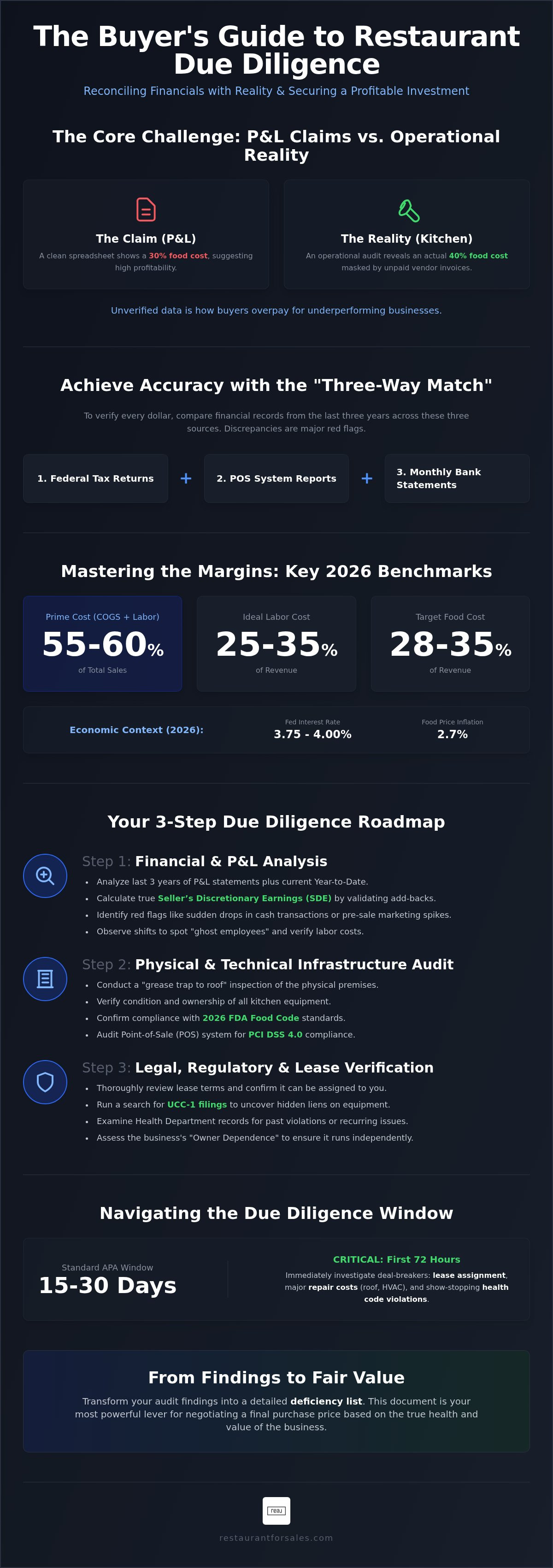
Due diligence in the restaurant sector is the rigorous process of verifying the business’s "engine." It's easy for a seller to present a clean spreadsheet, but a P&L statement is only a claim until operational data proves it true. Many buyers overpay because they fail to reconcile financial reporting with the physical state of the kitchen. Using a structured restaurant operational due diligence checklist allows you to see if the reported profits are sustainable or if they're the result of deferred maintenance and unpaid liabilities.
Professional buyers use a "Three-Way Match" to ensure accuracy. You must compare federal tax returns, POS system reports, and monthly bank statements for the last three years. If the POS shows $1.2 million in sales but the bank deposits only total $900,000, you have a problem. Buyers in 2026 must also look beyond EBITDA to evaluate "Owner Dependence." With the Federal Reserve interest rate sitting at 3.75% to 4.00% as of September 2026, the cost of capital is high. You can't afford to buy a job; you need a business that functions independently of the seller's personal involvement.
The Link Between Financials and Floor Operations
Financial statements rarely tell the whole story about labor efficiency. You need to observe shifts to spot "ghost employees" on the payroll who aren't actually present or productive. Compare these observations with your restaurant operational due diligence checklist to ensure labor costs, which typically range from 25% to 35% of revenue, are accurate. Food costs also require physical verification. Check waste logs and vendor invoices to ensure the 28% to 35% food cost benchmark is being met through operational discipline rather than accounting tricks. For more context on benchmarking, see our 2026 Restaurant Valuation Guide.
Setting Your Due Diligence Timeline
A standard Asset Purchase Agreement (APA) usually provides a 15 to 30-day window for investigation. This period is intense and requires a methodical approach. Focus on critical deal-breakers like lease assignments and Health Department records within the first 72 hours. If the landlord won't approve a transfer or the roof requires a $50,000 repair, you need to know immediately. Most brokers use a secure data room to centralize these documents. This keeps the process organized and ensures that sensitive employee and vendor information remains confidential until the deal is finalized.
Step 1: Analyzing the Profit and Loss (P&L) Statement
Begin your financial investigation by requesting the last three full years of P&L statements alongside the current Year-to-Date (YTD) figures. This historical data allows you to identify trends and ensure the business isn't just having a "lucky" quarter. While the P&L provides the broad strokes of profitability, it's merely a starting point. You'll need to use your restaurant operational due diligence checklist to verify that these numbers align with the actual cash flowing through the register and the inventory sitting in the walk-in.
A critical part of this step is identifying "add-backs" to calculate the Seller’s Discretionary Earnings (SDE). Add-backs are one-time or personal expenses that won't carry over to a new owner, such as the seller's personal vehicle lease or a non-recurring equipment repair. However, be cautious. Sellers often try to "add back" essential manager salaries or necessary maintenance. Accurate SDE calculation is the foundation of a fair purchase price, and misidentifying these figures can lead to a significant overvaluation of the asset.
In 2026, you must analyze Prime Cost benchmarks with extreme precision. Prime cost, which is the sum of your Cost of Goods Sold (COGS) and total labor, should ideally sit at 60% or lower of total sales. High-performing restaurants often aim for 55%. With food price inflation at 2.7% as of August 2026, even a 2% creep in COGS can erase your net margin. Consulting a detailed Restaurant Due Diligence Checklist can help you categorize these expenses correctly to see if the current operator is managing their margins effectively or simply surviving on volume.
Spotting Red Flags in Revenue Reporting
Verify reported revenue by comparing POS "Z-Tapes" against the monthly P&L entries. Look for a consistent ratio between cash and credit transactions; a sudden drop in cash reporting might suggest the seller is pocketing funds to lower their tax liability, which also artificially lowers the business value. Watch for seasonal "pump and dump" strategies where marketing spend spikes right before a sale to inflate top-line revenue. This creates a false impression of growth that likely won't persist after the transition.
Verifying Labor and Controllable Expenses
Labor is often the most manipulated line item. Review the seller’s 941 quarterly tax filings and compare them directly to the P&L labor costs. If the P&L shows significantly lower labor costs than the tax filings suggest, you may be looking at "under-the-table" payments. These are massive legal liabilities for a buyer. Additionally, evaluate how rising minimum wage trends in 2026 will impact future margins. While the federal tipped minimum remains $2.13, state-level increases can quickly turn a profitable floor plan into a deficit. If you're unsure about the accuracy of the seller's reported earnings, seeking a professional restaurant valuation can provide an objective baseline for your negotiation.
Step 2: The Physical and Technical Infrastructure Audit
A standard commercial inspector often lacks the specialized knowledge required to evaluate a high-volume commercial kitchen. Your restaurant operational due diligence checklist must prioritize a "Grease Trap to Roof" inspection. This involves hiring specialists to check the fire suppression system, the HVAC load, and the structural integrity of the walk-in refrigeration units. If the hood system isn't up to the 2026 FDA Food Code standards, you could face a $20,000 upgrade cost before you even open your doors. Physical due diligence ensures that the price you pay reflects the actual condition of the assets.
Verifying equipment ownership is equally vital. Don't assume the ovens and fryers on the floor are included in the sale. You must conduct a UCC-1 search to identify any liens or active leases on the equipment. If a dish machine or POS terminal is leased, those contracts must be formally transferred or paid off at closing. This process often coincides with understanding restaurant lease assignments, as the landlord may have specific rights regarding fixtures attached to the property.
Equipment Condition and Maintenance Logs
Request the last 12 months of repair and maintenance (R&M) invoices to look for recurring issues. A compressor that's been repaired three times in six months is a liability, not an asset. Test all critical systems during peak service hours to see how they perform under stress. This data allows you to build a Capital Expenditure (CapEx) forecast. Knowing exactly what's likely to break in the next 18 months gives you the leverage to ask for a price credit during the final negotiation stages.
Digital Assets and Cybersecurity
In 2026, a restaurant’s digital footprint is as valuable as its physical one. Audit the ownership of the Google Business Profile, Yelp, and all social media accounts to ensure you aren't locked out post-closing. Check that POS and third-party delivery contracts are transferable without sudden fee hikes. Since PCI DSS 4.0 is fully enforceable in 2026, you must verify that the current payment gateway meets these heightened security standards. Failing to audit data privacy compliance for customer loyalty programs could expose you to significant regulatory fines from day one.
Step 3: Legal, Regulatory, and Lease Verification
Legal and regulatory verification is the stage where "caveat emptor" becomes a reality. You must verify that the business is compliant with all local, state, and federal mandates to avoid inheriting massive liabilities. Use your restaurant operational due diligence checklist to track the status of the health department history. Review the last three years of inspection reports carefully. Pay close attention to the 2026 FDA Food Code update. This new edition increases the focus on allergen awareness and active managerial control. If the current owner hasn't updated their documentation to reflect these standards, you'll be responsible for the transition costs and potential fines.
Employment law is another high-risk area that requires a deep audit. Review the workers’ comp history and check for any pending labor claims or "demand letters" from former employees. Verify I-9 compliance for all current staff members to ensure legal eligibility. While the federal tipped minimum wage remains $2.13 per hour in 2026, many local jurisdictions have implemented higher cash wage requirements. Understanding these nuances is a key part of How to Buy a Restaurant in 2026. Additionally, confirm the liquor license status. Transfer timelines vary wildly by state; a 90-day delay in licensing can bankrupt a new venture before it even starts.
The Lease Assignment Deep Dive
The lease is often the most valuable asset you're acquiring, but it's also the most dangerous. Verify the remaining term and ensure there are clear options to renew. Many buyers get trapped by "Assignment Clauses" that allow a landlord to refuse a transfer or trigger a massive rent hike upon sale. Look for Common Area Maintenance (CAM) traps. These annual escalations can grow significantly if they aren't capped in the original agreement. If you need help navigating these complexities, our restaurant lease assignment services can ensure your interests are protected during the transfer process.
Permits and Zoning Compliance
Never assume the current Certificate of Occupancy is valid for your intended use. Confirm the seating capacity and zoning match the physical reality of the space. You must also verify ADA (Americans with Disabilities Act) compliance for the facility. If the building hasn't been updated to modern accessibility standards, a change of ownership may trigger mandatory, expensive renovations. Finally, check for outstanding building code violations or encroachments that could lead to legal disputes with neighbors or the municipality.
Finalizing the Deal: Using Diligence to Negotiate
Once you've completed your restaurant operational due diligence checklist, the focus shifts from investigation to execution. Every red flag or maintenance issue you've documented becomes a data point for the final negotiation. You aren't just looking for problems; you're building a "Deficiency List" that quantifies the cost of bringing the restaurant up to your standards. This list serves as a professional justification for price credits or required repairs before the final Asset Purchase Agreement (APA) is signed.
You must also recognize your "Walk-Away" point. Some issues, like an irreparable structural lease problem or a history of severe health code violations, can't be fixed with a simple price reduction. If the landlord refuses to remove a personal guarantee or the building's infrastructure won't support your concept, it's better to forfeit your due diligence costs than to acquire a failing legacy. Recognizing these deal-breakers early protects your capital for a better opportunity.
Negotiating Credits and Escrows
Strategic buyers often use escrow accounts to protect themselves against "undiscovered" liabilities, such as unpaid vendor bills or pending labor claims. Setting aside a percentage of the purchase price for 90 to 180 days ensures the seller remains accountable for their period of ownership. You should also request direct price reductions for deferred maintenance found during the physical audit. If the cash flow you've verified is lower than initially claimed, consider structuring a "Seller Carry" note. This makes a portion of the payment contingent on the business meeting specific performance benchmarks post-closing, aligning the seller's interests with your success.
The Role of Professional Brokerage
A restaurant broker acts as the essential referee during this high-stakes phase. They manage the data room and the restaurant operational due diligence checklist to keep the deal on track, ensuring all deadlines in the APA are met. Brokers are also vital for maintaining confidentiality. They can facilitate site visits during off-hours to prevent staff anxiety or turnover before the transition is official. Their expertise in high-value commercial transactions ensures the final contract reflects the operational reality you've uncovered. If you're ready to move from analysis to acquisition, speak with a professional restaurant broker today to secure your investment.
Finalize the deal by defining the transition period and non-compete agreements. A standard transition usually includes two to four weeks of on-site support from the seller to introduce you to key vendors and staff. Ensure the non-compete clause is geographically specific and long enough to prevent the seller from opening a rival concept nearby. This transition planning, combined with rigorous diligence, ensures you aren't just buying a kitchen, but a functional and profitable business engine.
Secure Your Investment Through Rigorous Verification
Executing a successful acquisition requires moving beyond the surface level of financial statements. True protection comes from reconciling the P&L with the physical kitchen to ensure the "engine" you're buying is actually functional. By auditing everything from the grease trap to the tech stack, you transform uncertainty into data-driven leverage. A comprehensive restaurant operational due diligence checklist is your best defense against overpaying for hidden liabilities or structural lease issues that could stall your growth.
As a national marketplace for high-value restaurant transactions, we provide the professional infrastructure needed for a secure transition. Our expert valuation services help serious buyers set accurate benchmarks. Our success-based brokerage commissions ensure interests are aligned from the first tour to the final signature. Don't leave your capital to chance during the most critical phase of the deal.
View Active Restaurant Listings and Start Your Due Diligence
With the right data and a methodical approach, you can step into your new role with the confidence of a seasoned operator. We're here to ensure every step of your acquisition journey is grounded in transparency and professional stability.
Frequently Asked Questions
What are the most common red flags in a restaurant P&L?
Common red flags include food costs that fluctuate wildly outside the 28% to 35% industry standard or labor costs that don't align with payroll tax filings. Look for unexplained spikes in miscellaneous expenses or a sudden drop in maintenance spending, which often indicates deferred repairs. If the P&L shows high profitability but the bank deposits don't match, it's a sign of manipulated reporting or poor cash management.
How long does restaurant due diligence typically take?
A standard due diligence period typically ranges from 15 to 30 days as defined in the Asset Purchase Agreement. This timeframe allows you to execute your restaurant operational due diligence checklist thoroughly. You must prioritize high-risk items like lease assignments and health inspections in the first week. Extending this window is possible through negotiation, but most professional sellers prefer a disciplined timeline to maintain transaction momentum and confidentiality.
Can I perform due diligence without a professional accountant?
While you can perform the initial review yourself, hiring a professional accountant or a restaurant broker is highly recommended for high-value transactions. Experts can spot subtle discrepancies between POS reports and tax filings that an untrained eye might miss. They also help calculate accurate Seller’s Discretionary Earnings (SDE). Using professional valuation services ensures you don't overpay based on inflated or misunderstood financial data provided by the seller.
What happens if I find a major issue during the inspection?
If you discover a major issue, such as a failing HVAC system or a structural lease flaw, you have three primary options. You can request a price reduction, ask the seller to repair the item before closing, or walk away from the deal entirely. Most buyers use these findings to create a deficiency list. This document serves as the professional basis for negotiating credits or escrow holdbacks to cover future costs.
Should I talk to the employees during the due diligence process?
You should generally avoid speaking with employees until the deal is nearly finalized to maintain confidentiality. Direct interaction can cause staff anxiety and lead to unwanted turnover before you take ownership. Most professional brokers manage site visits during off-hours to prevent disrupting operations. If you must observe staff, do so as a secret shopper to evaluate service quality and kitchen efficiency without revealing your identity or intentions.
What documents should be in a restaurant seller’s data room?
A comprehensive data room should include three years of P&L statements, federal tax returns, and current lease agreements. You should also find equipment maintenance logs, health department reports, and POS reports for revenue verification. Don't overlook technical documents like third-party delivery contracts and PCI compliance certificates. Having these items organized allows you to complete your restaurant operational due diligence checklist efficiently and builds trust between the buyer and seller.
How do I verify the accuracy of cash sales in a restaurant?
Verifying cash sales requires a three-way match between your POS system reports, daily bank deposit slips, and monthly bank statements. If the POS reports $5,000 in cash sales but the bank only shows $3,000 in deposits, the revenue claim is unverified. You should also analyze the ratio of cash to credit transactions. A sudden shift in this ratio can indicate that the seller is pocketing cash or underreporting income.
Is a liquor license always transferable to a new owner?
A liquor license is not always transferable and depends heavily on local and state regulations. Some jurisdictions require a completely new application, while others allow for a formal transfer process. You must verify the status of the license and any pending violations early in your due diligence period. Delays in licensing can take 90 days or longer, which significantly impacts your ability to generate revenue from day one.


