

The purchase price listed on your Letter of Intent is almost never the actual amount of capital you'll need to successfully take over a business. While the sticker price is the headline, the hidden costs of buying a restaurant can quickly erode your planned working capital if you aren't prepared for "Day Zero" liabilities. You've likely spent months analyzing cash flow and menu costs, yet many buyers still feel a sense of dread when faced with unexpected utility deposits or immediate equipment repairs during the transition.
It's a common frustration in the industry, but it doesn't have to be your experience. This 2026 financial survival guide provides the clarity you need to manage the acquisition process with confidence. You'll learn how to budget for the first 90 days of operation without draining your reserves. We'll provide a comprehensive checklist of acquisition expenses, from professional valuation fees to the specific requirements of lease assignments. This overview ensures you avoid financial surprises and keep your new venture on solid ground from the moment you receive the keys.
Key Takeaways
- Define your Total Capital Requirement (TCR) to differentiate between the marketing term "turnkey" and the actual financial liquidity needed for a successful takeover.
- Identify the hidden costs of buying a restaurant associated with inventory at cost and the substantial deposits required for commercial utility bonds.
- Navigate the complexities of lease assignments and licensing transfers to prevent administrative delays and unexpected security deposit top-offs.
- Anticipate facility liabilities by accounting for the "30-day failure" rule on equipment and the costs of upgrading outdated point-of-sale technology.
- Use professional valuation and brokerage services to identify closing prorations and credits that can significantly reduce your upfront financial burden.
Beyond the Purchase Price: Defining the Hidden Costs of Acquisition
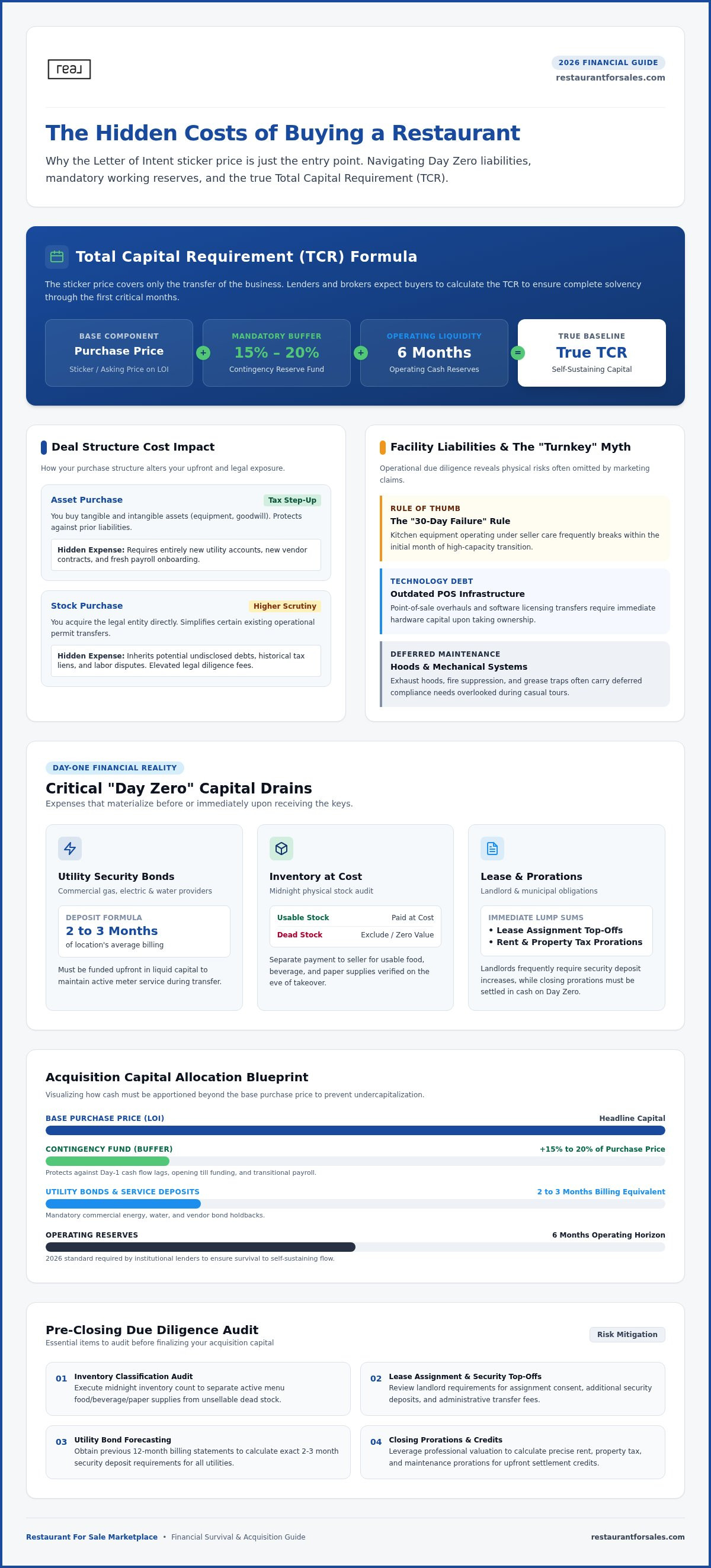
Many entrepreneurs mistake the purchase price for the total investment. In reality, the sticker price is just the entry point. Understanding the hidden costs of buying a restaurant requires a shift in perspective from the "asking price" to the Total Capital Requirement (TCR). This figure represents the purchase price plus the liquid capital required to reach a self-sustaining cash flow. Falling into the "sticker price" trap leads to chronic under-capitalization, which remains a primary reason new owners struggle in their first year. By 2026 standards, sophisticated lenders and brokers expect to see a TCR that accounts for at least six months of operating reserves.
Sellers often use the word "turnkey" to imply a business is ready to run without additional investment. This is rarely a financial reality. Even a well-maintained facility requires immediate cash for fresh inventory, staff training, and brand updates. Conducting thorough operational and financial due diligence is the only way to uncover these "invisible" liabilities before you sign the contract. This process helps you identify if the "turnkey" kitchen actually needs a major hood repair or a point-of-sale system overhaul that the seller hasn't disclosed.
The Difference Between Asset and Stock Purchases
The structure of your deal significantly impacts the hidden costs of buying a restaurant. In an asset purchase, you buy specific items like equipment, furniture, and goodwill. This structure usually allows for a tax-favorable "step-up" in basis, but it requires you to set up new accounts for everything from utilities to payroll services. A stock purchase involves buying the entire legal entity. While this can simplify the transfer of certain permits, it often means inheriting undisclosed debts, labor disputes, or historical tax liens. Professional fees for stock deals are typically higher because they require more intensive legal scrutiny to protect you from these entity-level risks.
Why 'Closing Costs' Are Only the Tip of the Iceberg
Standard closing costs like escrow fees, attorney billing, and state filing fees are predictable but often underestimated. Beyond these, you must prepare for "Day Zero" requirements. This includes the cash needed for the opening till, emergency repairs, and immediate payroll for the transition week. A disciplined financial strategy involves setting aside a contingency fund of 15% to 20% of the purchase price. This reserve acts as a buffer against the inevitable equipment failures or slow initial weeks that can cripple an unprotected budget. You'll also need to account for prorations, such as rent and property taxes, which are often settled as a lump sum at the time of closing.
Transition and Working Capital: The Day-One Financial Reality
The moment you take possession of a restaurant, your focus shifts from the abstract deal to operational reality. One of the most immediate hidden costs of buying a restaurant is the liquid capital required to fund the transition period. While the purchase price covers the business itself, your working capital ensures the doors stay open and the kitchen stays functional from the first hour of your ownership. Failing to account for these immediate outlays often leads to a cash crunch before your first month of sales is even recorded.
Managing Inventory at Closing
Inventory at Cost is a mandatory closing adjustment that requires a separate payment to the seller for all usable food, beverage, and paper supplies on hand at the time of transfer. This process usually involves a "midnight count" on the eve of the takeover to establish an accurate value. It's vital to differentiate between usable stock and "dead stock," which includes expired ingredients or items that don't fit your new menu. You shouldn't pay for a previous owner's poor ordering habits or slow-moving products that will only take up valuable shelf space.
According to the State of the Restaurant Industry report, food and labor costs remain the most significant pressures on a restaurant's bottom line. Starting with an accurate, lean inventory valuation is essential for protecting your initial profit margins and ensuring you aren't over-capitalized in non-perishable goods.
Utility and Service Deposits
Commercial utility companies typically demand security bonds or deposits equal to two or three months of the location's average billing. With 2026 energy pricing remaining a volatile factor for high-volume kitchens, these deposits can easily reach five figures. You must also budget for transfer fees associated with waste management, grease trap cleaning, and linen services. These vendors often require new contracts and upfront payments before they'll continue service for a new operator, even if the previous owner was a long-term client.
Insurance is another significant upfront expense. Most carriers require the full annual premium or a substantial down payment for general liability, property, and workers' compensation coverage before the keys change hands. Additionally, you'll need to budget for "shadow payroll." This covers the cost of paying your inherited staff for transition meetings and training on new point-of-sale or kitchen systems during the first week. Identifying these requirements early with a professional restaurant brokerage service allows you to negotiate prorations and credits that can offset these "Day Zero" expenses.
Compliance and Legal Fees: Navigating the Regulatory Paperwork
Securing the physical assets of a business is only half the battle. The regulatory framework surrounding food service is dense, and compliance represents one of the most significant hidden costs of buying a restaurant. These expenses often surface during the final weeks of a transaction, requiring immediate payment to government agencies, landlords, and professional advisors. Without a clear plan for these administrative outlays, you risk delaying your opening or operating under legal uncertainty.
The True Cost of Lease Assignments
Landlords typically charge administrative review fees to process a lease assignment. These fees cover the cost of their legal counsel reviewing your financial statements and business plan. Beyond the review fee, you may face a "top-off" requirement for the security deposit. If the current rent is higher than when the seller first signed the lease, the landlord will likely demand additional funds to bring the deposit up to the current two-month or three-month equivalent. For a deeper dive into the mechanics of this process, see our guide on Understanding Restaurant Lease Assignments.
You should also prepare for the possibility of a personal guarantee. Many 2026 commercial leases require new owners to personally back the lease, which may involve additional legal review costs for your own attorney to ensure your personal assets are appropriately protected through "good guy" clauses or limited guarantees.
Liquor License and Health Permit Transfers
Transferring a liquor license is rarely a simple name change. It often involves escrow requirements where a portion of the purchase price is held to ensure all state taxes and historical liabilities are cleared. In many jurisdictions, you'll need to pay for a temporary permit to continue serving alcohol while the permanent transfer is pending. These temporary permits are a recurring "hidden" expense that can last several months.
Health department permits present another financial hurdle. When a restaurant changes hands, the local health department often conducts a new inspection. They may require you to bring the facility up to the most current 2026 building codes, even if the previous owner was grandfathered in. This could mean mandatory upgrades like installing additional hand-washing sinks, updating grease traps, or replacing floor drains. These compliance-driven renovations are non-negotiable and must be factored into your day-one capital requirements.
Don't overlook entity formation and professional counsel. Setting up a new LLC or S-Corp involves state filing fees and the cost of a specialized restaurant attorney to draft your operating agreement. Using a CPA who understands the specific nuances of restaurant accounting is an investment that prevents costly tax errors during the transition year.
Facility Liabilities: Deferred Maintenance and Technology Debt
Physical and digital infrastructure represents a significant portion of the hidden costs of buying a restaurant. While a kitchen might look functional during a walkthrough, the stress of a transition often reveals underlying weaknesses. The industry follows an informal "30-day failure" rule, where equipment that was limping along under previous ownership finally breaks under the new usage patterns or different staff handling. Without a dedicated capital reserve for these immediate repairs, a single compressor failure or a broken dishwasher can derail your first month's cash flow.
Deferred maintenance is rarely visible to the untrained eye. Items like HVAC systems, grease traps, and refrigeration seals are frequently neglected by sellers looking to exit. These components are expensive to service and even costlier to replace. You should also account for the aesthetic costs of your transition. Changing the name and brand identity involves more than just a new menu. Outdoor signage, window decals, and interior branding can cost thousands of dollars in permits and fabrication before you even serve your first customer.
The Hidden Cost of Outdated Technology
Technology debt is a modern liability that many buyers overlook. Inheriting an outdated Point of Sale (POS) system often comes with high SaaS subscription transfer fees or hardware that isn't compatible with modern merchant processing standards. If the previous owner hasn't updated their hardware for EMV compliance, you may be liable for fraudulent transactions from day one. Upgrading these systems requires both a capital outlay for new hardware and a "soft" cost in labor for training your employees on the new platform during their first week. Merchant processing setup fees and software integration costs should be line items in your pre-closing budget.
Evaluating Physical Assets During Due Diligence
Buying a restaurant "As-Is" is standard practice, but it shouldn't mean buying blindly. You must budget for professional inspections of the HVAC, kitchen hood, and fire suppression systems. These inspectors provide a realistic timeline for the remaining life cycles of your heavy equipment. A professional equipment audit is significantly less expensive than an emergency compressor replacement during a Saturday night service. If an inspection reveals major deficiencies, you can use that data to negotiate a credit at closing or a reduction in the purchase price. Utilizing professional restaurant valuation services during this phase ensures that the price you pay accurately reflects the actual condition of the assets you are inheriting.
Professional Services: Investing to Mitigate Risk
Professional services are often viewed as discretionary expenses, but they serve as essential insurance against the hidden costs of buying a restaurant. Engaging experts early in the acquisition process allows you to identify financial leakage and operational risks that aren't apparent in a standard profit and loss statement. These services provide the objective data needed to justify your offer and protect your capital from unforeseen liabilities. When you invest in specialized counsel, you aren't just paying for paperwork; you're buying the certainty that your new venture is built on a transparent financial foundation.
The Value of a Professional Valuation
A professional valuation does more than establish a fair price. It uncovers "off-book" liabilities that a seller might not disclose or even realize exist. By analyzing the business through a standardized lens, you can identify discrepancies in labor records or vendor contracts that could lead to future expenses. For a detailed breakdown of current market methodologies and how they impact your purchase, refer to Restaurant For Sale Marketplace's 2026 Restaurant Valuation Guide.
Using valuation data effectively allows you to negotiate "credits" at the closing table. If the valuation reveals that the facility's deferred maintenance is higher than industry averages, you can request a reduction in the final payment. This proactive approach ensures your working capital remains intact for growth rather than being drained by immediate repairs. It's a strategic tool that transforms a potential liability into a negotiation lever.
Brokerage and Transaction Management
Navigating a commercial transaction requires a structured closing process that handles complex prorations. A professional broker manages the "Closing Statement," which accounts for all adjustments. This includes credits for prepaid rent, security deposits, and prorated property taxes. In most cases, brokerage commissions are success-based and paid by the seller, making their expertise an accessible resource for buyers looking to professionalize their acquisition. The broker acts as a facilitator, ensuring that all "Day Zero" requirements are met without last-minute financial surprises.
You should also account for CPA fees related to forensic accounting and obtaining tax clearance certificates. These certificates are vital to ensure you aren't held liable for the previous owner's unpaid sales or payroll taxes. A CPA's role is particularly important when evaluating cash-heavy businesses, as they verify that reported income aligns with bank deposits and purchase records. Escrow and title services further protect the transaction by ensuring all equipment and assets are free of UCC-1 filings or other encumbrances. To ensure a transparent acquisition, explore restaurant brokerage services at Restaurant For Sale Marketplace and leverage our expertise in managing complex commercial transitions.
Securing Your Restaurant Acquisition Strategy for 2026
Success in the restaurant industry requires looking beyond the initial purchase price to account for the Total Capital Requirement. By identifying the hidden costs of buying a restaurant early, you protect your working capital from being drained by immediate equipment failures, utility bonds, or lease assignment fees. A disciplined approach to due diligence ensures that your "Day Zero" operations are funded for stability rather than survival. Professional valuation and transaction management turn these potential liabilities into manageable line items.
Navigating these financial complexities is more efficient with the right partners. Our national marketplace provides verified listings and professional valuation tools designed for smart buyers. We offer expert brokerage for high-value commercial transactions to help you manage prorations and credits effectively. Find Your Next Investment on the Restaurant For Sale Marketplace to begin your journey with a clear financial roadmap. With the right preparation, your transition from buyer to owner will be both professional and profitable.
Frequently Asked Questions
What are typical closing prorations in a restaurant sale?
Typical prorations include base rent, property taxes, common area maintenance (CAM) fees, and prepaid service contracts. These adjustments ensure the seller pays for expenses up to the closing date while you take over responsibility from that point forward. A professional broker calculates these figures during the final closing statement. This process provides a clean financial break and prevents you from paying for the previous owner's final operational days.
Do I have to pay for the food and liquor inventory separately?
Yes, inventory is almost always treated as a separate payment from the business purchase price. This is one of the most common hidden costs of buying a restaurant that catches new owners off guard. You pay for "inventory at cost" based on a physical count performed the night before the takeover. This ensures you only pay for usable stock that matches your current menu and quality standards.
How much should I budget for a commercial lease security deposit?
You should budget for a security deposit equivalent to two to three months of the current base rent plus CAM charges. Landlords often require a "top-off" if the current rent has increased since the seller's original lease was signed. You must also account for administrative review fees charged by the landlord's legal team. These costs vary depending on the specific terms of the lease assignment and your financial strength.
What is a 'Tax Clearance Certificate' and why does it cost me to get one?
A Tax Clearance Certificate is a document from the state confirming the seller has paid all sales and payroll taxes. While the certificate itself might have a small filing fee, the real cost is the professional time your CPA spends performing the forensic accounting required to verify the records. Obtaining this document is non-negotiable because it protects you from successor liability for the previous owner's unpaid government debts.
Are there hidden costs in keeping the existing restaurant staff?
Yes, you must account for accrued vacation pay, sick leave, and potential unemployment insurance rate hikes. If you keep the staff, you may inherit their longevity for benefits or be responsible for training them on new systems. You should also budget for "shadow payroll" during the transition week. This covers the time spent in meetings and training sessions that don't generate immediate revenue but are essential for a successful takeover.
How much do restaurant brokers charge for acquisition assistance?
Most restaurant brokers earn their income through success-based commissions paid by the seller upon the completion of the sale. As a buyer, you typically don't pay a direct fee for a broker's assistance in finding a listing or managing the transaction. However, you should budget for professional fees if you hire a broker specifically for independent valuation services or as a dedicated buyer's representative in a complex commercial deal.
What is the cost of a liquor license transfer in 2026?
The cost includes the state's official transfer fee plus the expense of a temporary permit to maintain service during the processing window. You must also account for mandatory compliance upgrades required by the health department during the 2026 transfer inspection. These regulatory costs are significant because they often require immediate payment to government agencies and legal counsel to ensure the license remains in good standing throughout the transition.
How much working capital should I have after the purchase is complete?
You should maintain a liquid reserve equal to three to six months of operating expenses. This working capital acts as a buffer against slow initial months or unexpected equipment failures. By planning for the hidden costs of buying a restaurant, you ensure your bank account isn't empty on day one. Having this reserve allows you to focus on marketing and growth rather than struggling to cover your first few payroll cycles.


