

In 2026, the average U.S. bar loses 20% to 25% of its liquid inventory to shrinkage, yet many buyers overlook this critical data point when researching what to look for when buying a bar. You likely recognize that acquiring a hospitality business is a complex undertaking involving far more than just a physical space and a drink menu. It's a high-stakes investment where the difference between a thriving local staple and a financial burden often lies in the details hidden within the P&L statements and lease agreements.
This guide will help you master the financial, legal, and operational factors required to identify a high-value acquisition while avoiding common pitfalls like hidden debt or liquor license transfer delays. We'll examine verified valuation multiples, the intricacies of lease longevity, and the essential due diligence steps needed to protect your capital. By following this structured approach, you'll gain the clarity needed to value a business accurately and the confidence to make a formal offer based on professional standards. This methodical framework ensures you transition from a prospective buyer to a prepared investor.
Key Takeaways
- Secure the "Triple Threat" of bar assets by verifying the transferability of the liquor license and the longevity of the commercial lease.
- Validate financial performance through three years of tax returns and learn why unrecorded cash income should never factor into a formal valuation.
- Master what to look for when buying a bar by auditing high-cost physical assets, specifically refrigeration and draft systems, before making an offer.
- Audit the establishment's digital reputation and concept longevity to distinguish between a temporary trend and a stable community institution.
- Leverage professional brokerage and valuation services to navigate complex lease assignments and ensure you don't overpay for the business.
The Foundation of the Deal: Liquor Licenses and Lease Agreements
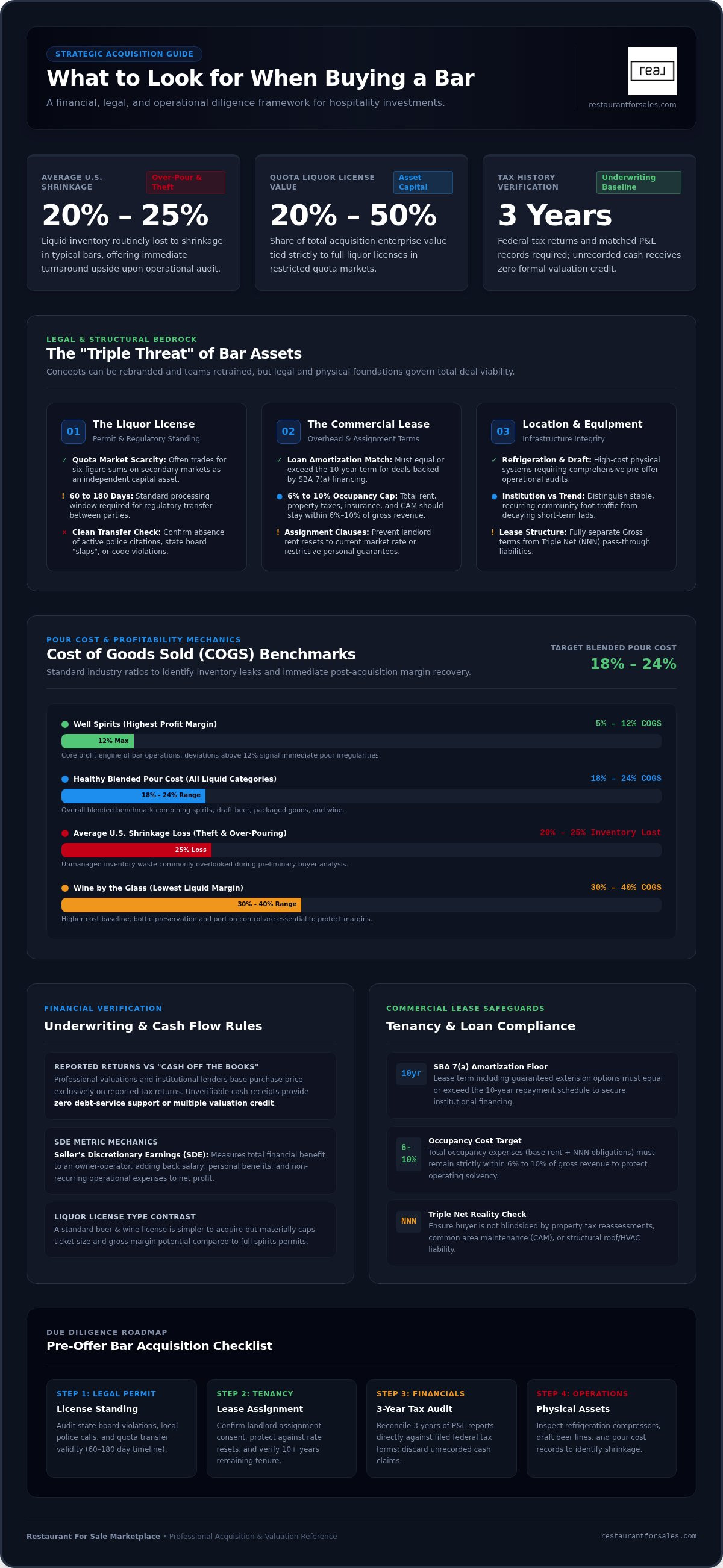
A successful acquisition rests on the "Bar Asset Triple Threat": the license, the lease, and the location. While a concept can be rebranded and staff can be retrained, these three elements form the legal and financial bedrock of the business. When evaluating what to look for when buying a bar, these foundational assets require more scrutiny than the menu or the décor. The liquor license is the most volatile component because its value is tied to state-specific quotas and strict regulatory standing. If the license is compromised, the business effectively ceases to exist as a bar.
Liquor licenses vary significantly in impact. A full liquor license in a "quota" market can account for 20% to 50% of the total acquisition enterprise value. These licenses often trade on secondary markets for six-figure sums due to their scarcity. In contrast, a beer and wine license is generally easier to obtain but significantly limits your revenue and margin potential. Investors must determine if the license is tied to the premises or the individual, as this dictates the complexity of the transfer process. This transfer typically requires 60 to 180 days to complete, depending on the jurisdiction.
The lease is the second pillar of the deal. You aren't just taking over a physical space; you're inheriting a legal obligation that dictates your monthly overhead. A professional restaurant lease assignment review is essential to ensure the landlord cannot arbitrarily block the sale or spike the rent upon transfer.
Critical Lease Terms to Negotiate
For any acquisition involving SBA 7(a) financing, the commercial lease term must equal or exceed the 10-year loan amortization period. If the current lease has only a few years remaining without verifiable extension options, the deal is likely unfundable. You must also examine assignment clauses. Some landlords use a business sale as a trigger to "reset" rent to current market rates or demand personal guarantee continuity that might be unfavorable. Finally, understand your true costs by distinguishing between Gross and Triple Net (NNN) leases. In a NNN structure, you pay for property taxes, building insurance, and maintenance. Total occupancy costs should strictly sit between 6% and 10% of gross revenue to protect your operating margins.
Liquor License Due Diligence
Due diligence involves verifying the license's standing with the state board. You must check for past violations, police calls for service, or "slaps" that could hinder a smooth transfer. Unresolved citations or local code violations can halt the process indefinitely. When researching what to look for when buying a bar, verify if the license is a "quota" type. In moratorium markets, the license itself is a capital asset that retains value even if the business fails. Ensuring the license is "clean" and transferable is the only way to guarantee you can serve customers on your first day of ownership.
Financial Scrutiny: Analyzing SDE, EBITDA, and Revenue Streams
Financial transparency is the only way to mitigate risk during an acquisition. When you are determining what to look for when buying a bar, the most critical document is the federal tax return. Sellers frequently claim high profits "off the books," but professional valuations and lenders only recognize reported income. You should demand at least three years of Profit and Loss (P&L) statements and matching tax returns to establish a reliable baseline. This "paper trail" confirms the business's stability and prevents you from overpaying based on the common "cash business" myth.
Analyzing the Cost of Goods Sold (COGS) is equally vital. A healthy bar typically operates with a blended pour cost between 18% and 24%. Spirits usually offer the highest margins, with well spirits sitting as low as 5% to 12% COGS. In contrast, wine by the glass often hits 30% to 40%. If the current owner's costs exceed these industry benchmarks, it may indicate significant shrinkage. Research shows the average U.S. bar loses 20% to 25% of its liquid inventory to over-pouring or theft. Identifying these inefficiencies during the due diligence phase allows you to spot opportunities for immediate margin improvement post-close.
SDE vs. EBITDA: Which Metric Should You Use?
Seller’s Discretionary Earnings (SDE) represents the total financial benefit to a single full-time owner-operator. This includes net profit, the owner's salary, and non-essential "add-backs" like personal travel or health insurance paid by the business. EBITDA (Earnings Before Interest, Taxes, Depreciation, and Amortization) is the metric preferred by semi-absentee investors who plan to hire a general manager. SDE is the standard for bars under $1M in revenue because it reflects the total cash flow available to a working owner. For a deeper look at how these metrics influence sales price, see our 2026 restaurant valuation guide.
Verifying Revenue Authenticity
You must verify every dollar by cross-referencing Point of Sale (POS) reports with actual bank deposits. Discrepancies between what the register records and what hits the bank account are immediate red flags. This process is essential when learning what to look for when buying a bar, as it separates legitimate revenue from creative accounting. Scrutinize the sales mix to ensure the revenue isn't overly dependent on low-margin food items. A bar that generates 80% of its revenue from high-margin spirits is a much more attractive investment than a "bar and grill" where food labor eats into the profits. If you are unsure how to normalize these financials, utilizing professional valuation services can provide the clarity needed to make a disciplined offer.
Physical and Operational Assessment: Equipment and Inventory
The physical assets of a bar are often secondary to its cash flow, but they represent a significant capital risk if they fail immediately after the sale. When evaluating what to look for when buying a bar, you must distinguish between the fair market value of the Furniture, Fixtures, and Equipment (FF&E) and the cost of replacement. Most bar equipment depreciates rapidly. While a seller might value a five-year-old draft system at its original purchase price, its fair market value is likely 30% to 50% lower. However, for tax year 2026, IRS Section 179 allows for a maximum immediate expensing deduction of $2,560,000 for equipment and refrigeration. This tax benefit can offset some of the initial capital expenditure required to modernize an aging facility.
Refrigeration is your largest hidden cost. The "Ice Machine & Cooling Rule" dictates that if a walk-in cooler or ice machine is over seven years old, you should budget for an imminent replacement. These units are the high-cost heart of the operation. A failure during a peak shift doesn't just cost money for repairs; it results in lost revenue and spoiled inventory. Similarly, inventory management requires a strict audit during the transition. You should only pay for "clean" inventory at cost. Avoid paying for "dead stock", such as dusty bottles of niche liqueurs that haven't moved in six months, as they provide no immediate return on investment.
The Equipment Life Cycle Audit
A thorough inspection must go beyond the surface. Walk-in coolers and draft systems should be audited for temperature consistency and line cleanliness. HVAC and plumbing systems are common points of failure in older commercial buildings and are often "unseen" during a casual walkthrough. Ensure the HVAC unit is capable of handling the heat load of a full house during summer months. Additionally, scrutinize the POS system. Determine if you're inheriting outdated hardware that requires a total overhaul or a modern SaaS contract that's easily transferable. Outdated systems contribute to the 20% to 25% liquid inventory shrinkage seen in bars that lack integrated pour-to-sales variance reporting.
Staff Retention and Culture
The value of a bar is often tied to its "star" bartenders who maintain the regular customer base. Identifying these key personnel early is critical for maintaining revenue stability post-close. You must also verify that the previous owner was compliant with all labor laws and payroll taxes to avoid inheriting legal liabilities. A change in ownership naturally creates uncertainty. Proactive communication is necessary to maintain staff morale and prevent a wave of turnover that could leave you understaffed during your first month of operation. A stable, well-trained team is a primary indicator of a healthy culture and a functional business model.
Market Positioning: Concept, Reputation, and Digital Presence
The market positioning of a bar determines its long-term viability and the stability of its revenue. When researching what to look for when buying a bar, you must distinguish between a "staple" institution and a "fad" concept. A staple bar relies on consistent local regulars and has survived multiple economic cycles. A fad bar might show high current revenue but lacks the staying power to justify a high valuation multiple. You should conduct a formal reputation audit by analyzing Google and Yelp sentiment specifically from the last 12 months. This timeframe reveals the current management's performance and highlights any emerging issues with service quality or safety that could impact future traffic.
Competition analysis is a vital part of your market audit. You need to identify any new liquor license applications or planned commercial developments within a 2-mile radius. A new high-concept competitor opening nearby can quickly erode your market share and force expensive rebranding. Understanding the "neighborhood local" sentiment is also essential, as bars often thrive or fail based on their integration into the community. For a broader view of the acquisition process beyond these specific bar metrics, refer to our guide on how to buy a restaurant in 2026.
The Digital Asset Audit
In 2026, a bar's digital footprint is a core component of its enterprise value. You must verify that all social media handles and follower engagement are fully transferable in the bill of sale. Check the ownership status of the Google Business Profile to ensure you aren't locked out of managing reviews post-acquisition. Existing email lists and loyalty program databases represent a "warm" audience that you can market to on day one. These assets provide immediate cash flow potential and should be documented during your due diligence process.
Neighborhood and Demographic Trends
The relevance of a bar concept depends entirely on the local population. You should analyze changing area demographics to ensure the theme still resonates with the neighborhood's current residents. For instance, approximately 20% to 25% of consumers now regularly consume low-alcohol or zero-proof drinks. A bar that has not adapted its menu to include functional cocktails may be missing out on high-margin revenue streams. Finally, evaluate physical accessibility. Parking availability is a critical factor for suburban bars, while consistent foot traffic is the primary driver for urban locations. To find opportunities that have already passed this rigorous vetting, browse our vetted bar listings.
Executing the Deal: Why Professional Brokerage Matters
Buying a bar isn't just an asset purchase; it's a high-stakes commercial transaction that requires strict confidentiality. A broker ensures the sale remains private, preventing premature staff turnover or customer loss before the transition is complete. Utilizing specialized restaurant brokerage services protects you from "lemons" by ensuring the business has been vetted for financial and legal viability. This professional oversight is critical when determining what to look for when buying a bar, as it filters out listings with unresolvable lease issues or compromised licenses.
Financing the acquisition often involves SBA 7(a) loans, which carry a maximum maturity of 10 years and a statutory limit of $5,000,000. For loans exceeding $350,000, interest rates are typically capped at the WSJ Prime Rate plus 3.0%, which currently sits near 9.75%. Seller financing is another common tool, often used to bridge the gap between the purchase price and the lender's loan-to-value requirements. The closing timeline is frequently dictated by the 60 to 180 days required for liquor license transfers, making a structured escrow process essential for protecting your earnest money deposit.
The Value of an Expert Intermediary
A broker acts as a proactive facilitator, managing the emotional friction that often arises between buyers and sellers during negotiations. They provide access to "off-market" listings that aren't found on public portals, giving you a distinct advantage in a competitive market. An expert intermediary also ensures all contingencies are met before funds are released from escrow. This includes verifying that the landlord has formally approved the lease assignment and that the business has cleared all local health and fire inspections. This disciplined approach minimizes your post-close liability.
Next Steps: From Inquiry to Ownership
The acquisition process begins with signing a Non-Disclosure Agreement (NDA) to gain access to sensitive financial data. After reviewing the records, you'll submit a Letter of Intent (LOI) to outline your offer price and terms. This document triggers the formal 30-day due diligence window. During this period, you'll conduct the deep-dive audits of POS logs, tax returns, and equipment life cycles mentioned in previous sections. This window is your final chance to verify what to look for when buying a bar before the deal becomes binding. Restaurant For Sale Marketplace provides the specialized tools and listings needed to move from inquiry to ownership with accuracy and speed.
Securing Your Position in the Hospitality Market
Successful bar ownership requires a balance of operational insight and financial discipline. You've learned that the "Triple Threat" of lease, license, and location forms the bedrock of any profitable deal. By auditing equipment life cycles and verifying revenue through tax returns, you've mastered the essentials of what to look for when buying a bar. This structured approach moves you beyond the "cash business" myths and into the reality of data-driven investing. Every step, from the initial NDA to the final escrow release, must be handled with precision to avoid the common pitfalls of hidden debt or failing infrastructure.
Restaurant For Sale Marketplace provides the expertise needed to navigate these high-value commercial transactions. We offer professional hospitality valuations, a national network of expert brokers, and confidential transaction management to protect your interests. You're now equipped to transition from a prospective buyer to a prepared investor. We invite you to view active bar and restaurant listings at Restaurant For Sale Marketplace to begin your search with vetted opportunities. Taking this methodical path ensures you enter the market with the stability and reliability required for long-term growth.
Frequently Asked Questions
What is the most important thing to look for when buying a bar?
The "Triple Threat" of the liquor license, the commercial lease, and the location is the most vital factor. When considering what to look for when buying a bar, you must ensure the license is clean of violations and the lease has at least 10 years of security. Without these two legal foundations, the physical location's value drops significantly. Professional valuation services can help you determine if these assets justify the asking price.
How much cash flow should a bar have to be a good investment?
A healthy investment typically maintains a Prime Cost below 65% of gross sales. This includes cost of goods sold and total labor expenses. You should look for Seller’s Discretionary Earnings (SDE) that comfortably cover your loan payments while providing a competitive salary. Most independent bars transact at 2.0x to 2.2x SDE. If the cash flow cannot support the debt service, the business is likely overpriced for the current market.
Can I buy a bar with no experience?
You can buy a bar without direct experience, but securing traditional financing like an SBA 7(a) loan will be challenging. Lenders prefer buyers with a proven operational track record in the hospitality industry. If you lack experience, you might need to hire a seasoned general manager or bring on a partner with industry credentials. Most successful first-time owners spend significant time learning what to look for when buying a bar before making an offer.
What happens to the liquor license when I buy a bar?
Liquor licenses do not automatically transfer with the sale of the business. You must file a formal person-to-person transfer application with your state’s regulatory board. This process includes background checks and public posting windows that typically last 30 days. Approval timelines vary by jurisdiction, often taking between 60 and 180 days. You should ensure the deal is contingent upon the successful transfer of this license to protect your investment capital.
How do I know if the bar owner is lying about their profits?
Verification requires matching the seller’s federal tax returns with their Point of Sale (POS) logs and monthly bank statements. If a seller claims "unreported cash" to justify a higher valuation, you should disregard those figures entirely. Lenders and professional brokers only recognize verifiable, reported income. Discrepancies between recorded sales and bank deposits are a major red flag. Always insist on a 30-day due diligence period to perform a thorough financial audit.
Is it better to buy a bar or start one from scratch?
Buying an existing bar is generally safer because it provides immediate cash flow and a proven customer base. Starting from scratch involves high build-out costs, permitting delays, and a significant period of zero revenue. An established business also has a legacy of local reputation and staff that you can build upon. While starting fresh allows for total creative control, an acquisition offers a faster path to profitability and easier access to financing.
What are the common red flags in a bar lease?
Red flags include lease terms shorter than your loan period and the absence of clear renewal options. You should also watch for assignment clauses that allow the property owner to block a future sale or spike the rent during a transfer. High Triple Net (NNN) charges that push your total occupancy costs above 10% of gross revenue are another concern. A professional review of restaurant lease assignments is essential to avoid these common pitfalls.
How long does the process of buying a bar usually take?
The entire process from inquiry to closing typically takes six to nine months. The median time a hospitality business stays on the market is roughly 170 to 178 days. Once you sign a Letter of Intent, the closing period is often dictated by the liquor license transfer, which can take up to 180 days in strict jurisdictions. Using a broker helps streamline these timelines by managing the complex paperwork and coordination between multiple parties.


