

Due diligence is not a scavenger hunt for facts; it is a rigorous stress-test of the seller's narrative against financial reality. When you begin identifying the right questions to ask when buying a restaurant business, you aren't just looking for confirmation of what is working. You are looking for the structural cracks that the current owner might have overlooked or intentionally obscured. It's natural to feel a sense of urgency when a promising location hits the market, but rushing into a deal without verifying "cash" income claims or the transferability of the lease is a recipe for a catastrophic investment. You want to ensure that the profitability you see on paper actually reaches your bank account after the closing.
This guide provides a comprehensive framework designed to help you master the due diligence process and uncover hidden liabilities before they become your problem. We've compiled 23 essential questions that move beyond surface-level financials to address tax liens, equipment debt, and the specifics of seller's discretionary earnings. By following this structured approach, you will gain the confidence needed to verify a restaurant's true valuation and build a transition plan that protects your capital. From dissecting the P&L statements to auditing the physical assets, you'll learn exactly how to separate a high-performing business from a potential money pit.
Key Takeaways
- Adopt a "Trust but Verify" mindset to ensure every claim in the offering memorandum is backed by documented evidence.
- Learn the essential questions to ask when buying a restaurant business to verify Seller's Discretionary Earnings and identify any undisclosed tax liens.
- Audit operational stability by identifying key employees and confirming how inventory is valued at the time of closing.
- Protect your physical footprint by confirming lease renewal options and the landlord's requirements for a successful lease assignment.
- Use a professional broker as an essential buffer to ask hard financial questions while maintaining a positive relationship with the seller.
The Strategic Vetting Mindset: Why Your Questions Determine ROI
The acquisition of a commercial kitchen is a high-stakes transaction where information asymmetry often favors the seller. Successful buyers recognize that a formal due diligence investigation is not a formality; it's the process of verifying every claim made in the offering memorandum. In the 2026 market, a "Trust but Verify" approach is essential for any serious entrepreneur. You must assume that while the narrative provided by the seller is optimistic, the underlying data may tell a different story. This mindset protects your capital from being tied up in a failing operation disguised as a turnkey opportunity.
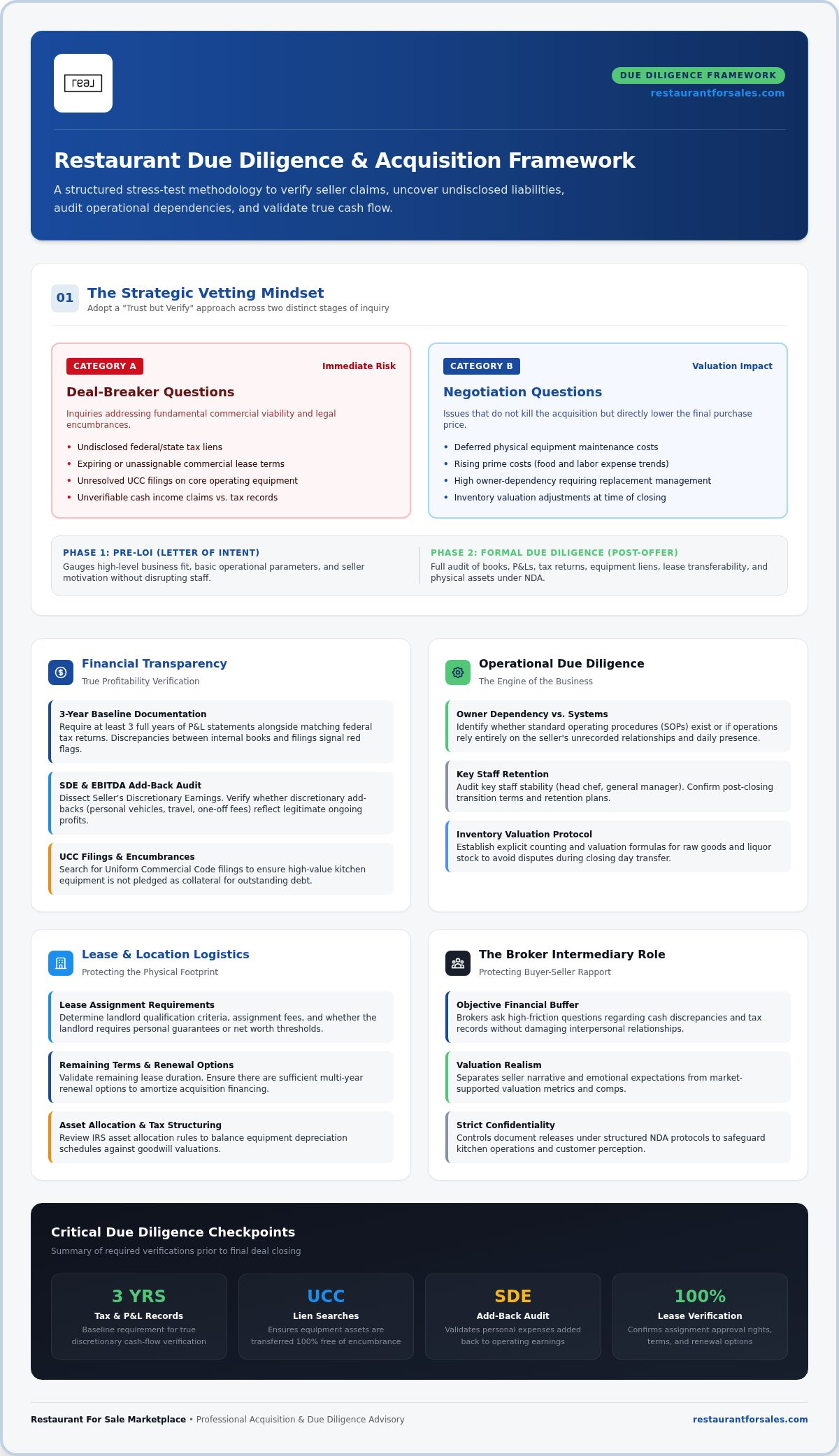
Your strategy should categorize inquiries into two distinct groups. First, identify "deal-breaker" questions that address fundamental viability, such as undisclosed tax liens or expiring leases. Second, focus on "negotiation" questions that might not kill the deal but could lower the purchase price, like deferred equipment maintenance or rising food costs. Using a professional intermediary often facilitates these conversations. They can extract honest answers and financial records without damaging the rapport between buyer and seller, ensuring the deal remains on track while you get the facts you need.
The Core Objective: Narrative vs. Data
Sellers naturally emphasize potential and future growth to justify a higher asking price. As a buyer, your focus must remain on historical performance and verifiable records. This distinction is critical when identifying if a restaurant is "owner-dependent" or truly process-driven. An owner-dependent business often collapses once the founder exits, making the acquisition far riskier than it appears on paper. It's vital to cross-reference every verbal answer with the data points found in our 2026 restaurant valuation guide. Matching the seller's narrative to documented financial reality ensures you don't pay for "potential" that you'll have to build yourself.
Setting the Stage for Professional Inquiry
Timing is everything when determining which questions to ask when buying a restaurant business. Preliminary questions occur before the Letter of Intent (LOI) to gauge basic fit and seller motivation. However, deep-dive financial and operational inquiries belong in the formal due diligence phase after an offer is accepted. Maintaining strict confidentiality during this process protects the business's reputation and staff morale. While you may occasionally speak with the owner, directing technical or sensitive financial questions to the broker is usually more effective. This professional distance allows for a rigorous audit of the books without creating personal friction that could stall the closing process.
Financial Transparency: Questions to Uncover True Profitability
Profitability is the foundation of your investment. You must request at least three years of Profit and Loss (P&L) statements and federal tax returns to establish a reliable baseline. Discrepancies between internal books and tax filings are common; however, you need to understand the reason behind every variance. If a seller cannot produce these documents, it is a significant red flag regarding the business's organizational health. These financial records represent the most critical data points when determining which questions to ask when buying a restaurant business.
Investigating liabilities is equally critical. Ask if there are outstanding tax liens, UCC filings, or undisclosed debts that could follow the assets. A UCC filing indicates that equipment may be used as collateral for a loan, which could complicate the transfer of ownership. It's helpful to review IRS rules on asset allocation and business sales to understand how purchase price allocations affect your future tax obligations and depreciation schedules. For a professional review of these figures, you can consult the experts at Restaurant For Sale Marketplace through our restaurant valuation services to ensure the asking price aligns with market reality.
Verifying the SDE and EBITDA
The Seller’s Discretionary Earnings (SDE) often include "add-backs" for personal expenses or one-time costs. You must ask for a specific breakdown of these items to ensure they are legitimate business expenses. If a seller claims significant "cash" income not reflected on tax returns, proceed with extreme caution. These claims are difficult to verify and often cannot be used to support a higher valuation. Understanding how specific restaurant valuation methods are applied to these adjusted numbers will help you determine if the projected ROI is realistic and sustainable.
Expense and Liability Deep-Dives
Operating costs can fluctuate, so you need to know the current food and labor cost percentages relative to industry benchmarks. Ask if all equipment leases are current and transferable to a new owner. Additionally, inquire about upcoming capital expenditure requirements. A kitchen that requires a major equipment replacement in six months significantly changes the deal's value. Verifying what percentage of sales is processed through the POS system provides a data-driven anchor for all other financial claims. These specific questions to ask when buying a restaurant business reveal the true health of the operation beyond the seller's narrative.
Operational Due Diligence: Assessing the 'Engine' of the Business
Operational due diligence shifts the focus from the balance sheet to the daily mechanics of the business. You need to understand how the "engine" runs when the current owner isn't present. One of the most important questions to ask when buying a restaurant business involves the stability of the workforce. Start by analyzing the staff turnover rate and identifying key employees whose departure could destabilize the kitchen. In the 2026 labor market, retaining talent is a competitive advantage that directly impacts your bottom line. You must ask if the current manager intends to stay through the transition and if there are any pending labor disputes that could become your liability.
Physical assets require a technical audit. Inquire about the age and service history of major HVAC and refrigeration units. Replacing a walk-in cooler shortly after acquisition can erase your first year's profit. Additionally, you must verify how revenue is generated. A high reliance on third-party delivery apps often comes with steep commission fees that erode margins compared to in-house dining.
Human Capital and Culture
The culture of a restaurant is often tied to its compensation structure. Ask how the staff is currently paid, specifically regarding the distribution of tips versus service charges. This transparency helps you anticipate potential morale issues during the handover. You should also verify if any key personnel have employment contracts or non-compete agreements. Understanding these human elements is essential when formulating questions to ask when buying a restaurant business, as a mass exodus of staff on day one is a risk you cannot afford.
Technology and Physical Assets
Modern restaurants rely heavily on their tech stack. Determine if the POS system is owned or leased and ensure you'll have full access to historical data for future trend analysis. Your physical inspection must also confirm that the kitchen meets all 2026 health and fire safety codes. Beyond the heavy equipment, assess the condition of front-of-house furniture and fixtures.
Inventory management is another critical area. You need to know if the inventory is included in the asking price and how it will be valued at closing. Following IRS guidelines on the sale and allocation of business assets is essential to ensure that tangible assets like food stock and equipment are correctly accounted for. This structured approach to operational vetting ensures that the turnkey business you're buying doesn't require an immediate overhaul.
Lease and Location Logistics: Protecting Your Physical Footprint
The lease is often the most significant intangible asset in a restaurant acquisition. Without a secure, long-term location, the business's goodwill is virtually worthless. You must determine the exact number of years remaining on the current lease and verify all options to renew. A common mistake is assuming a lease transfer is automatic. You must ask if the landlord is prepared to grant a restaurant lease assignment or if they will require a completely new lease agreement with updated terms. These are fundamental questions to ask when buying a restaurant business because a landlord has the power to stall a deal or significantly increase your overhead.
Beyond the base rent, you need a clear breakdown of "Common Area Maintenance" (CAM) fees and any percentage rent clauses. CAM fees cover shared expenses like parking lot lighting and landscaping, which can fluctuate annually. If the lease includes percentage rent, the landlord takes a portion of your gross sales once a specific threshold is met. Additionally, investigate the local area for planned developments. A new construction project nearby could either boost your foot traffic or block access to your parking lot for months. Understanding these external factors is a critical part of your location due diligence.
Navigating the Landlord Relationship
A landlord's reputation is as important as the lease terms themselves. Ask the seller about the landlord's history with maintenance requests and general cooperation. You should also check for "exclusive use" clauses that prevent the landlord from leasing adjacent spaces to direct competitors. Be prepared for the landlord to request personal guarantees for the lease transfer. This means your personal assets could be at risk if the business fails to meet its rent obligations. Verifying these details early prevents surprises during the final stages of the transaction.
Real Estate vs. Leasehold Interest
In some transactions, you aren't just buying a lease; you're buying the land and building. This shift changes your financial strategy entirely. When investing in a restaurant with real estate, you gain an appreciating asset and eliminate the risk of landlord disputes, but you also take on property tax liabilities and structural maintenance. You must evaluate the "highest and best use" of the land to ensure the restaurant operation is the most profitable use for that specific footprint. If you need assistance evaluating these complex property terms, contact our team for expert restaurant brokerage services. These specific questions to ask when buying a restaurant business ensure that your physical location remains a stable platform for growth rather than a liability.
Interpreting the Answers: The Role of a Broker in Acquisition
Gathering raw data is only the first step; the true value lies in how you interpret that information to mitigate risk. A professional broker serves as a critical filter during this phase. They act as a strategic buffer, allowing you to ask the most difficult financial questions to ask when buying a restaurant business without damaging the rapport with the seller. This professional distance is vital because you will likely need the seller's cooperation during the training period after the sale. A broker compares the seller's claims against current market data and industry benchmarks to ensure the valuation is grounded in financial reality rather than optimistic projections.
The Value of an Authoritative Third Party
Brokers facilitate the secure exchange of sensitive documents that a seller might be hesitant to release to an unvetted buyer. Detailed tax returns, payroll records, and granular POS reports are handled with professional discretion. Beyond document management, an intermediary is responsible for managing the "due diligence clock." This ensures you stay on track with contractually mandated deadlines for inspections, financing, and lease approvals. They also act as a central coordinator, ensuring your attorney and accountant receive the specific data they need to protect your interests. This includes facilitating the escrow process and ensuring that title transfers are handled without legal encumbrances that could stall the closing.
Finalizing the Deal
Once you have analyzed the answers to your questions to ask when buying a restaurant business, you can move toward the final stages of the transaction. These insights provide the objective leverage needed to negotiate the final purchase price or request credits for necessary equipment repairs found during the inspection. It's also the phase where you define the training and transition period within the purchase agreement. You should ensure the seller is contractually obligated to stay on for a set duration to train you on proprietary recipes, staff management, and vendor relationships. For those navigating this for the first time, our how to buy a restaurant in 2026: the complete acquisition guide provides a step-by-step roadmap for a successful transfer.
View our current national restaurant listings and speak with a broker today.
Finalizing Your Strategy for a Successful Acquisition
Mastering the due diligence process requires moving beyond surface-level enthusiasm to conduct a rigorous audit of every financial and operational claim. By utilizing these specific questions to ask when buying a restaurant business, you transition from a passive observer to an informed investor capable of identifying hidden liabilities before they impact your bottom line. Success in the 2026 market depends on your ability to verify that the reported profitability and lease stability are grounded in documented reality rather than seller optimism.
Professional support is an essential component of a secure transaction. Our firm provides specialized Restaurant Brokerage Services and Expert Valuation Appraisals to ensure your acquisition is built on a foundation of accurate data. We operate on Success-Based Commissions, which aligns our objectives with your goal of a smooth and profitable closing. This disciplined approach allows you to focus on the operational transition while we manage the complexities of the deal structure.
Start Your Acquisition Journey: Browse National Restaurant Listings
With a comprehensive framework of questions and the right expert guidance, you can move forward with the confidence that your new investment is positioned for long-term growth.
Frequently Asked Questions
What is the single most important question to ask a restaurant seller?
The most important question is "Why are you selling?" Understanding seller motivation helps you gauge if the exit is due to genuine retirement or a hidden operational threat. If the seller is leaving because of a planned development or a sharp increase in local competition, the business's future ROI is at risk. This query serves as the foundation for all other questions to ask when buying a restaurant business during your initial inquiry.
How do I verify a restaurant's cash sales if they aren't on the tax returns?
Verifying cash sales that aren't on tax returns is difficult and carries significant risk. You should cross-reference Point of Sale (POS) reports with bank deposit slips and purchase invoices. If food costs are high but reported sales are low, it might indicate unrecorded income. However, most professional lenders and brokers will only value the business based on documented, reported income. Unverifiable cash claims should generally be excluded from your valuation model.
Should I ask the employees questions before I buy the restaurant?
You should generally avoid speaking with employees until the final stages of the transaction or after the closing. Sellers prioritize confidentiality to prevent staff turnover and morale issues. If you approach employees too early, you risk blowing the deal. Instead, ask the seller for a detailed organizational chart and turnover data. You can negotiate to meet key managers once a binding purchase agreement is in place and the due diligence period is near completion.
What happens if the landlord refuses to transfer the lease to me?
If the landlord refuses a lease assignment, the transaction typically cannot proceed unless the seller can provide an alternative location or you can negotiate a new lease. This is why lease contingencies are standard in most purchase agreements. You must review the "assignment and subletting" clause in the original lease early in the process. Landlords often require the buyer to have a similar or better financial standing and experience level than the current tenant.
How many years of financial records should I realistically expect to see?
You should realistically expect to see at least three full years of Profit and Loss (P&L) statements and federal tax returns. This timeframe allows you to identify long-term trends and cyclical patterns in the business's performance. Comparing these documents helps you verify the accuracy of the seller's narrative. If a restaurant has been open for less than three years, you should request every available monthly statement since the inception of the business to assess its growth trajectory.
What is a 'personal guarantee' and why does the landlord want one?
A personal guarantee is a legal agreement where you personally assume liability for the lease's financial obligations if the business fails. Landlords require this to mitigate the risk of a new tenant defaulting on rent. In a restaurant lease assignment, the landlord wants to ensure that even if the corporate entity goes bankrupt, they can still recover losses from your personal assets. You should consult an attorney to negotiate the duration or cap of this guarantee.
What are the common red flags in a restaurant's profit and loss statement?
Common red flags in a P&L statement include declining year-over-year sales, food costs that exceed 35% of revenue, and inconsistent labor expenses. You should also watch for excessive "owner add-backs" that seem like legitimate business expenses rather than personal perks. Significant fluctuations in utility costs or sudden drops in maintenance spending can also indicate that the owner is "polishing the books." These are critical red flags to identify when formulating your questions to ask when buying a restaurant business.
Is it better to buy the assets of a restaurant or the entire corporation (stock sale)?
Most buyers prefer an asset sale because it allows them to acquire the equipment and goodwill without inheriting the seller's corporate liabilities. In a stock sale, you buy the entire corporation, which includes its history of tax liens, lawsuits, and undisclosed debts. While a stock sale can simplify the transfer of certain permits or licenses, the legal risks are significantly higher. Most small to mid-market restaurant transactions are structured as asset sales to protect the buyer's capital.


