

What if the most valuable asset in your restaurant isn't something you can touch, count, or carry out the door? For many owners, the true worth of their business lies in its reputation, staff culture, and brand loyalty. Yet, these intangibles are often the first things buyers try to negotiate away. It's frustrating to face a skeptical buyer who views your years of hard work as mere "blue sky" without a clear price tag. You've likely felt the fear of leaving money on the table because you couldn't bridge the gap between your tax returns and your actual market value.
Accurately valuing restaurant goodwill is no longer a matter of guesswork or simple "plug numbers." Under the strict SBA SOP 50 10 8.1 rules effective October 2026, lenders now require rigorous independent appraisals for transactions over $250,000. This guide will show you how to calculate and maximize your brand's invisible value using current industry multiples. We'll break down the residual method, explain how to separate personal from enterprise goodwill, and give you the data needed to defend your asking price against even the most skeptical buyers.
Key Takeaways
- Identify the core components of intangible value, including brand reputation and turnkey operational systems, that command a premium in the 2026 market.
- Learn how to apply data-driven methodologies for valuing restaurant goodwill to ensure you don't leave money on the table during a sale.
- Discover how to reduce "Key Man Risk" to prevent buyers from discounting your business based on owner-dependency.
- Understand the critical difference between informal broker opinions and certified appraisals required for SBA financing and tax compliance.
What is Restaurant Goodwill and Why Does It Matter in 2026?
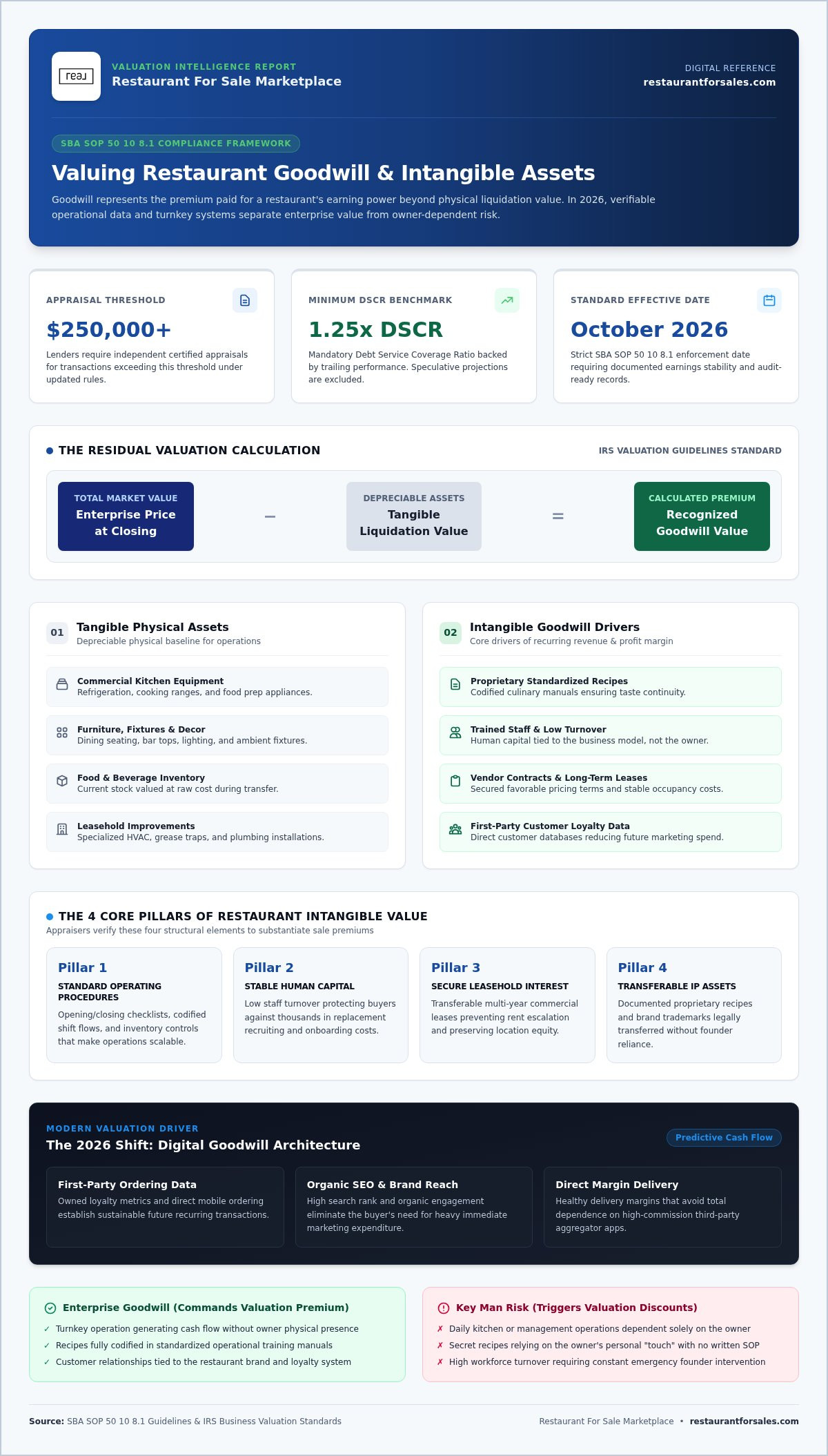
In professional brokerage, goodwill represents the premium a buyer pays for a business's earning power beyond its physical inventory. It is the calculated difference between the liquidation value of your equipment and the actual market price at closing. While historically dismissed by skeptics as "blue sky" guessing, valuing restaurant goodwill in 2026 has become a precise exercise driven by historical performance and operational stability. It is often the largest component of a profitable restaurant’s sale price because it represents the probability that customers will return tomorrow.
The industry has moved away from gut-feeling valuations. With the implementation of SBA SOP 50 10 8.1, lenders now demand a minimum 1.25x Debt Service Coverage Ratio (DSCR) based on actual trailing performance. Speculative projections no longer suffice for financing. This shift means your reputation must be backed by verifiable data. Sophisticated buyers look for accounting goodwill that reflects sustainable cash flow, not just a popular brand name. The process of valuing restaurant goodwill now requires reconciling tax records with operational systems to prove that the premium is earned through efficiency.
Tangible vs. Intangible Assets
Tangible assets provide the physical foundation for operations. These include kitchen equipment, refrigeration units, furniture, fixtures, and dining room decor. They also encompass your current food and beverage inventory and leasehold improvements like specialized HVAC or plumbing systems. These assets have a clear, depreciable market value that is easy to quantify.
Intangible assets are the drivers of profit margins. These include:
- Proprietary recipes and standardized menus.
- A trained, stable staff with low turnover rates.
- Existing vendor contracts and favorable long-term lease terms.
- A first-party customer loyalty database.
Total business value emerges when these categories interact. A high-end range is only worth its resale value, but a high-end range operated by a trained chef using a proprietary recipe creates enterprise value.
The 2026 Shift: Digital Goodwill
A restaurant's digital footprint is now a primary driver of intangible value. Buyers scrutinize first-party loyalty program data and mobile ordering metrics to gauge future revenue stability. High-ranking SEO and active social media influence reduce the need for future marketing spend, which adds to the purchase premium. Furthermore, delivery platform data that shows healthy margins, rather than reliance on high-commission third-party aggregators, signals a robust brand. Enterprise goodwill is the value that remains even after the founder exits.
The Anatomy of Restaurant Intangible Value
Buyers don't write six-figure checks for "potential" or "ambiance." When valuing restaurant goodwill, professional appraisers look for tangible proof that the business can generate profit without the current owner's presence. A truly turnkey operation commands a premium because it eliminates the steep learning curve and operational friction inherent in new startups. This value is built on four core pillars: documented systems, a stable workforce, secure leasehold interest, and transferable intellectual property.
Staff retention is perhaps the most significant risk-mitigation factor. High turnover forces a new owner to spend thousands on recruitment and training, which directly eats into the cash flow justifying the sale price. Conversely, a loyal team that remains in place post-sale ensures continuity. This human capital is a vital part of the intangible asset mix, provided the relationships are with the business rather than just the founder.
The "Recipe Value" myth often leads to disputes. A secret sauce is only an asset if it's documented in a standardized manual and legally transferred. If the culinary success depends on the owner's "touch" rather than a repeatable process, buyers will discount the goodwill heavily. To ensure your business stands up to scrutiny, you should align your documentation with IRS Business Valuation Guidelines, which emphasize the importance of identifying specific intangible assets and their contribution to earning capacity.
Proprietary Systems and SOPs
Standard Operating Procedures (SOPs) are the engine of a high-value restaurant. When every task, from opening checklists to inventory management, is codified, the business becomes a scalable machine. Codified systems are essential when valuing restaurant goodwill, as they prove the business is a repeatable model rather than a personality-driven fluke. During the role of a restaurant broker in your business sale, an expert will often perform a systems audit to highlight these efficiencies. If you want to maximize your exit, you can request professional restaurant valuation services to see how your current systems impact your market price.
Leasehold Interest and Location Longevity
A restaurant's goodwill is only as secure as its right to occupy the space. A below-market lease in a prime corridor creates significant Leasehold Value, which is a transferable intangible asset. Buyers prioritize locations with long-term options that extend 10 to 15 years into the future. Without a stable lease, the brand's reputation has no home. You must pay close attention to transferability, as detailed in our guide on understanding restaurant lease assignments, to ensure the landlord doesn't kill the deal at the eleventh hour.
Methods for Valuing Restaurant Goodwill
Isolating the intangible premium from a total purchase price requires a disciplined financial approach. When valuing restaurant goodwill, the methodology shifts based on the scale of the operation. For independent, owner-operated establishments, we focus on Seller’s Discretionary Earnings (SDE). This figure represents the total cash benefit to a single owner, including salary, owner health insurance, and non-essential perks. Larger multi-unit groups or manager-run locations instead use Earnings Before Interest, Taxes, Depreciation, and Amortization (EBITDA) to reflect a more corporate structure. Regardless of the metric, your final valuation must be defendable during the rigorous due diligence process. Lenders under 2026 guidelines now demand historical trailing performance rather than optimistic projections, making accurate calculations vital for deal completion.
The Excess Earnings Method
The Excess Earnings Method, often referred to as the Treasury Method, provides a structured way to separate tangible worth from reputation. It's particularly useful for destination restaurants where the brand drives significant traffic. The process follows four distinct steps:
- Step 1: Determine the fair market value of all tangible assets, such as furniture, fixtures, and kitchen equipment.
- Step 2: Calculate a reasonable return on those tangible assets, typically based on industry standard rates between 8% and 12%.
- Step 3: Subtract that return from the total normalized earnings to identify the "excess" earnings generated solely by the brand.
- Step 4: Capitalize these excess earnings at a risk-adjusted rate, often 20% to 30%, to arrive at a final goodwill value.
This methodology ensures that the intangible price isn't just a guess, but a reflection of the business's ability to outperform its physical components.
Market Multiples and Purchase Price Allocation
Market multiples serve as the most common benchmark in the 2026 landscape. Independent restaurants currently trade between 1.5x and 3.0x SDE, with a median of 2.15x. Multi-unit platforms often secure higher multiples, ranging from 4.0x to 7.0x EBITDA, due to their scalability and reduced owner dependency. For tax reporting, both parties must agree on the purchase price distribution using the residual allocation method under 26 CFR § 1.1060-1. This ensures the IRS receives consistent data on Form 8594, which categorizes goodwill as a Class VII asset. Misalignment here is a major audit red flag. To stay aligned with shifting interest rates and lending hurdles, consult our 2026 Restaurant Valuation Guide for the latest market data.
Factors That Increase or Decrease Your Goodwill
Goodwill is a fluctuating asset that responds directly to operational health and market perception. When valuing restaurant goodwill, buyers look for evidence that your success is sustainable and transferable. Consistent year over year revenue growth is the strongest validator of a goodwill claim, as it proves the brand is gaining market share rather than merely surviving. Conversely, stagnant or declining traffic signals that the brand's relevance is fading, which leads to immediate multiple compression during negotiations.
Key Man Risk remains a primary value suppressor in the 2026 market. If a restaurant is chef driven or depends entirely on the founder's personal reputation, it often trades at a significant discount, typically between 1.0x and 2.5x SDE. Buyers fear that revenue will depart with the owner. To maximize your premium, you must transition from a personality led business to a systems led business. Physical maintenance also plays a vital role. A lack of curb appeal or aging kitchen infrastructure suggests deferred maintenance, which forces buyers to factor in future capital expenditures that reduce the remaining intangible value.
Value Drivers: What Buyers Crave
High value transactions are driven by assets that provide a competitive moat. Buyers prioritize businesses with exclusive rights to a popular franchise territory or a unique brand concept that cannot be easily replicated. A clean legal history is equally essential; a lack of outstanding labor disputes or health department citations provides the peace of mind necessary to close. Additionally, a robust customer database with high engagement rates in a first party loyalty program offers a predictable revenue stream that justifies a higher premium.
Goodwill Killers: Red Flags to Avoid
In 2026, buyers use AI driven sentiment analysis to scrape years of digital feedback. A pattern of unresolved negative reviews or poor online sentiment can terminate a deal instantly. Internal culture is also scrutinized. High staff turnover suggests a toxic workplace, which represents a massive operational risk for a new owner. If you want to ensure your business commands its full market potential, you should get a professional restaurant valuation to identify and correct these red flags before going to market.
Finally, lack of digital adaptability is a major deterrent. Restaurants that rely solely on third party delivery platforms with 15% to 30% commission drags are viewed as less valuable than those with strong direct ordering channels. Valuing restaurant goodwill requires a balance between traditional hospitality and modern digital efficiency.
Securing a Professional Restaurant Valuation
Attempting a DIY valuation often leads to deal failure during the final stages of a transaction. While an owner may have a deep understanding of their business, they rarely possess the objective market data required to satisfy institutional lenders. Under the SBA SOP 50 10 8.1 rules taking effect October 1, 2026, an independent, third party business appraisal is mandatory for any change of ownership transaction exceeding $250,000. These reports must comply with USPAP Standards 9 and 10 to be accepted. Without a professional report, buyers will struggle to secure financing, and sellers will find it nearly impossible to justify their "blue sky" premiums to skeptical underwriters.
It's vital to distinguish between a Broker Opinion of Value (BOV) and a formal Certified Appraisal. A BOV is an essential strategic tool used to set a competitive listing price and guide negotiations. It relies on real time market multiples and recent transaction data. In contrast, a Certified Appraisal, executed by a credentialed expert such as a CVA or ABV, is a legal document required for tax compliance, marital dissolution, or SBA lending. Both are necessary at different stages of the sale process. A professional valuation acts as a shield during due diligence, ensuring that the price remains firm even when a buyer's CPA begins looking for reasons to discount the assets.
The Role of Professional Appraisers and Brokers
Brokers play a proactive role in valuing restaurant goodwill by highlighting the operational efficiencies that generic appraisers might overlook. They use granular market data to defend premiums for high ranking digital footprints or proprietary SOPs. To secure SBA 7(a) financing, lenders require an unbiased report that proves the business meets the minimum 1.25x Debt Service Coverage Ratio (DSCR) hurdle. This third party verification builds the trust necessary for a buyer to move forward with confidence. For those on the other side of the table, our guide on how to buy a restaurant in 2026 provides a roadmap for verifying these intangible claims during the acquisition phase.
Final Steps: Documenting the Value
Success in valuing restaurant goodwill depends on the quality of your documentation. You must gather three years of federal tax returns, year to date P&L statements, and a detailed list of FF&E. Beyond financials, you should include your lease agreement, documented SOPs, and employee manuals. This data is synthesized into a Confidential Information Memorandum (CIM), which serves as the primary marketing document for the sale. A well prepared CIM tells the story of your brand's reputation and justifies the Class VII goodwill allocation on IRS Form 8594. If you're ready to move toward an exit, contact Restaurant For Sale Marketplace for professional restaurant valuation services to ensure your legacy is priced accurately.
Positioning Your Brand for a High-Value Exit
In the 2026 market, the process of valuing restaurant goodwill has transitioned from subjective estimation to a rigorous, data-driven discipline. Success depends on your ability to prove that your brand, staff, and systems can generate consistent returns long after you've handed over the keys. By standardizing your operations and securing your leasehold interest, you transform intangible potential into a defendable financial asset. Professional brokerage services are essential to navigating these complexities and ensuring you don't leave money on the table during negotiations.
Our team provides national expertise in restaurant lease assignments and brokerage services focused on maximizing your total transaction value. We operate on success-based commissions; we only win when you do. This alignment ensures we're committed to defending every dollar of your business's hard-earned reputation. If you're ready to discover the true market worth of your establishment, Get a Professional Restaurant Valuation for Your Business today. Taking this proactive step now will give you the confidence and clarity needed for a successful transition.
Frequently Asked Questions
Is restaurant goodwill the same as "blue sky" value?
While people use these terms interchangeably in casual conversation, they differ in professional appraisals. Blue sky is often a subjective estimate of a restaurant's future potential or "hustle" value. Goodwill is a measurable accounting asset representing the premium paid over the fair market value of tangible assets. In 2026, lenders reject vague blue sky claims, requiring data-driven reports that prove the business's earning power is sustainable and transferable to a new owner.
How is goodwill treated for tax purposes when selling a restaurant?
Under IRS Section 1060, goodwill is classified as a Class VII asset. Buyers must amortize this cost over 15 years on a straight-line basis. Sellers typically treat the gain from goodwill as a long-term capital gain, which often carries a more favorable tax rate than ordinary income. Valuing restaurant goodwill correctly ensures both parties avoid red flags on IRS Form 8594, which can trigger federal audits if the allocations don't match.
Can a restaurant have negative goodwill?
Yes, negative goodwill occurs when a restaurant sells for less than the fair market value of its net tangible assets. This usually happens during distressed sales or liquidations where the business is losing money. In these cases, the brand and reputation have no premium value because the operation cannot generate a return on its equipment and leasehold improvements. It indicates that the intangible assets are a liability rather than a benefit to the buyer.
Does a restaurant’s location count as goodwill or a tangible asset?
The physical real estate is a tangible asset, but the advantage of a prime location is an intangible asset known as leasehold interest. If the restaurant has a below-market lease in a high-traffic area, that leasehold value contributes to the total goodwill. It represents the expectancy of continued customer patronage due to the site's convenience. Professional valuation services distinguish between the physical space and the economic benefit derived from the specific location's longevity.
How do I prove the value of my recipes during a sale?
You prove recipe value by demonstrating their contribution to profit margins and their ease of transfer. Documentation is the primary tool for this. You must provide standardized recipe cards, ingredient cost analysis, and proof that the kitchen staff can execute the menu without your direct supervision. When valuing restaurant goodwill, buyers only pay for recipes that are codified in a manual and protected as intellectual property within the business's legal structure.
Will a bank finance the goodwill portion of a restaurant purchase?
Banks do finance goodwill, but they require rigorous documentation to support the premium. Under 2026 SBA 7(a) guidelines, lenders focus on the Debt Service Coverage Ratio (DSCR) of 1.25x. They'll fund the intangible portion if the historical cash flow comfortably covers the debt payments. However, SBA 504 loans strictly prohibit financing goodwill. Buyers usually rely on 7(a) loans or seller financing to cover the portion of the price exceeding the tangible asset value.
How does an owner’s exit affect the goodwill valuation?
An owner's exit can significantly decrease goodwill if the business is founder-dependent. This is known as personal goodwill. If customers come specifically for the owner's personality or a chef's unique talent, that value often departs with the individual. To maintain a high enterprise valuation, you must show that the brand, systems, and staff function independently. Buyers often apply a key man discount if the transition poses a risk to future revenue stability.
What is the typical multiple used for restaurant goodwill in 2026?
In 2026, single-unit independent restaurants typically trade at 1.5x to 3.0x Seller's Discretionary Earnings (SDE), with an industry median of 2.15x. Larger, manager-run groups or franchised platforms often shift to EBITDA-based multiples ranging from 4.0x to 7.0x. These multiples fluctuate based on prime cost efficiency, lease longevity, and digital loyalty metrics. Higher multiples are reserved for businesses that demonstrate low owner dependency and consistent year-over-year revenue growth across major markets.


