

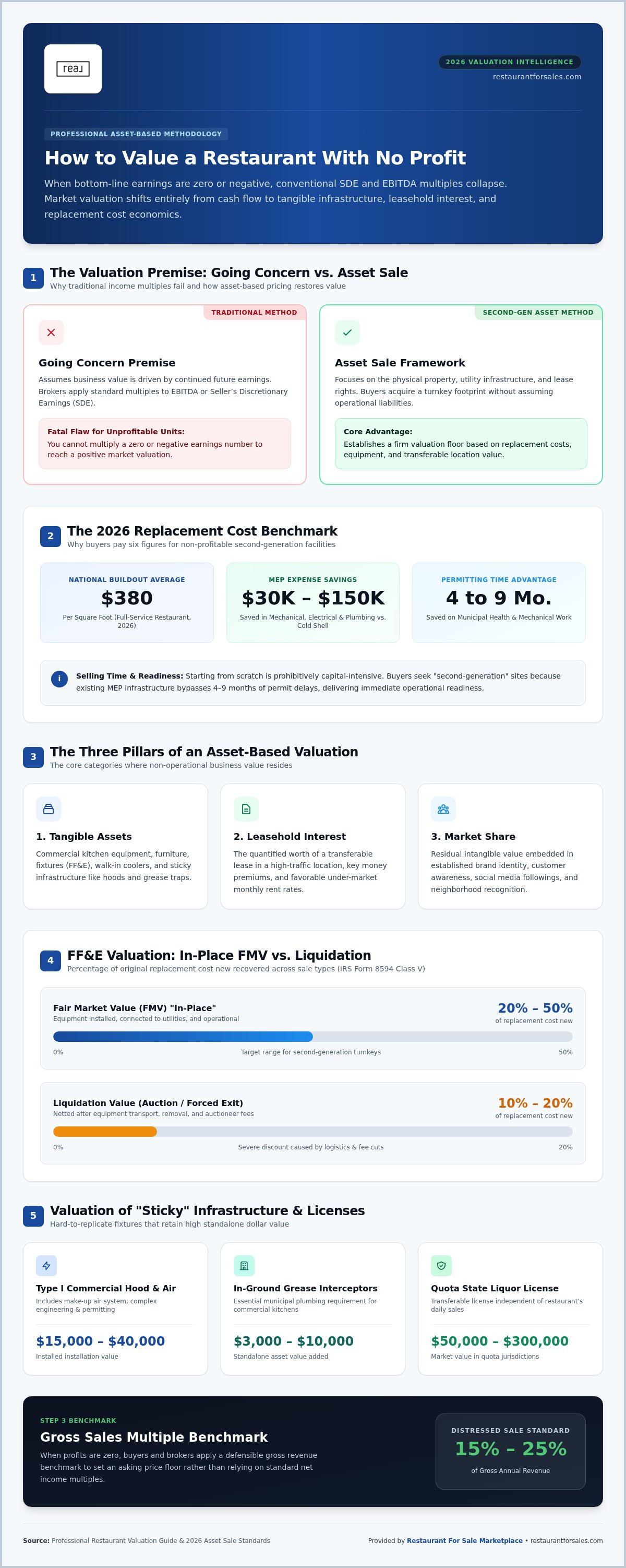
Building a new full-service restaurant in 2026 costs an average of $380 per square foot. This high barrier to entry means your "unprofitable" business might be worth six figures to a buyer just for the existing infrastructure. If you're staring at a tax return with negative numbers, it's natural to feel like your investment has vanished. You're likely worried about selling for less than the equipment is worth or losing the leverage of your prime lease. Understanding how to value a restaurant with no profit requires shifting your focus from cash flow to tangible and strategic assets.
We'll teach you the professional methods used to determine market value when the income statement doesn't help. You'll learn how to calculate an asset floor and apply the 15% to 25% gross revenue multiples typically seen in distressed sales. This guide previews the difference between an asset sale and a going-concern sale, providing the clarity you need to set a firm asking price. By the end, you'll have the data to negotiate confidently with brokers and buyers who see the potential in your second-generation space. We'll explore how to monetize your equipment, location, and buildout to ensure you don't leave money on the table.
Key Takeaways
- Transition from income-based metrics to asset-based valuations to identify the true market worth of a turnkey facility.
- Distinguish between Fair Market Value and Liquidation Value to ensure you don't undersell your kitchen equipment and infrastructure.
- Learn how to value a restaurant with no profit by quantifying leasehold interest and identifying potential key money premiums for prime locations.
- Apply current 2026 industry benchmarks for gross revenue multiples to establish a defensible asking price in a distressed sale.
- Prepare a strategic due diligence folder that highlights the replacement cost savings and permitting advantages of your second-generation space.
Defining the Framework: Asset Sale vs. Going Concern
Determining the market price for a business typically relies on the going concern accounting premise, which assumes the business will continue to generate earnings. For profitable entities, brokers use multiples of EBITDA or Seller’s Discretionary Earnings (SDE). However, when the bottom line is zero or negative, these traditional formulas fail. You can't multiply a negative number to reach a positive valuation.
This is why an Asset Sale becomes the primary framework. Instead of selling a stream of future income, you are selling the tangible and intangible components that make up the facility. In 2026, the value shifts from what the restaurant is making to what the physical assets are worth to a new operator. Understanding how to value a restaurant with no profit requires focusing on the three pillars of value:
- Tangible Assets: Commercial kitchen equipment, furniture, and fixtures (FF&E).
- Leasehold Interest: The value of a transferable lease in a high-traffic area, especially if the rent is below current market rates.
- Market Share: Intangible value found in established branding, social media followers, and local recognition.
When to Choose an Asset-Based Valuation
Asset-based valuations are the standard for distressed businesses in prime locations. Buyers in this category aren't usually looking to salvage your existing menu; they want your "second generation" space. This term refers to a site that already contains the necessary mechanical, electrical, and plumbing (MEP) infrastructure for food service. If you are trying to figure out how to value a restaurant with no profit, you must stop looking at the income statement and start looking at the replacement cost of your infrastructure.
Many buyers actively seek asset sales because they can acquire a turnkey footprint without assuming the previous owner's operational liabilities. This path is often cleaner for both parties, as it focuses strictly on the transfer of physical property and lease rights.
The Role of Replacement Cost in 2026
Replacement cost is a massive driver of value in today's market. With national average buildout costs for full-service restaurants reaching $380 per square foot in 2026, starting from scratch is prohibitively expensive for many entrepreneurs. A new buildout requires months of capital-intensive work, including installing Type I hoods, which can cost up to $40,000, and in-ground grease traps.
When you sell a turnkey setup, you're selling time. Municipal permitting for health and mechanical work now takes between 4 and 9 months in many markets. A buyer can save $30,000 to $150,000 in MEP expenses by choosing a second-generation site over a cold shell. This immediate operational readiness is a premium asset that justifies an asking price even when cash flow is absent.
Step 1: Calculating the Value of Furniture, Fixtures, and Equipment (FF&E)
Creating a detailed inventory is the first tactical step in understanding how to value a restaurant with no profit. You must list every item from the walk-in cooler to the POS terminals. In an asset sale, buyers look at Fair Market Value (FMV) "in-place," which typically ranges from 20% to 50% of the original replacement cost new. This is significantly higher than Liquidation Value, which often nets only 10% to 20% after accounting for transport and auction fees. For tax purposes, these items fall under Class V assets in IRS Form 8594 asset acquisition reporting. Proper classification ensures both buyer and seller remain compliant during the transaction.
Beyond moveable equipment, focus on "sticky" infrastructure. A Type I commercial hood and make-up air system can cost between $15,000 and $40,000 to install today. In-ground grease interceptors add another $3,000 to $10,000 in value. If you hold a transferable liquor license in a quota state, this single asset could be worth between $50,000 and $300,000, regardless of your restaurant's daily sales. If you're struggling to itemize these components, seeking restaurant valuation services can help establish a defensible floor price.
The "Big Three" Kitchen Assets
Ventilation hoods are the anchor of kitchen value. Because they require complex mechanical engineering and permitting, they represent a massive saving for a buyer. Refrigeration systems, specifically walk-in coolers and freezers, follow closely in importance. Finally, heavy cooking equipment like ranges and ovens are valued based on their age and maintenance logs. Clear service records can increase the appraised value of these machines by demonstrating longevity.
Inventory and Smallwares
Don't overlook the smaller details. Unopened food and beverage inventory should be valued at landed cost. Smallwares, including glassware, linens, and plateware, are usually bundled at a bulk discount. In 2026, high-tech additions like Kitchen Display Systems (KDS) and integrated POS hardware hold significant weight. These systems are often easier to transfer than older legacy software, making them attractive to modern operators.
Step 2: Assessing Leasehold Interest and Key Money
In many competitive markets, the lease itself is the most valuable asset you own. Leasehold interest represents the tangible financial benefit of holding a contract at a rate below current market prices. if your monthly rent is significantly lower than what a new tenant would pay for a similar shell next door, you possess a transferable asset. When determining how to value a restaurant with no profit, this rent spread can be capitalized to justify a higher asking price. It's a strategic advantage that savvy buyers will pay to acquire.
Key money is the premium a buyer pays to step into this position. It covers the right to the lease and the existing improvements. This process is often facilitated through restaurant lease assignments, where the buyer assumes your existing terms and renewal options. A lease with ten years of term remaining is far more valuable than one with only eighteen months. Long-term stability allows a buyer to amortize their investment over a decade, making the "ready-to-open" nature of your space even more attractive.
Location and Demographics
A "proven" location remains an asset regardless of your current net income. If your restaurant has high visibility and foot traffic but lacks profit, a buyer may conclude the concept was the issue rather than the geography. You are selling a tested footprint. Additionally, many older sites hold "grandfathered" permits for specific uses, such as sidewalk seating or grease trap configurations, that current zoning laws might otherwise restrict. These permits are tied to the location and add significant value to the deal.
The Premium of a "Ready-to-Open" Space
Speed to market is a primary motivator for modern buyers. Quantifying the value of existing plumbing, electrical, and HVAC systems is essential. These elements fall under the commercial trade fixtures classification, meaning they are tenant-owned improvements that can be transferred. In high-barrier-to-entry markets, where construction permits can take nine months to process, a "ready-to-open" space allows a buyer to begin generating revenue almost immediately. They don't have to endure the typical 4 to 9 month municipal permitting delay.
You should frame your asking price around the time and capital a buyer saves. By avoiding the construction phase, a buyer avoids thousands of dollars in carry costs like rent and insurance. This "soft cost" savings is a powerful tool when explaining how to value a restaurant with no profit to a skeptical prospect. It transforms a business failure into a strategic real estate opportunity.
Step 3: Benchmarking Against Gross Sales Multiples
While previous steps focused on physical assets and lease rights, gross revenue provides a vital indicator of market demand. Top-line sales prove that the location successfully attracts customers, even if the current bottom line is negative. When determining how to value a restaurant with no profit, buyers often look at revenue to gauge the "volume potential" of the facility. High sales suggest the concept is viable, but the failure likely stems from operational inefficiencies like high labor costs or poor portion control.
In the 2026 market, unprofitable or break-even restaurants typically trade at a benchmark of 15% to 25% of annual gross sales. This percentage rarely exceeds 30% unless the location is extraordinary or the buildout is nearly new. Using a revenue multiple allows you to capture the value of the customer base and the established market presence that an asset-only appraisal might miss. For a comprehensive breakdown of current market multiples, refer to our 2026 Restaurant Valuation Guide.
Applying these multiples correctly ensures you aren't leaving money on the table when selling a high-volume site. To ensure your calculations align with current national transaction data, you should get a professional restaurant valuation from an expert who understands the nuances of distressed sales.
Proof of Concept via Top-Line Revenue
High gross sales are a powerful selling point. They demonstrate to a buyer that the kitchen can handle significant volume and that the neighborhood supports the business. You should highlight loyal customer databases, email lists, and social media following as part of this value. A buyer sees "low hanging fruit" in these numbers; they believe they can apply better management practices to convert that existing traffic into profit immediately.
Adjusting the Multiple for Risk
The specific multiple you apply within the 15% to 25% range depends on risk factors. You'll likely land on the lower end if the restaurant has a poor online reputation or unsustainable labor costs. Conversely, you can argue for the higher end if sales are growing or if you have excellent reviews that a new owner can leverage. Using "Pro Forma" projections is helpful here to show a buyer what the business could realistically achieve under new, more efficient management. This shift in perspective moves the conversation from past losses to future opportunity.
Packaging the Sale: Turning Assets into an Opportunity
Presentation is a critical factor when selling a business that lacks positive cash flow. While the financial statements might not impress, the physical condition of the facility must instill confidence. A clean, organized kitchen suggests that the equipment has been well-maintained, which protects its Fair Market Value. Understanding how to value a restaurant with no profit involves more than just spreadsheets; it requires showing a buyer that the "bones" of the operation are solid. You should compile a comprehensive due diligence folder that includes health department permits, recent hood cleaning certificates, grease trap maintenance logs, and a clear copy of the lease agreement. This transparency reduces perceived risk and speeds up the closing process.
Finding the right buyer for an asset sale requires a targeted approach. A professional restaurant broker specializes in identifying "concept conversion" buyers. These are often experienced operators or expanding brands looking for a specific footprint rather than a specific menu. They value the speed of a turnkey takeover and the existing infrastructure over your past sales performance. By focusing your marketing on the facility's potential, you move the conversation away from your P&L and toward the buyer's future success.
Highlighting the "Turnkey" Advantage
Your listing description should emphasize the "Second Generation" benefits of the space. Explicitly compare your asking price to the national average buildout cost of $380 per square foot. If a buyer can acquire your 2,000-square-foot restaurant for $150,000, they are saving hundreds of thousands in construction costs and nearly a year in permitting delays. The ideal buyer is often an entrepreneur who has the capital to build but lacks the patience for a nine-month municipal approval process. Framing the sale as a "speed to market" opportunity justifies a premium price that liquidation values can't reach.
Negotiating the Deal
Expect some buyers to attempt lowball offers based on liquidation prices. You must hold your ground by using the replacement cost argument developed in previous sections. Remind the prospect that while used equipment has a market floor, the cost of the "installed" infrastructure, including plumbing, gas lines, and venting, is far higher. How to value a restaurant with no profit effectively depends on your ability to defend these soft costs. Deal structures for asset sales are typically cash-heavy at closing, though offering a small percentage of seller financing can sometimes help a buyer bridge the gap if they are converting the concept and need to preserve their own capital for rebranding.
Maximizing Your Exit Value
Selling an unprofitable business doesn't mean walking away empty-handed. By focusing on the replacement cost of your infrastructure and the strategic value of your lease, you can secure a defensible market price. We've detailed how tangible assets and "ready-to-open" status provide massive capital savings for buyers in 2026. Understanding how to value a restaurant with no profit is the difference between a total loss and a successful asset transfer.
You don't have to guess your asking price. Our professional restaurant valuation services provide the data needed to negotiate with confidence. We leverage success-based brokerage commissions and a national network of qualified buyers to ensure your goals align with market reality. Whether you possess a prime location or a specialized kitchen footprint, your investment still holds significant potential for the right operator.
Get a Professional Valuation for Your Restaurant Today and take the first step toward a clean, professional exit. Your hard work has created a turnkey opportunity that is ready for its next chapter.
Frequently Asked Questions
Is a restaurant with no profit worth anything?
Yes, a restaurant with no profit is absolutely worth something because of its tangible assets and infrastructure. Buyers often pay for the "second generation" status of the space, which includes expensive mechanical, electrical, and plumbing work already in place. In 2026, building a new facility costs an average of $380 per square foot. By purchasing your assets, a buyer avoids these high construction costs and months of permitting delays.
What is the most valuable asset in a non-profitable restaurant?
The most valuable asset is typically the "sticky" infrastructure, such as the Type I hood system and in-ground grease traps. These components are essential for operation and expensive to install from scratch. Additionally, a transferable lease in a high-traffic area holds significant value. If you hold a full liquor license in a quota state, that license may even be the single most expensive asset you own, regardless of your current monthly losses.
How do you calculate the value of a restaurant lease?
You calculate lease value by comparing your current rent to the current market rate for similar spaces. This difference, known as the rent spread, represents a direct saving for the buyer. You also need to factor in the remaining term and renewal options. A lease with ten years of stability is more valuable than one nearing expiration. This calculation is a core part of how to value a restaurant with no profit.
What is the average revenue multiple for an asset sale?
The current 2026 industry standard for an asset sale is typically between 15% and 25% of annual gross sales. While profitable businesses trade at higher multiples of cash flow, unprofitable ones rely on this revenue benchmark to prove concept viability. This multiple rarely exceeds 30% unless the location is exceptional. Using this range helps you establish a realistic asking price that reflects the volume potential of the kitchen without relying on nonexistent net income.
Can I sell my restaurant if I am losing money every month?
You can certainly sell a restaurant that is losing money. These transactions are structured as asset sales rather than going-concern sales. The buyer isn't purchasing your financial losses; they are purchasing the opportunity to open a new concept in a turnkey facility. This approach is common for owners who have a great location but an ineffective menu or high labor costs. It's a strategic way to exit the market while recouping your initial investment.
What is the difference between liquidation value and fair market value?
Fair market value represents the price a buyer pays for equipment that remains "in-place" for continued use. This usually ranges from 20% to 50% of the original cost. Liquidation value is the much lower price fetched at a forced auction after equipment is removed. Auction prices often net only 10% to 20% of the original cost. Understanding this difference is essential when learning how to value a restaurant with no profit to avoid underselling your assets.
Should I hire a broker to sell an unprofitable restaurant?
Hiring a professional broker is highly recommended for asset sales. Brokers have access to a national network of "conversion" buyers who specifically look for second-generation spaces. They also manage the complex process of restaurant lease assignments and landlord negotiations. Because these deals often involve all-cash buyers or seller financing, having an expert facilitator ensures the transaction stays on track. A broker helps you find buyers who value your footprint more than your current P&L.
How long does it take to sell a restaurant as an asset sale?
Based on 2026 market data, the median time to sell a food and beverage business ranges between 168 and 180 days. This period covers the time from the initial listing to the final closing. Asset sales can sometimes move faster if the buyer is an experienced operator ready to convert the space immediately. However, you should plan for approximately six months to find the right buyer, complete due diligence, and secure landlord approval for the lease transfer.


