

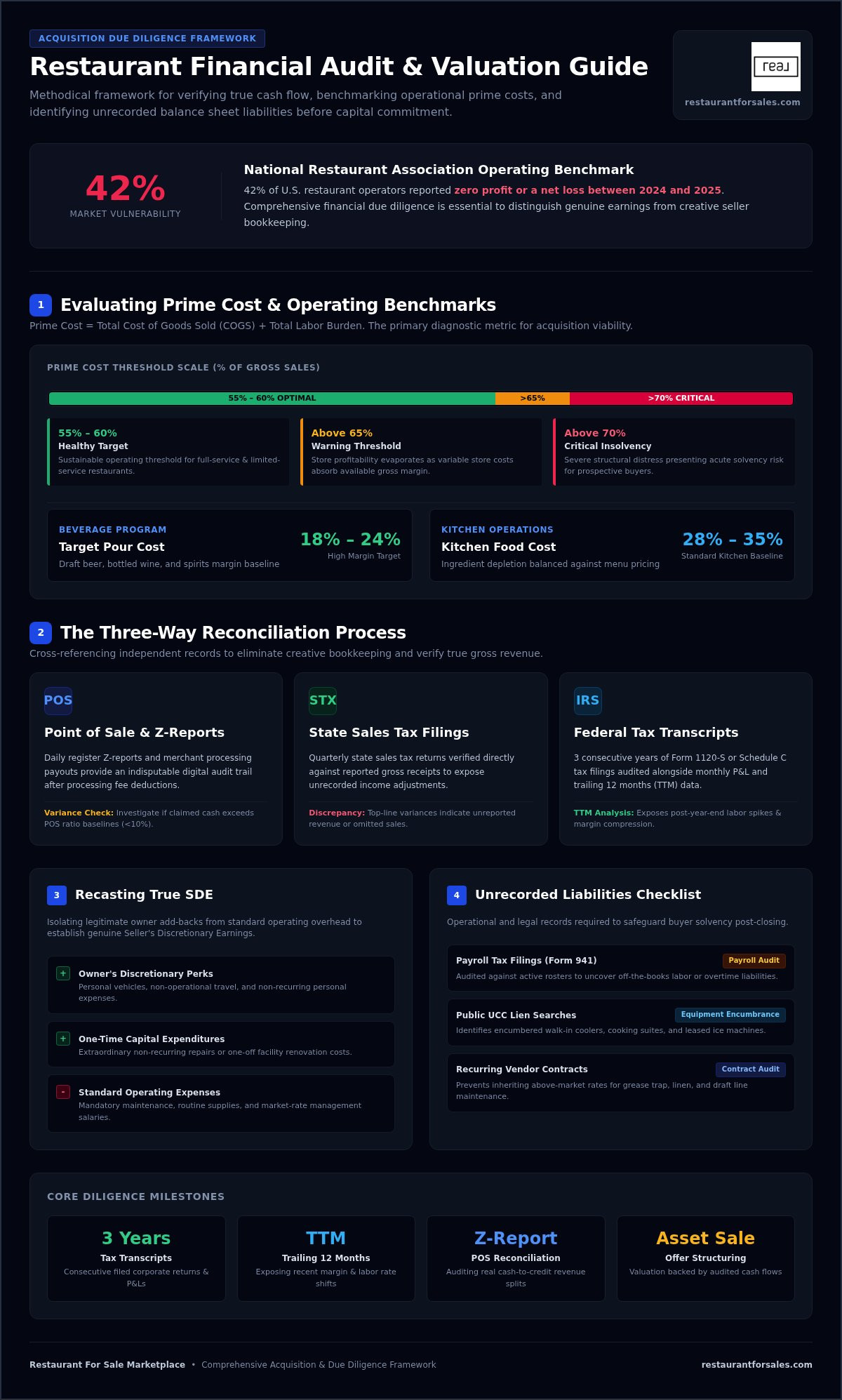
According to the National Restaurant Association, 42% of U.S. restaurant operators reported zero profit or a net loss between 2024 and 2025. That sobering metric explains why analyzing restaurant financials before buying is the most critical phase of your acquisition journey. When you evaluate an operating food and beverage business, you likely worry about inheriting manipulated accounting records, inflated owner perks, or point-of-sale figures that fail to match filed federal tax returns. You aren't alone; untangling genuine operational earnings from creative seller bookkeeping is where most prospective buyers lose their footing.
This due diligence guide shows you how to audit financial statements, verify true cash flow, and identify hidden balance sheet liabilities before you commit capital. You'll learn how to accurately calculate Seller's Discretionary Earnings, benchmark prime costs against verified industry norms, and reconcile daily point-of-sale summaries with official tax transcripts. What follows is a methodical framework to help you uncover operational vulnerabilities, assess commercial lease risks, and structure an acquisition offer reflecting audited cash flow rather than an arbitrary asking price.
Key Takeaways
- Master the three-way reconciliation process by cross-referencing Point of Sale reports, sales tax filings, and IRS business tax transcripts.
- Establish true operating margins by benchmarking food, beverage, and labor prime costs against sustainable operational thresholds.
- Recast financial statements to isolate legitimate discretionary add-backs from standard operating expenses when calculating true Seller's Discretionary Earnings.
- Protect your investment when analyzing restaurant financials before buying by identifying unrecorded liabilities, gift card float, and deceptive revenue trends.
- Translate audited cash flows into a defensive asset purchase structure and valuation multiple supported by historical operational data.
The Due Diligence Checklist: Core Financial Records Every Buyer Must Review
A successful acquisition requires an unvarnished view of operational cash flow. When analyzing restaurant financials before buying, relying solely on seller-prepared summaries leaves you vulnerable to hidden shortfalls. You must demand at least three consecutive years of filed federal business tax returns alongside monthly profit and loss statements. Comparing monthly breakdowns exposes seasonal dips, sudden margin compression, and mid-year inventory adjustments. To understand how these accounting audits align with purchase milestones, consult our guide on how to buy a restaurant in 2026.
Primary Tax and Accounting Statements
Never rely on internal bookkeeping alone. Compare Schedule C or Form 1120-S corporate tax filings directly against internal profit-and-loss reports to verify top-line revenue consistency. Cross-reference quarterly state sales tax returns against reported gross receipts; any discrepancy between sales tax filings and reported gross revenue points directly to unrecorded adjustments or omitted income. Additionally, scrutinize the trailing twelve months (TTM) of operating data to identify immediate margin erosion or labor spikes that occurred after the most recent fiscal year-end.
Operational Records and Point-of-Sale Audit Files
POS systems generate an indisputable digital audit trail. Request daily register Z-reports to audit cash-to-credit transaction ratios. If a seller claims cash sales represent 25% of gross receipts, yet industry baselines and POS transaction counts reflect under 10%, that variance demands immediate investigation. Next, examine merchant processing statements to verify net payouts after credit card processing charges and chargebacks are deducted. Pair this analysis with recent broadline supplier invoices to evaluate unpaid vendor balances and measure ongoing ingredient price inflation.
Equipment Leases, Payroll Summaries, and Vendor Contracts
Unrecorded operational obligations can severely compromise buyer solvency post-closing. Comprehensive due diligence involves auditing the following operational records:
- Payroll tax returns (Form 941): Audit federal quarterly filings against active employee rosters to expose off-the-books labor or unreported overtime liabilities.
- UCC lien searches: Inspect public lien filings and commercial equipment leases to identify encumbered walk-in coolers, cooking suites, or ice machines.
- Vendor service contracts: Review recurring agreements for grease trap maintenance, linen supply, and draft line servicing to prevent inheriting above-market rates.
Mastering this document audit is fundamental when analyzing restaurant financials before buying. Thorough verification ensures your baseline earnings reflect actual operating realities rather than aspirational bookkeeping.
Evaluating Restaurant Operating Metrics: Prime Cost and Expense Benchmarks
Top-line revenue figures mean very little if variable store costs consume all available margin. When analyzing restaurant financials before buying, prime cost serves as the single most critical diagnostic metric. Prime cost combines total cost of goods sold (COGS) with your total labor burden. In a healthy full-service or limited-service restaurant, combined prime costs should range between 55% and 60% of gross sales. Once this combined figure crosses 65%, store profitability evaporates; prime costs above 70% represent an operation facing critical insolvency risk.
Deconstructing Total Cost of Goods Sold
Total COGS must be split into dedicated product categories rather than lumped together. Separate food expenses from draft beer, bottled wine, and spirits. High-margin beverage programs should carry pour costs between 18% and 24%, balancing out kitchen food costs that often range from 28% to 35%. Calculate waste shrinkage by checking supplier deliveries against POS depletion numbers. If vendor invoices reflect steep meat or dairy price increases that weren't matched with menu price updates, food margins will show sharp, unrecovered compression.
Analyzing Total Labor Burden and Staffing Efficiency
Labor expenditures require scrutiny far beyond base hourly payroll rates. Effective audits consolidate front-of-house wages, back-of-house kitchen prep, overtime, payroll taxes, workers' compensation insurance, and employee benefits:
- Direct payroll split: Separate fixed general manager salaries from variable hourly kitchen and floor staff.
- Operational thresholds: Profitable full-service operators maintain median labor costs near 34.2% of sales, while loss-making units often average 42.9%.
- Productivity metrics: Evaluate sales per labor hour (SPLH) across shift dayparts to determine whether overstaffing plagues slow afternoon prep shifts.
Occupancy, Utility, and Fixed Overhead Benchmarks
Fixed real estate obligations must remain strictly proportionate to sales volume. Total occupancy costs, which include base lease rates, property insurance, real estate taxes, and common area maintenance (CAM), should ideally sit between 6% and 8% of gross revenue, with 10% serving as the absolute upper ceiling. Compare utility bills across seasonal extremes to identify mechanical inefficiencies in walk-in compressors or HVAC systems. Heavy repair line items often signal aging refrigeration units nearing the end of their operational lifecycle. To establish accurate earnings adjustments across these categories, utilizing professional restaurant valuation services provides verified clarity before you submit an asset purchase offer.
Recast Financials for True Seller's Discretionary Earnings
Tax minimization is the primary goal of most independent restaurant owners, not showing high net income. As a result, bottom-line book profit rarely reflects what a buyer actually takes home. When analyzing restaurant financials before buying, you must recast the company's operating statements to calculate Seller's Discretionary Earnings (SDE). Start with the net operating income reported on the most recent federal tax return. From there, restore non-operating charges, documented owner compensation, and legitimate personal perks run through the corporate account. For a detailed breakdown of how baseline cash flow translates into purchase multiples, review our 2026 restaurant valuation guide.
Legitimate vs. Disallowed Add-Back Categories
Lenders scrutinize every line item. Under SBA underwriting rules, debt service coverage cannot rely on unsubstantiated personal adjustments. Legitimate add-backs include non-cash depreciation, amortization, commercial interest expenses from the seller's liabilities, one active owner's salary, and discretionary personal expenses like cellular plans or personal vehicle leases. Conversely, underwriters reject routine capital maintenance disguised as one-time repairs, such as standard kitchen hood cleanings or regular grease trap pumping.
To recast earnings accurately, categorize adjustments into three distinct operational buckets:
- Owner compensation: Add back the primary operator's W-2 wages, personal health insurance premiums, and documented discretionary distributions.
- Non-cash and financial expenses: Restore physical equipment depreciation, intangible asset amortization, and previous bank interest payments.
- Non-recurring items: Add back isolated professional expenses, such as initial trademark registrations or historical legal settlements that won't recur.
Adjusting for Owner-Operator Labor Replacement
A major flaw in naive financial reviews is ignoring unpaid operational labor. If the business lists $150,000 in SDE, but the seller works 60 hours weekly as head chef and general manager, that cash flow is heavily distorted. Passive buyers must deduct the market-rate salary required to hire a replacement manager, often $65,000 to $80,000 plus payroll taxes. Similarly, if family members handle front-of-house hosting or bookkeeping without recorded W-2 wages, their fair-market compensation must be deducted directly from adjusted earnings.
Normalizing Extraordinary and One-Time Expenses
Clean earnings reflect predictable future operations. Strip out short-term anomalies like catastrophic equipment losses covered by insurance or one-off exterior signage overhauls. Recalculate utility overhead if abnormal regional grid surcharges inflated previous trailing bills. Finally, ensure food and beverage baselines use current, sustainable supplier pricing rather than expired distributor discounts. Accurately analyzing restaurant financials before buying ensures you only pay for repeatable, documented cash flow.
Financial Red Flags: Spotting Cash Discrepancies and Unrecorded Liabilities
Sellers often attempt to justify higher asking prices by promising unrecorded cash revenue or downplaying operational obligations. When analyzing restaurant financials before buying, you must treat unsubstantiated verbal claims as operational non-events. Lenders provide zero debt financing for off-the-books revenue. Validating true earning potential requires cross-referencing Point of Sale (POS) audit archives with filed federal transcripts, stripping out unrecorded risks before drafting an asset purchase agreement.
The Unreported Cash Trap and Bank Deposit Reconciliation
Modern card and mobile wallet usage accounts for up to 90% of restaurant transactions. If an owner claims substantial "pocket cash" profits, conduct a strict three-way reconciliation across 36 months of data:
- POS master registers: Compare daily net cash receipts directly against bank teller deposit slips.
- Tax transcripts: Match Form 1099-K payment card totals against gross receipts reported on filed federal returns.
- Audit exposure: Recognize that endorsing off-the-books revenue exposes you to severe state sales tax audits and civil tax fraud liabilities.
Any persistent shortfall between register cash tallies and documented bank deposits points to skimmed funds or unrecorded transactions that cannot be financed or valued.
Hidden Balance Sheet Liabilities and Working Capital Deficits
Operating balance sheets frequently obscure debt obligations that threaten incoming cash flow. Review the restaurant's aging accounts payable to verify that vendor balances with food distributors or linen providers aren't severely past due. Outstanding customer gift cards represent another critical liability; the seller pocketed the upfront cash, yet you must provide the future food and labor without payment. Insist on a dollar-for-dollar purchase price reduction or escrow holdback for active gift card float. Additionally, audit state payroll tax records and historical tip-pooling practices to ensure the business faces no pending wage-and-hour compliance penalties.
Distorted Margins from Deferred Maintenance and Skimped Repairs
Artificially low maintenance expenses often indicate neglected infrastructure rather than exceptional operational efficiency. Look for these deferred maintenance indicators:
- Omitted service logs: Check maintenance histories for HVAC systems, kitchen exhaust hoods, and grease traps.
- Refrigeration life cycles: Missing repair entries on aging walk-in coolers often precede catastrophic compressor failure.
- Municipal compliance: Review pending fire suppression certifications and municipal health department records for mandatory facility upgrades.
Analyzing restaurant financials before buying protects you from inheriting sudden capital expenditures. If you suspect accounting irregularities or undocumented liabilities in a target acquisition, consult professional restaurant brokerage services to verify seller representations before executing purchase agreements.
Translating Financial Diligence into Deal Structure, Valuation, and Closing
Audit findings must directly shape your purchase contract rather than remaining theoretical notes. When analyzing restaurant financials before buying, the verified numbers dictate your valuation multiple, escrow reserves, and financing structure. Always structure the acquisition as an asset purchase agreement rather than a stock purchase. An asset acquisition allows you to acquire selected kitchen equipment, inventory, and intangible assets while leaving unrecorded historical tax liabilities, supplier disputes, and wage claims with the seller's legal entity.
Applying Industry Valuation Multiples to Audited Earnings
Independent owner-operated restaurants typically transact between 1.5x and 3.0x verified Seller's Discretionary Earnings (SDE). Concepts heavily reliant on an owner's personal recipes or floor presence sit at the lower end (1.5x to 2.0x). Systematized models with experienced management in place command upper-tier multiples (2.5x to 3.0x). Additionally, your purchase price must preserve adequate operating cash flow to satisfy commercial lending standards; SBA underwriters require a minimum Debt Service Coverage Ratio (DSCR) of 1.25:1 based strictly on historical, adjusted earnings.
Structuring Protections: Escrows, Holdbacks, and Seller Notes
Insulate your working capital against post-closing surprises by embedding specific financial protections into the asset purchase agreement:
- Indemnification escrow holdback: Place 10% to 15% of the purchase price into third-party escrow for 90 to 180 days to absorb unbilled utility statements, disputed vendor balances, or omitted tax assessments.
- Subordinated seller financing: Structure a portion of the purchase price through a seller note containing right-of-offset provisions if financial representations prove materially false post-sale.
- Closing physical inventory audit: Conduct a joint stock count on the immediate eve of closing, pricing usable food and unopened alcoholic beverages at documented invoice cost rather than estimated retail value.
Securing Landlord and Broker Support for Seamless Transfer
A purchase agreement remains meaningless without commercial lease approval. Commercial landlords review your net worth, liquidity, and operational experience just as rigorously as commercial lenders do. Learn the requirements for managing restaurant lease assignments early in your timeline so your lease term matches or exceeds your acquisition debt amortization schedule. Navigating audit discrepancies, landlord screening, and closing escrows demands experienced transaction advisory. Connect with a professional restaurant broker to analyze active acquisition listings and secure comprehensive representation throughout your due diligence process.
Move from Financial Diligence to a Protected Acquisition
Thorough due diligence transforms high-stakes uncertainty into an actionable negotiation strategy. Successfully analyzing restaurant financials before buying requires looking past tax-minimized statements to verify actual cash flow through official tax transcripts, benchmark prime costs against sustainable industry standards, and expose unrecorded liabilities before drafting your purchase contract.
Applying these audit principles protects your upfront capital and ensures you negotiate purchase terms grounded in operational reality. A defensive asset purchase structure, reinforced by indemnification escrows, right-of-offset provisions, and manageable commercial lease assignments, turns financial diligence into long-term business stability.
Navigating financial recasting and landlord lease screenings doesn't have to be overwhelming with experienced transaction support. Backed by specialized national brokerage experience and proprietary valuation methods benchmarked against verified sales data, our team provides comprehensive guidance from initial statement reviews to the closing table. Explore vetted restaurant acquisition opportunities and advisory services to evaluate your next business acquisition with complete clarity and confidence.
Frequently Asked Questions
How many years of financial statements should I review before buying a restaurant?
You should review a minimum of three consecutive years of filed business tax returns and monthly profit and loss statements, alongside the trailing twelve months. This multi-year window reveals revenue patterns, seasonality, and long-term cost trends while smoothing out anomalous quarters. Analyzing restaurant financials before buying over a three-year timeline also satisfies standard SBA loan underwriting criteria and confirms whether recent store performance reflects genuine stability or a temporary spike.
What is Seller's Discretionary Earnings (SDE) and how does it differ from EBITDA?
SDE measures the total financial benefit available to a single full-time owner-operator, whereas EBITDA measures operating profitability independent of owner compensation and capital structure. SDE adds back the primary owner's salary, discretionary perks, interest, depreciation, and non-recurring expenses to net profit. EBITDA excludes owner wage add-backs because it assumes professional management is already in place, making it the preferred metric for multi-unit groups and institutional acquisitions.
What should I do if a restaurant seller claims significant unrecorded cash income?
Disregard unrecorded cash claims completely during valuation and deal pricing negotiations. Commercial lenders assign zero borrowing capacity to undocumented revenues, and you can't verify the legitimacy of cash that never touches bank accounts. Paying for unrecorded cash forces you to overpay on an inflated multiple while potentially exposing you to inherited civil tax fraud liabilities. Insist that purchase offers reflect only documented bank deposits and filed tax transcripts.
What is a healthy prime cost percentage for an independent restaurant?
A healthy prime cost benchmark sits between 55% and 60% of gross sales for both quick-service and full-service dining concepts. Prime cost combines total cost of goods sold with complete labor expenditures, including hourly wages, taxes, and worker benefits. If this figure climbs past 65%, your operating margins become razor-thin. While analyzing restaurant financials before buying, verify that food costs don't exceed 35% and labor stays under 35% to ensure sustainable cash flow.
Can I assume historical tax liabilities if I complete an asset purchase?
An asset purchase generally shields you from the seller's past corporate debts, but specific state successor liability statutes can still transfer unpaid sales and payroll taxes. Even in an asset transaction, state tax authorities may hold the buyer accountable if the seller leaves substantial unpaid sales tax obligations behind. You can protect yourself by requiring formal state tax clearance certificates, running comprehensive lien searches, and holding closing funds in escrow until taxing agencies issue final releases.
How do commercial landlords evaluate a buyer's financials during a lease transfer?
Commercial landlords evaluate a prospective buyer's liquidity, tangible net worth, credit history, and relevant operating experience before approving a lease assignment. Most property managers require personal financial statements showing unencumbered liquid reserves equal to at least six to twelve months of rent and operating expenses. Landlords also examine your business plan and personal credit score to confirm you can comfortably service lease obligations throughout the remaining term without defaulting.
Why is an SBA lender's financial review beneficial for a prospective restaurant buyer?
An SBA lender functions as an objective, third-party underwriting barrier that independently validates the acquisition's financial viability. SBA lenders enforce rigorous historical debt service coverage requirements, pulling official transcripts directly via IRS Form 4506-C and rejecting unverified seller add-backs. If an SBA underwriter refuses to finance a restaurant because historical cash flow cannot service the debt, it provides an invaluable early warning that the business is overpriced or structurally unprofitable.


