

What if the most valuable asset in your restaurant isn't your high-end kitchen equipment or your secret menu, but a single paragraph buried on page forty of your rental contract? Many entrepreneurs treat their lease as a static monthly expense, yet it's actually the foundation of your business's resale value. You've likely worried about hidden costs in CAM charges or restrictive "Use Clauses" that could limit your ability to adapt your menu. It's a common concern because a poorly negotiated contract can prevent you from ever selling your business to a future buyer.
We're here to ensure your lease supports growth rather than stifling it. This guide will help you master the 10 key clauses in a restaurant lease agreement to protect your investment and secure a profitable exit strategy. By understanding these critical legal and financial protections, you'll gain the confidence to negotiate for predictable expenses and robust assignment rights. We'll walk through the essential provisions every operator needs to understand for a successful 2026 operation, turning your lease into a strategic tool for long-term wealth and stability.
Key Takeaways
- Learn why your lease is a transferable asset that directly impacts your business valuation and Seller's Discretionary Earnings (SDE).
- Understand how to navigate the financial complexities of NNN structures and percentage rent to ensure predictable monthly expenses in 2026.
- Discover the key clauses in a restaurant lease agreement that protect your future exit, specifically focusing on assignment and assumption rights.
- Identify "deal-killer" clauses through a professional lease audit to prevent restrictive use terms from limiting your operational growth.
- Leverage the expertise of a restaurant broker to bridge the gap between landlord demands and your long-term financial goals.
Why Your Restaurant Lease is a Strategic Business Asset
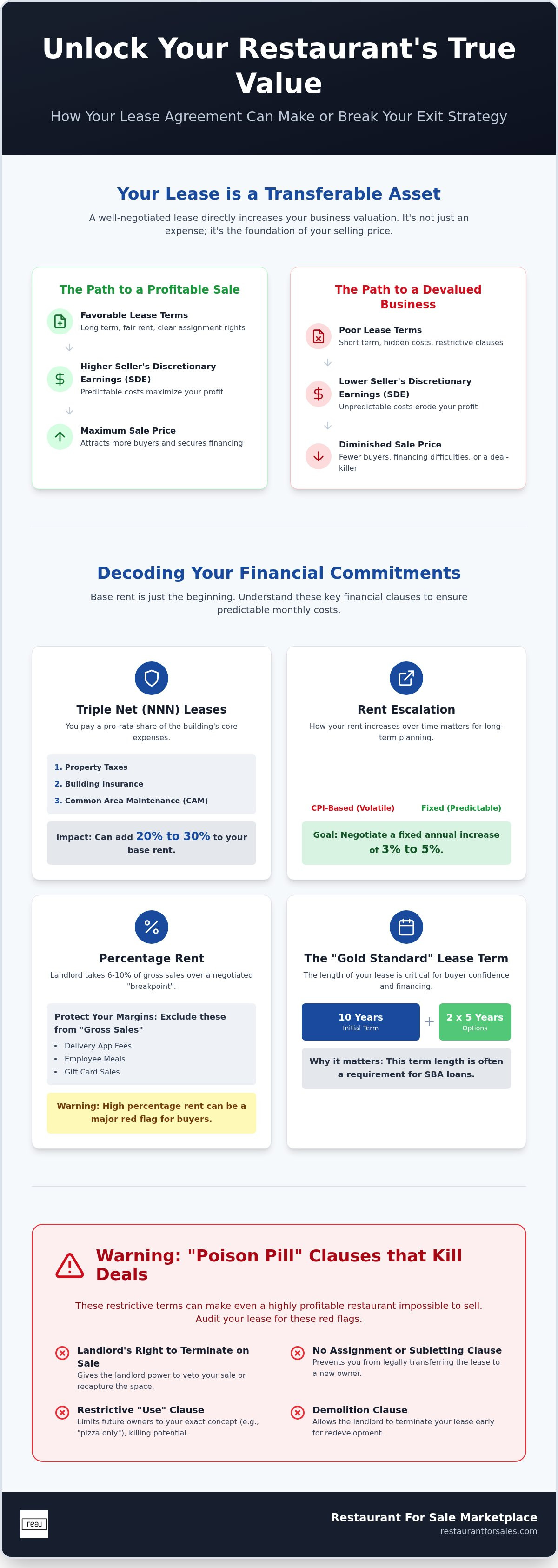
A restaurant lease is far more than a monthly expense. It's the legal foundation of your entire enterprise. Unlike a standard office or retail agreement, a restaurant lease acts as a hybrid between a real estate contract and an operational license. It dictates not just where you work, but how you cook, what you sell, and ultimately, how much your business is worth when you decide to exit. In the high-stakes world of commercial transactions, your lease is a transferable asset that can either facilitate a smooth sale or act as a total deal-killer.
Your lease terms directly influence your Seller's Discretionary Earnings (SDE). In the current 2026 market, every dollar committed to rent or unmanaged Common Area Maintenance (CAM) fees is a dollar removed from your bottom line. Because business buyers apply a multiple to your SDE to determine price, a poorly negotiated lease can shave hundreds of thousands of dollars off your final sales price. Identifying the key clauses in a restaurant lease agreement early on ensures that your overhead remains predictable and your profit margins stay attractive to future investors.
The 2026 landscape requires a delicate balance between long-term security and operational flexibility. You need enough time on the lease to satisfy lenders, but you also need the ability to pivot your concept if market trends shift. A "poison pill" clause, such as a landlord's right to terminate upon a sale or an unreasonable "Use Clause," can make even a highly profitable restaurant impossible to sell. We see this often where a business is thriving, but the underlying contract prevents a transfer of ownership.
The Difference Between Retail and Restaurant Leases
Standard retail leases don't account for the heavy infrastructure required for food service. A true restaurant lease must address specific technical needs like grease trap maintenance, high-capacity gas lines, and specialized roof venting. Zoning and health department compliance aren't just operational hurdles; they must be prerequisites within the lease itself. If the building's infrastructure can't support your equipment or meet 2026 health codes, your lease becomes a liability. You must ensure the document explicitly allows for the heavy utility loads and environmental impacts inherent in food production.
Lease Terms and Your Exit Strategy
When it comes to resale, a 10-year lease with multiple five-year options remains the gold standard. This longevity provides the stability buyers crave and is often a requirement for securing SBA loans, which typically require the lease term to match the loan duration. The amount of time remaining on your agreement is a primary factor in a professional restaurant valuation. Without at least 10 years of secured term, including options, you'll likely find that potential buyers cannot secure the financing needed to complete the transaction, significantly shrinking your pool of qualified prospects.
Financial Clauses: Beyond the Base Rent
Base rent is rarely the final cost of occupancy. In most modern agreements, the advertised price is just the starting point. Understanding the financial key clauses in a restaurant lease agreement is vital for maintaining cash flow. Most restaurant spaces operate under a Triple Net (NNN) structure. This means you are responsible for your pro-rata share of property taxes, building insurance, and common area maintenance (CAM). In 2026, the national median rent for restaurants ranges from $35 to $45 per square foot NNN, but your total monthly outlay could be 20% to 30% higher once these nets are added.
Rent escalation is another critical factor. Landlords often propose annual increases tied to the Consumer Price Index (CPI). While this might seem fair, CPI can be volatile. Negotiating a fixed annual increase, typically between 3% and 5%, provides the predictability you need for long-term budgeting. If you are unsure how these costs impact your bottom line, consulting a professional brokerage team can help you benchmark these expenses against industry standards.
Understanding Percentage Rent in 2026
Percentage rent allows landlords to share in your success, typically ranging from 6% to 10% of gross sales once you exceed a "breakpoint." The breakpoint is the specific sales volume where this additional rent kicks in. While common, you must negotiate strict exclusions to protect your margins. In a 2026 operational environment, you should exclude delivery app fees, employee meals, and gift card sales from your gross sales calculation. High percentage rent requirements can be a major red flag for future buyers. They essentially act as a permanent tax on growth and can significantly lower your business's resale value.
CAM Charges and Audit Rights
Common Area Maintenance fees cover shared expenses like parking lot lighting, landscaping, and security. For retail centers, these typically run between $2 and $9 per square foot. You must ensure that capital improvements, such as a full roof replacement or the landlord's personal legal fees, are excluded from your CAM bill. Negotiating a 3% to 5% cap on annual increases for controllable CAM charges prevents unexpected spikes in your overhead.
Always include a formal audit right in your contract. Industry data indicates that tenants are overcharged on CAM expenses by an average of 11.4%. Having the right to verify these costs ensures transparency. For new developments, consider negotiating a Base Year for the first 24 months. This stabilizes your costs while the property reaches full occupancy, preventing you from subsidizing the landlord's vacant units.
Operational and Exit Clauses: Protecting Your Future Sale
While financial terms dictate your monthly overhead, operational and exit provisions determine your terminal value. These key clauses in a restaurant lease agreement act as the exit door for your investment. If these clauses are overly restrictive, you may find yourself owning a profitable business that is legally impossible to sell. Protecting your ability to transfer the lease is just as important as negotiating the rent. You must ensure that the contract treats the lease as a transferable asset rather than a personal service agreement between you and the landlord.
Beyond the transfer itself, you must watch for the "Recapture Clause." This is a hidden trap that allows a landlord to terminate the lease and take back the space the moment you request an assignment. This effectively kills your business sale before it starts. Similarly, personal guarantees should not be permanent. Negotiate a "burn-down" provision where the guarantee expires after a set period of timely payments, or ensure a mandatory release of the guarantor once a qualified buyer assumes the lease. Without these protections, you could remain financially liable for a business you no longer own.
The Assignment Clause: Your Key to Selling
A restaurant lease assignment is the specific provision that allows you to hand over the keys to a new operator. It's your number one priority for a future exit. You must ensure the landlord's consent can be "not unreasonably withheld, conditioned, or delayed." This prevents the landlord from blocking a sale based on personal whim or using the transfer as leverage to hike the rent for the new buyer.
Watch out for "Profit Sharing" or "Bonus Value" clauses. Some landlords include language that entitles them to a percentage of your business sale price in exchange for approving the assignment. This is a direct hit to your retirement or next investment. Your goal is a clean transfer where the original tenant is fully released from future liability, allowing you to walk away from the transaction with your proceeds intact and your obligations settled.
Use Clauses and Exclusivity
The "Use Clause" defines what you are allowed to do in the space. You should always push for a "Broad Use" clause, such as "any lawful restaurant use," rather than a "Narrow Use" clause like "only a vegan taco shop." Markets change, and a buyer might want to convert your taco shop into a burger concept. If the lease is too specific, you'll have to go back to the landlord for permission, which often comes with a price tag.
Exclusivity is the flip side of the use clause. You need an "Exclusive Use" provision to prevent the landlord from leasing the unit next door to a direct competitor. If you run a pizza shop, you don't want a national pizza chain moving into the same plaza six months later. Exclusive Use protects the restaurant's market share. In the 2026 market, where consumer spending is highly targeted, this protection is the difference between a thriving location and a failing one.
How to Negotiate Key Clauses: A Step-by-Step Guide
Negotiating a commercial contract requires a methodical approach. You don't just sign what is handed to you; you build a framework that protects your capital. The process begins with a rigorous "Lease Audit" using a negotiation checklist to identify potential pitfalls. Once you've identified the risks, categorize them into "Must-Haves" and "Nice-to-Haves." For example, a robust assignment clause is a non-negotiable "Must-Have" if you ever plan to sell your business. You must prioritize these key clauses in a restaurant lease agreement to ensure your long-term interests are secured before the first dollar of rent is paid.
Phase 1: The Letter of Intent (LOI)
The LOI is your most powerful leverage point. This is the stage where you negotiate the most difficult terms before the landlord's attorney spends hours on a formal draft. Focus on securing multiple "Options to Renew" and a "Right of First Refusal" on adjacent spaces to allow for future expansion. It's also vital to establish a clear "Rent Commencement Date." In 2026, build-outs take longer due to equipment lead times. You should negotiate at least 90 to 120 days of "possession only" time to complete your kitchen installation before monthly payments begin. This window is essential for managing your initial cash flow during the construction phase.
Phase 2: The Technical Review
Modern restaurant operations have high technical demands. You must verify the "Condition of Premises" and explicitly define who is responsible for the HVAC system. With kitchen ventilation costs increasing by 6% to 9% in the first half of 2026, you shouldn't inherit a failing unit. Your "Force Majeure" clause also needs a 2026 update. Ensure it includes specific language regarding health-related closures or government-mandated capacity limits. This protects you from paying full rent during unforeseen interruptions beyond your control. Additionally, confirm that signage rights and outdoor seating permits are explicitly included to maximize your visibility and floor space.
Finally, leverage Tenant Improvement (TI) allowances. In 2026, typical TI allowances range from $80 to $180 per square foot for restaurant spaces. This capital is essential for installing infrastructure like grease traps and gas lines. Before you finalize any terms, have your document reviewed by both a specialized attorney and a professional restaurant broker to ensure the lease doesn't contain "deal-killer" language that could hinder a future sale. This dual-review process bridges the gap between legal protection and market reality.
The Role of a Broker in Lease Analysis and Business Sales
The technical details of a commercial contract are only half the battle. The other half is understanding how those terms translate into market value. A restaurant broker plays a pivotal role in this process by identifying "deal-killer" clauses that might technically be legal but practically prevent a sale. While an attorney ensures the document is enforceable, a broker ensures it is marketable. By analyzing the key clauses in a restaurant lease agreement from a transaction perspective, a professional intermediary can bridge the gap between a landlord's rigid demands and a buyer's need for financial viability.
Lease terms are a primary driver of business worth. A lease with 15 years of secured term and a fixed 3% escalation schedule justifies a higher valuation multiple than a month-to-month agreement. Restaurant For Sale Marketplace acts as a national expert partner in these scenarios, specializing in high-value lease assignments that maximize the seller's proceeds. We treat the lease as a core component of the business asset, ensuring every provision supports a successful future exit.
Why Brokers See What Lawyers Miss
Brokers bring operational insight that purely legal reviews often overlook. A lawyer might find a "Percentage Rent" clause legally sound, but a broker knows that a 10% rate in a low-margin fine dining concept will crush daily cash flow and deter 2026 buyers. We understand what "standard" terms actually look like in the current market, such as the 3% to 5% caps on controllable CAM charges mentioned earlier. This market knowledge prevents you from agreeing to terms that are outside the industry norm.
The most complex part of any transaction is the "Tri-Party" negotiation. A broker manages the delicate balance between the seller's exit goals, the buyer's operational needs, and the landlord's requirement for a stable tenant. This coordination is essential for preventing the landlord from using a transfer request as an opportunity to unreasonably hike the rent or change the use clause. We facilitate the communication rhythm needed to keep all parties moving toward a successful closing.
Securing Your Success
Preparation is the difference between a failed deal and a record-breaking sale. Our success-based brokerage commissions align our interests with yours, ensuring we only profit when your lease is successfully assigned and your business is sold. Preparing your lease for a smooth restaurant acquisition involves auditing these documents years before you actually list the business. This proactive approach ensures that when the right buyer appears, the lease is an asset rather than a hurdle.
Whether you are looking to secure your first location or planning a national exit, professional guidance is indispensable. Contact Restaurant For Sale Marketplace today for a comprehensive professional lease and business evaluation. We provide the expertise needed to navigate the complexities of 2026 commercial real estate, ensuring your lease remains your greatest strategic asset.
Securing Your Restaurant’s Future Through Strategic Leasing
A well-negotiated contract is the difference between a thriving business and a trapped investment. By mastering the key clauses in a restaurant lease agreement, you've taken the first step toward protecting your margins and ensuring your business remains a transferable asset. Remember that your assignment rights and operational flexibility are just as critical as the base rent for your long-term valuation. These provisions form the legal foundation that allows you to pivot when markets change and exit when the time is right.
Navigating these complexities requires a partner who understands both the real estate market and the operational reality of the food service industry. Restaurant For Sale Marketplace offers specialized expertise in national restaurant lease assignments and professional valuation services to help you maximize your sales price. Our success-based brokerage commissions mean we're fully committed to your transaction's success. Whether you're entering a new space or preparing to sell, having an expert guide ensures you don't leave money on the table.
Browse Restaurant Listings with Favorable Lease Terms to find your next opportunity. You have the tools to build a secure foundation for your brand. Start your journey with confidence today.
Frequently Asked Questions
What is the most important clause in a restaurant lease?
The Assignment and Assumption clause is arguably the most critical because it dictates your ability to sell the business. Without a clear right to transfer the lease, your restaurant has no resale value. You must ensure the landlord cannot "unreasonably withhold" consent. This is one of the key clauses in a restaurant lease agreement that directly impacts your long-term return on investment and exit strategy.
Can a landlord refuse to transfer my lease to a buyer?
Landlords can refuse a transfer if the prospective buyer fails to meet specific financial or operational standards outlined in the contract. However, if your lease includes a "reasonableness" standard, they cannot block a qualified buyer without a valid commercial justification. Ensuring your lease assignment rights are clearly defined protects you from a landlord who might otherwise try to use the transfer as leverage to increase rent.
What is a 'Personal Guarantee' and how do I limit it?
A Personal Guarantee is a legal commitment that makes you personally liable for the lease obligations if the business fails. You can limit this risk by negotiating a "burn-down" provision, which reduces or eliminates the guarantee after a few years of timely payments. You should also demand a clause that releases you from the guarantee once the lease is successfully assigned to a qualified new buyer during a business sale.
How does 'Percentage Rent' affect my restaurant's profit?
Percentage rent requires you to pay a portion of your gross sales, typically 6% to 10%, once you exceed a specific sales breakpoint. While this aligns the landlord's interests with your success, it can significantly reduce your net profit if the breakpoint is too low. It's essential to negotiate exclusions for non-revenue items like sales tax, employee meals, and delivery app fees to protect your actual earnings.
What is the difference between a 'Use Clause' and an 'Exclusivity Clause'?
The Use Clause defines the specific type of business you are permitted to operate in the space, such as a full-service Italian restaurant. In contrast, an Exclusivity Clause prevents the landlord from leasing other units in the same development to your direct competitors. While the Use Clause limits your operations, the Exclusivity Clause protects your market share by ensuring you are the only provider of your specific concept in that location.
What are 'Triple Net' (NNN) charges in a restaurant lease?
Triple Net (NNN) charges are additional expenses paid by the tenant to cover their pro-rata share of property taxes, building insurance, and common area maintenance. These costs are paid on top of the base rent and can fluctuate annually. It's vital to review these key clauses in a restaurant lease agreement to ensure capital improvements are excluded, as tenants should only be responsible for routine operational maintenance and shared building costs.
How long should a standard restaurant lease be in 2026?
In 2026, the industry benchmark for a restaurant lease is a 10-year initial term with two or three 5-year options to renew. This duration provides the stability needed to amortize high build-out costs and satisfies lenders for SBA financing. A shorter term can be a major liability when you try to sell, as buyers and their lenders typically require at least 10 years of remaining term.
Can I negotiate my CAM charges?
You can and should negotiate your Common Area Maintenance (CAM) charges by implementing an annual "cap" on controllable expenses, usually between 3% and 5%. You should also secure a formal audit right to verify the landlord's spending. Since industry data shows tenants are overcharged by an average of 11.4% on these fees, having the right to inspect the books ensures you only pay your fair share of shared costs.


