

The restaurant escrow process is not merely a financial formality; it is your primary legal shield against inheriting a previous owner's undisclosed tax debts or hidden liens. Most buyers and sellers approach the closing table with a valid sense of anxiety regarding "Bulk Sale" legal requirements and the potential for unexpected timeline delays. You've worked hard to reach this stage of the transaction, and the last thing you want is a surprise liability surfacing after the keys have changed hands. At Restaurant For Sale Marketplace, we understand that professional coordination is the difference between a failed deal and a successful transition.
This 2026 guide provides a clear roadmap to ensure a secure, lien-free transfer of ownership. By mastering the specific mechanics of the closing cycle, you can replace confusion with competence and move forward with total assurance. We will examine the critical steps required to clear a title, the specific legal filings mandated for the current market, and a transparent breakdown of who pays for what. Whether you are managing a lease assignment or a complex franchise resale, this structured overview will help you navigate the final steps of your professional journey with confidence.
Key Takeaways
- Understand the fundamental mechanics of the restaurant escrow process to protect your investment from successor liability and undisclosed tax debts.
- Learn how filing a formal Notice of Bulk Sale acts as a legal shield, ensuring the buyer receives a title that's free and clear of previous creditor claims.
- Identify the standard 30 to 60 day closing timeline and how to properly allocate escrow fees between the buyer and seller for a transparent transaction.
- Discover the critical importance of coordinating lease assignments and liquor license transfers as parallel tracks to the main escrow cycle.
- Master how a professional broker from Restaurant For Sale Marketplace acts as a project manager to synchronize communication between landlords, escrow officers, and regulatory boards.
What is Restaurant Escrow and Why is it Critical?
The restaurant escrow process acts as a vital security mechanism for both parties during a high-value business sale. At its core, you can ask What is Escrow? to understand that it involves a neutral third party holding assets or funds until specific conditions are met. In the context of a food service business, this process is significantly more complex than a standard real estate transaction. While a home sale focuses on the physical structure and land title, a restaurant sale involves a web of intangible assets, specialized equipment, and regulatory permits.
The escrow officer balances the interests of the buyer and seller by ensuring all contractual obligations are satisfied before money changes hands. This professional oversight is critical because it facilitates the "free and clear" promise. Without it, a buyer could unknowingly inherit thousands of dollars in "successor liability" from the seller's unpaid payroll taxes or undisclosed equipment liens. By using a structured escrow, the buyer receives a business that is legally unencumbered. The seller receives their proceeds only after proving their debts are settled. It is a disciplined system designed to mitigate risk for everyone involved.
The Neutral Third Party: Escrow Companies vs. Attorneys
A licensed escrow company typically manages the restaurant escrow process by following strict state regulations. The officer acts as a disciplined gatekeeper for all transaction funds. They don't take sides. Instead, they execute the written instructions provided by the buyer and seller. While some complex mergers or high-value acquisitions might involve an attorney-led escrow, most independent restaurant sales benefit from the standardized procedures of a dedicated escrow firm. This structure provides a transparent audit trail for every dollar moved during the closing cycle. It ensures that no party has an unfair advantage during the final stages of the deal.
Protecting the Earnest Money Deposit
Escrow provides immediate protection for the buyer's earnest money deposit once the Asset Purchase Agreement is signed. This initial capital stays in a protected account while the buyer completes due diligence. If a contingency isn't met, such as failing to secure a lease assignment or a liquor license transfer, the funds can be returned based on the agreed-upon terms. Clear, signed escrow instructions are mandatory. They prevent funds from being released prematurely or withheld unfairly. This grounded approach builds trust between parties who are often entering a high-stakes professional relationship for the first time. At Restaurant For Sale Marketplace, we prioritize this level of financial security to ensure every transaction remains professional and predictable.
The 5-Step Mechanics of a Restaurant Business Escrow
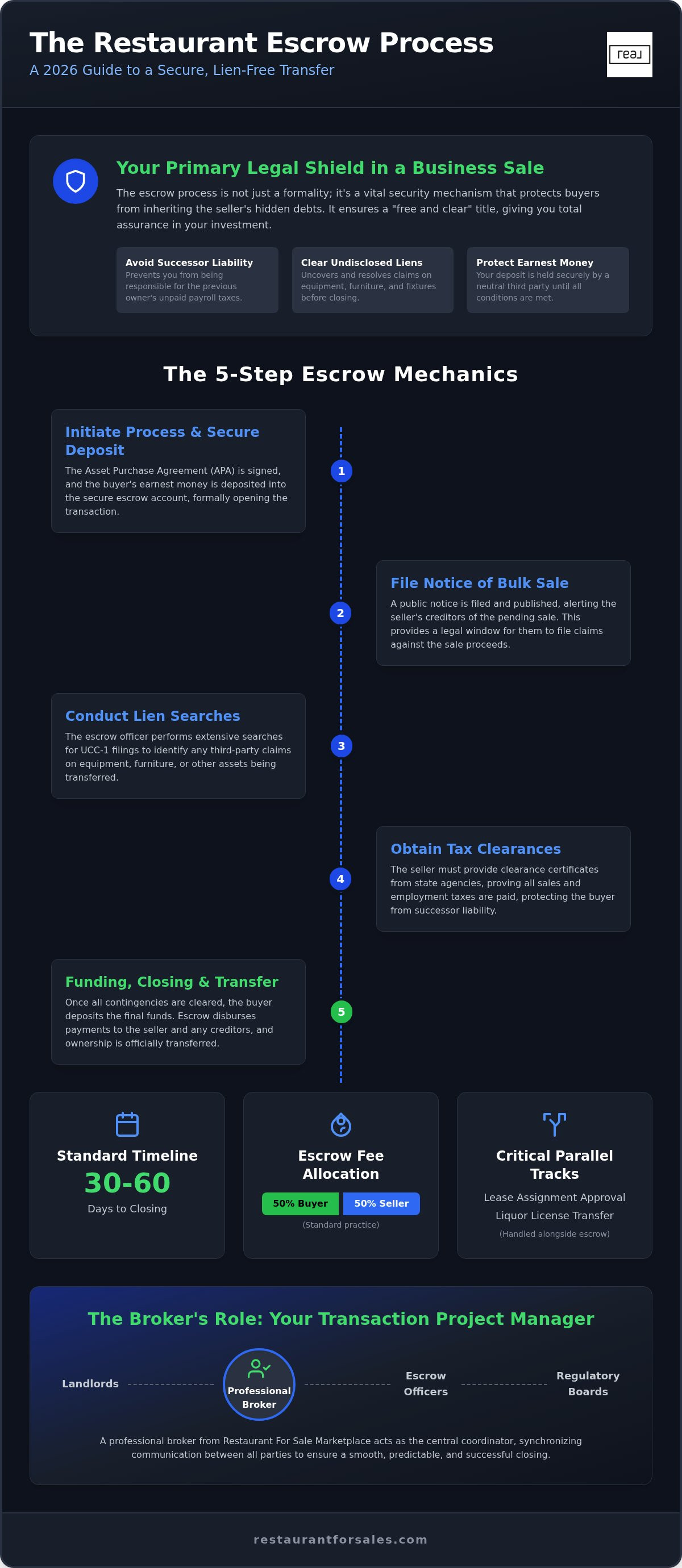
The restaurant escrow process follows a methodical sequence to ensure every asset is accounted for and every debt is cleared. It's a high-stakes timeline where accuracy matters more than speed. Each step is designed to strip away the risks associated with commercial ownership transfers and provide a disciplined path to the closing table.
Step 1 & 2: Initiating the Process and Public Notice
The cycle begins when the buyer and seller execute the Asset Purchase Agreement (APA) and the buyer submits their earnest money deposit to the escrow company. This act formally opens the escrow file and triggers the legal clock. The next immediate requirement is the filing and publication of a Notice of Bulk Sale in a local newspaper. This legal notice alerts potential creditors that a significant portion of the business assets is being sold. Bulk Transfer is a protection against "fly-by-night" sellers who might otherwise attempt to liquidate assets and disappear before paying their vendors or lenders. It provides a formal window for creditors to file claims against the escrowed funds, ensuring they're paid from the sale proceeds.
Step 3 & 4: Due Diligence and Clearances
During this middle phase, the escrow officer performs extensive lien searches, specifically looking for UCC-1 filings on restaurant equipment, furniture, and fixtures. These filings indicate that a third party, such as a lender or equipment lessor, has a legal claim to the physical assets. No buyer should close until these are fully released. Simultaneously, the escrow officer requests tax clearances from state authorities to ensure the seller has no outstanding sales tax or unemployment insurance liabilities. This step is non-negotiable because tax debts often follow the business, not just the owner, through successor liability.
While these searches are underway, both parties must coordinate the restaurant lease assignment with the landlord. This is often the most time-sensitive part of the transaction. It requires the landlord’s written consent and often a review of the buyer’s financial standing. If you need help managing these moving parts, our team at Restaurant For Sale Marketplace can provide the professional brokerage support necessary to keep the deal on track. We act as the coordinator between the landlord and the escrow officer to prevent delays.
Step 5: Final Disbursement and Closing
After all contingencies are removed and tax clearances are received, the final closing statements are prepared. The buyer sends the remaining balance of the purchase price via wire transfer. The escrow officer then pays off any remaining liens, settles prorated utilities, and distributes the net proceeds to the seller. The final bill of sale is recorded, and the keys are delivered. This final step marks the official transfer of ownership, concluding the restaurant escrow process and giving the buyer the security of a clean title and a fresh start.
Navigating Bulk Sale Laws and Creditor Protection
The historical roots of bulk sale laws trace back to the Uniform Commercial Code (UCC) Article 6. These regulations were designed to prevent business owners from selling their inventory and equipment "in bulk" and disappearing with the cash before paying their vendors or lenders. While many states have repealed the formal UCC version, the core principles remain a standard pillar of the restaurant escrow process. Publishing a formal notice creates a legal window for creditors to assert their claims. This ensures that the transaction isn't just a private deal between two parties, but a transparent transfer that respects existing financial obligations.
Successor Liability: The Buyer’s Greatest Risk
Successor liability is the legal doctrine where a buyer can be held responsible for the seller's unpaid debts, even if they weren't part of the original contract. In the restaurant industry, this most often applies to unpaid sales taxes, payroll taxes, and unemployment insurance contributions. If you bypass a formal escrow, the state can legally pursue your new business to satisfy the previous owner's tax bills. The restaurant escrow process severs this legal connection. By requiring a Tax Clearance Certificate from state authorities, the escrow officer confirms that all tax obligations are settled before the seller receives a dime. This certificate is the most critical document in your final closing package because it provides the legal immunity you need to operate without fear of past-due levies.
Managing Creditor Claims During the Notice Period
Once the Notice of Bulk Sale is published, creditors have a specific period to file claims with the escrow officer. This officer acts as a neutral administrator for these filings. If a food vendor or equipment lessor submits a claim for an unpaid balance, the escrow officer notifies the seller to verify the debt. If the seller acknowledges the claim, the amount is deducted from the sale proceeds and paid directly to the creditor at closing. This mechanism guarantees that the equipment, furniture, and fixtures you're buying are owned outright or that their leases are properly assumed. It prevents a situation where a lender could repossess your ovens or refrigeration units three months after you've taken over because the previous owner stopped making payments.
Sometimes, final utility bills or unresolved vendor disputes persist until the closing date. To keep the timeline moving, the escrow officer can establish a "holdback" fund. A portion of the seller's proceeds is kept in a separate account specifically to cover these trailing liabilities. Once the final bills are paid or the disputes are settled, the remaining funds are released to the seller. This grounded approach ensures that the buyer isn't left holding the bag for the seller's final operational costs, while still allowing the seller to close the deal on schedule.
Timeline and Costs: What to Expect During the Closing Phase
The average duration for a restaurant escrow process typically spans 30 to 60 days. This window allows enough time for the mandatory public notice period and the acquisition of necessary tax clearances. While all-cash transactions can sometimes close in as little as 14 to 21 days, financed deals usually require the full 45-day cycle to satisfy lender requirements. External factors often dictate the final pace. Regulatory compliance reviews or complex liquor license transfers can extend the timeline significantly. In some markets, specific energy benchmarking data uploads or green building compliance reviews can add an additional 7 to 10 days to the transaction schedule.
Who Pays the Escrow Fees?
In most commercial markets, the base escrow fee is split 50/50 between the buyer and the seller. This ensures both parties share the cost of the neutral third-party oversight. Beyond the base fee, several incidental costs appear on the final closing statement. These include lien search fees, newspaper publication costs for the Notice of Bulk Sale, and government recording fees. Each expense is itemized to provide a transparent view of the transaction's financial structure. Buyers should also account for parallel costs like lease assignment fees or pro-rated utility deposits. These are handled within the escrow account to ensure a clean break from the previous owner's financial obligations.
Confidentiality and the Public Notice Requirement
Maintaining confidentiality is a primary concern for sellers who don't want to alert staff or customers until the deal is finalized. However, the legal requirement to publish a Notice of Bulk Sale in a local newspaper presents a unique challenge. Most employees don't monitor legal notices in the back of a newspaper, but the risk of discovery remains. A seasoned broker manages this sensitive phase by timing the publication strategically. The goal is to ensure legal compliance while preventing premature rumors that could destabilize the business before the keys are handed over.
Communication with the landlord and regulatory boards must be handled with professional discretion. It's often best to announce the sale to the staff only after the major contingencies, such as the lease assignment, are removed. If you're concerned about balancing transparency with privacy during your sale, contact Restaurant For Sale Marketplace to discuss how our brokerage services protect your business interests throughout the closing cycle. We coordinate between all parties to maintain a steady, disciplined momentum without compromising your operational stability.
How a Professional Broker Streamlines the Escrow Process
A professional broker acts as the central project manager for the entire closing cycle. They bridge the gap between technical legal requirements and operational reality. While the escrow officer handles the funds and legal filings, the broker ensures that the landlord, the ABC board, and both parties stay on schedule. If a hidden lien appears during the UCC-1 search phase, the broker works to find the documentation needed to clear it or negotiates a payoff from the seller's proceeds. This proactive facilitation prevents minor administrative hurdles from becoming "deal killers" that stall the transaction. By maintaining a bird's-eye view of the restaurant escrow process, the broker anticipates bottlenecks before they impact the closing date.
Coordinating the Lease Assignment
The lease is frequently the most significant hurdle in the restaurant escrow process. Most escrow officers won't close until the landlord provides written consent for the transfer. Restaurant For Sale Marketplace facilitates this by preparing the buyer's financial package and professional resume to meet the landlord's specific criteria. We act as the primary point of contact for the property manager, addressing concerns about the new operator's experience or creditworthiness. We synchronize the lease assignment with the escrow close date to ensure there is no gap in occupancy rights. This coordination is essential for a seamless handover where the buyer takes control of the space the moment the funds are released.
The Final Walkthrough and Inventory Count
The night before the sale officially closes, the broker oversees the physical inventory count. This step ensures that the restaurant valuation remains accurate based on the actual "stock on hand" at the moment of transfer. Food, paper goods, and liquor inventory values can fluctuate significantly between the initial offer and the closing date. The final purchase price is adjusted to reflect the dollar value of usable, unopened stock. During this time, the broker also verifies that all included equipment is in working order through a final walkthrough. If an oven or walk-in cooler has failed since the due diligence period, the broker negotiates a credit or repair before the final disbursement. This grounded approach protects the buyer's capital and ensures the seller exits the business with a clean, undisputed final statement. Our team at Restaurant For Sale Marketplace remains embedded in the process until the final key is turned, bridging the gap between a signed contract and a successful opening day.
Securing Your Professional Future at the Closing Table
Navigating the restaurant escrow process requires a disciplined approach to legal compliance and financial transparency. You've learned that the Notice of Bulk Sale and Tax Clearance Certificates are not just administrative hurdles; they're your primary defenses against inherited successor liability. Whether you're managing a complex lease assignment or conducting a high-stakes final inventory count, accuracy at the closing table is non-negotiable. Success in the 2026 market depends on balancing these technical requirements with operational momentum to ensure a clean transfer of ownership.
At Restaurant For Sale Marketplace, we provide expert brokerage support through the entire escrow phase to keep your transaction on schedule. We are specialized in bar and restaurant transactions, leveraging a national network of qualified buyers and sellers to bridge the gap between opportunity and execution. Our proactive approach ensures that every lien search and permit transfer is handled with professional precision. View our current listings and start your acquisition journey to experience the stability of a market-leading partner. You're now equipped to move forward with the confidence and reliability of a seasoned industry insider.
Frequently Asked Questions
How long does the restaurant escrow process typically take?
The restaurant escrow process typically takes between 30 and 60 days to reach a formal closing. All-cash transactions might move faster, sometimes concluding in as little as 14 to 21 days, while financed deals often require the full 60-day window. This timeline accounts for mandatory public notice periods, tax clearance acquisitions, and landlord approvals for lease assignments. Delays often stem from complex regulatory reviews or liquor license transfers that require external agency involvement.
Can I buy a restaurant without using an escrow company?
While you can technically buy a restaurant without an escrow company, doing so exposes you to significant financial and legal risks. Escrow acts as a neutral third party that ensures all liens are cleared and taxes are paid before funds are released to the seller. Without this protection, you could unknowingly inherit the previous owner's unpaid payroll taxes or equipment debts. Most professional brokers and lenders require a formal escrow to guarantee a secure, lien-free transfer of ownership.
What is a Bulk Sale notice and why is it required?
A Bulk Sale notice is a public announcement published in a local newspaper to alert the seller's creditors about the pending transfer of business assets. This legal requirement is designed to prevent owners from selling their equipment and inventory and disappearing with the proceeds before settling their debts. By providing this notice, the buyer is protected from future claims made by the seller's vendors, lenders, or taxing authorities, ensuring the assets are transferred free and clear.
Who is responsible for paying the escrow fees in a restaurant sale?
Escrow fees are typically split 50/50 between the buyer and the seller in most commercial transactions. This shared cost structure reflects the neutral role of the escrow officer in protecting both parties' interests. Beyond the base fee, additional costs such as lien searches, publication fees for the Bulk Sale notice, and government recording charges are also itemized on the final closing statement. Your broker can help you review these prorated expenses to ensure they align with your purchase agreement.
What happens to the liquor license during the escrow process?
The liquor license transfer runs as a critical parallel track to the main restaurant escrow process. Funds are generally held in the escrow account and are not fully released to the seller until the state regulatory board provides formal approval for the transfer. If the license transfer is denied, the escrow instructions usually dictate how the funds are returned or if the deal is terminated. This synchronization prevents the buyer from paying for a business they cannot fully operate.
What is successor liability and how does escrow prevent it?
Successor liability is a legal principle where a new owner is held responsible for the previous owner's unpaid debts, specifically state taxes and unemployment insurance. The escrow process prevents this by requiring the seller to obtain official Tax Clearance Certificates from relevant government agencies before the sale closes. If debts are discovered, the escrow officer pays them directly from the sale proceeds. This ensures the buyer starts their new venture without the burden of the seller's past financial obligations.
What documents are required to open a restaurant escrow account?
Opening a restaurant escrow account requires several foundational documents, starting with a fully executed Asset Purchase Agreement. The buyer must also provide their initial earnest money deposit along with corporate formation documents, such as Articles of Incorporation or an LLC Operating Agreement. The seller provides equipment lists, existing lease agreements, and tax identification numbers. These documents allow the escrow officer to draft the formal escrow instructions that will govern the remainder of the closing cycle.
How is the final inventory value calculated at the close of escrow?
The final inventory value is determined through a physical count conducted by the buyer and seller, often the night before or the morning of the closing. This count focuses on unopened, usable stock such as food, paper goods, and liquor. The value is calculated based on the seller's actual cost, supported by recent invoices. The escrow officer then adjusts the final purchase price on the closing statement to reflect this dollar amount, ensuring the buyer pays only for the tangible assets they receive.


