

A franchise resale valuation is a three-way negotiation between the books, the brand, and the landlord. Most owners assume their hard work automatically translates into a high multiple, yet they often feel blindsided when franchisor requirements or lease assignments complicate the final number. Understanding how to value a franchise resale requires a precise balance of financial data and market sentiment. Whether you're managing a single unit or a multi-unit portfolio, the uncertainty surrounding brand equity and transfer fees can stall even the most promising deal.
You deserve a clear, defensible valuation that stands up to scrutiny during negotiations. This 2026 comprehensive guide deciphers the critical differences between SDE and EBITDA multiples, which currently range from 2.5x to 7.0x depending on your sector and unit count. You'll master the exact formulas used to determine true market value while learning how to navigate the franchisor's right of first refusal. We provide a roadmap to maximize your ROI and close your sale with confidence, ensuring no money is left on the table.
Key Takeaways
- Learn the core differences between valuing an independent restaurant and a franchise, where brand recognition acts as a stability multiplier for the buyer.
- Discover how to value a franchise resale using precise financial metrics, including SDE for owner-operated units and EBITDA for multi-unit portfolios.
- Evaluate the impact of intangible assets, such as the condition of your physical plant and the stability of your existing management team.
- Understand the logistical hurdles of franchisor involvement, including the Right of First Refusal and how transfer fees affect your final net proceeds.
- Move beyond unreliable "rule of thumb" multipliers by utilizing professional recasting to ensure your valuation is defensible during negotiations.
Understanding the Unique Value of a Franchise Resale
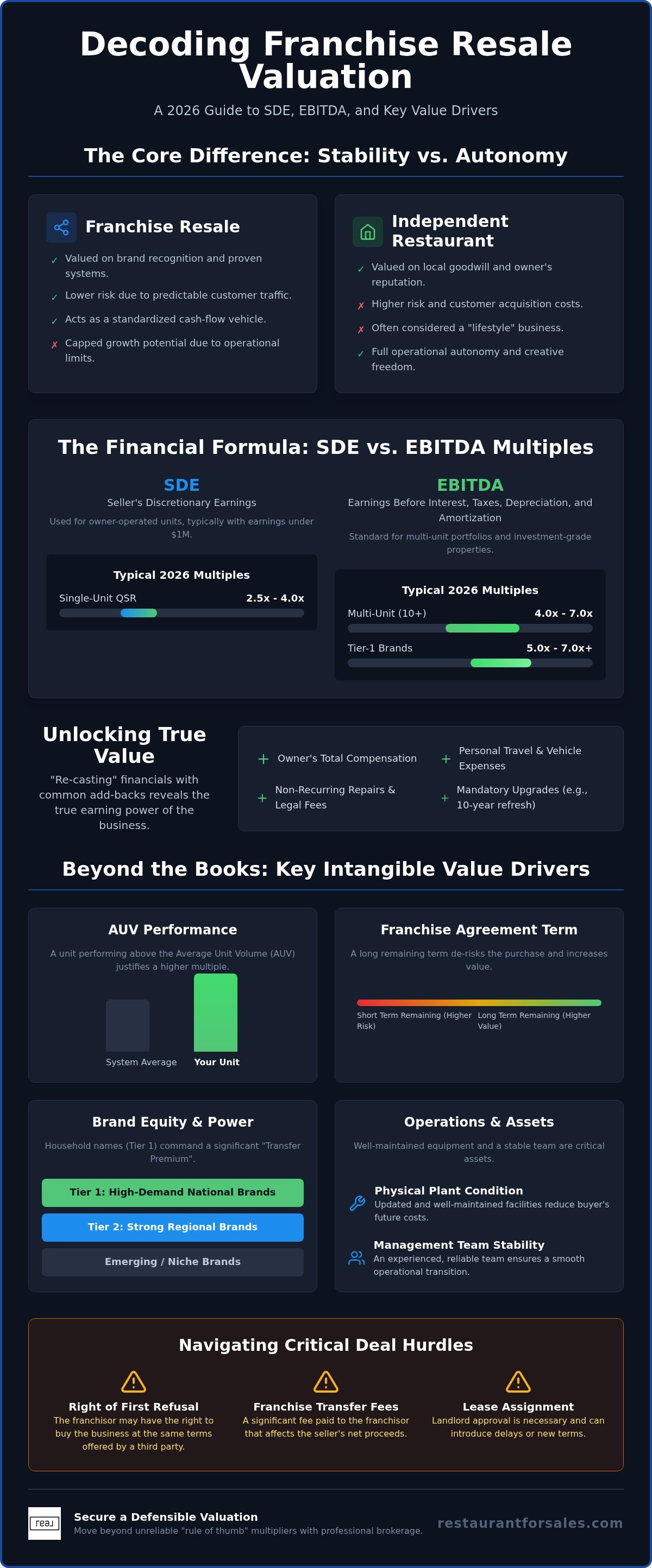
Valuing an independent restaurant relies heavily on local goodwill and the owner's personal reputation. When you analyze how to value a franchise resale, however, the focus shifts to the brand's national footprint and operational systems. An independent business is often a lifestyle play; a franchise is a standardized cash-flow vehicle. Brand recognition acts as a powerful multiplier for stability. It provides a predictable floor for customer traffic that independent startups lack, significantly reducing the cost of customer acquisition from day one.
In 2026, resales often command a premium over new build-outs. Inflationary pressures on construction materials and prolonged permitting timelines make existing locations highly desirable. A buyer pays for immediate cash flow and a de-risked operation. However, the remaining term on the Franchise Agreement is a pivotal factor. A short remaining term can depress the price, as the buyer must factor in upcoming renewal fees or the risk of non-renewal. These nuances are grounded in standard business valuation principles, which balance tangible assets against future earnings potential.
Brand Equity vs. Operational Autonomy
Strict franchisor systems are a double-edged sword. They reduce buyer risk by providing a proven playbook, but they also cap growth potential by limiting menu or operational changes. High-performing national brands, often called Tier 1 franchises, carry a significant Transfer Premium. This is the extra amount a buyer pays for the security of a household name. In contrast, regional or emerging brands might offer more flexibility but lack the same level of consumer trust. A professional valuation must account for where the brand sits in its lifecycle and how much control the buyer actually retains.
The Role of Systemwide AUV (Average Unit Volume)
Average Unit Volume (AUV) is the primary benchmark for assessing a specific location's health. It represents the total sales of all units in the system divided by the total number of units. If a resale location performs significantly above the systemwide AUV, it often justifies a higher multiple. Conversely, a unit performing below the average suggests local mismanagement or a poor site. Buyers in 2026 prioritize AUV consistency. They want to see that the revenue isn't just a result of a one-time marketing push, but a steady reflection of the brand's local strength. Understanding how to value a franchise resale requires looking past top-line revenue to see how the unit stacks up against its peers.
The Financial Formula: Calculating SDE and EBITDA Multiples
Determining how to value a franchise resale starts with choosing the correct financial baseline. For owner-operated locations with earnings under $1 million, we typically use Seller’s Discretionary Earnings (SDE). This metric includes the net profit plus the owner's salary, benefits, and non-essential expenses. For multi-unit portfolios or investment-grade properties, Earnings Before Interest, Taxes, Depreciation, and Amortization (EBITDA) is the standard. Most professional buyers prioritize EBITDA because it reflects the business's ability to operate under a management team without the original owner's daily involvement.
In 2026, valuation multiples for the restaurant sector remain highly specific to the business model. Single-unit Quick Service Restaurants (QSR) generally trade between 2.5x and 4x SDE. Larger multi-unit operations, specifically those with 10 or more locations, command higher multiples ranging from 4x to 7x EBITDA. These ranges are influenced by the specific brand; for instance, high-demand systems like McDonald's often reach 5x to 7x EBITDA. Understanding how franchise resale value is calculated across these different tiers is essential for a defensible offer. If you need a precise assessment of your unit's position, our restaurant valuation services provide the necessary market data to justify your price.
Normalizing Your Financial Statements
Add-backs are frequently the most contested part of a franchise valuation. To show the true earning power of a location, brokers "re-cast" the financials by adding back personal or one-time expenses that a new owner won't incur. Common restaurant add-backs include:
- The owner's total compensation and health insurance premiums.
- Personal travel or vehicle expenses run through the business.
- Non-recurring repairs or one-time legal fees.
- Franchisor-mandated upgrades, such as a 10 year "refresh" or remodel, which are treated as capital expenditures rather than daily operating costs.
Selecting the Right Multiple
Once the earnings are normalized, you must select a multiple that reflects the unit's risk and growth potential. Several operational factors can push a multiple to the high end of the 2026 range. Prime real estate locations, low staff turnover rates, and a high percentage of high-margin bar sales significantly increase value. Conversely, multiples are often depressed by an expiring lease with no options or a declining demographic trend in the territory. A Market Multiple is the standard ratio derived from recent comparable transactions within the same franchise system and geographic market. This approach ensures the valuation is grounded in what buyers are actually paying right now.
Beyond the Books: Intangible Factors That Influence Price
Financial statements provide the foundation for any transaction, but intangible assets often dictate whether a buyer pays a premium or demands a discount. When analyzing how to value a franchise resale, you must conduct a thorough inspection of the Physical Plant. Furniture, Fixtures, and Equipment (FF&E) that are near the end of their useful life represent a significant future liability. Similarly, the transferability of the current management team is a primary value driver. A "turnkey" operation with a stable, trained staff is worth more than a unit where the owner is the sole keeper of operational knowledge. Buyers pay for the systems and the people who run them, not just the physical assets.
Territory rights and technology integration also weigh heavily on the final price. A protected territory prevents the franchisor from opening a competing unit in your immediate trade area, while "encroachment" clauses can devalue your investment overnight. By 2026, a restaurant's technology stack, including AI-driven ordering and seamless third-party delivery integration, has become a core valuation component. These systems improve margins and reduce labor friction, making the business more attractive to sophisticated investors. If the technology is outdated, the cost of the necessary upgrade must be factored into your offer.
The "Remodel" Trap and Capital Expenditures
Most franchisors require a Property Improvement Plan (PIP) as a condition of the transfer. This mandatory remodel ensures the unit meets the current brand standards, but it can cost tens of thousands of dollars. When valuing an existing franchise, you must deduct the estimated PIP costs from the purchase price or negotiate a credit from the seller. With 2026 equipment and labor costs remaining high, failing to account for a pending refresh can destroy your first year's cash flow and ROI projections.
Quality of the Franchise System
The health of the franchisor is just as critical as the unit's local performance. A brand that is stagnant or involved in widespread litigation with franchisees is a significant risk. You should review the latest Franchise Disclosure Document (FDD) to see if new agreements include higher royalty or marketing fees that will apply to you upon transfer. A Tier 1 franchisor provides robust transition support and marketing muscle, which helps maintain revenue consistency during the change in ownership. Understanding these external brand pressures is a vital part of knowing how to value a franchise resale effectively and avoid overpaying for a declining system.
Navigating the Franchisor and Lease Transfer Hurdles
A successful transaction requires more than just an agreed-upon price; it demands the approval of two powerful third parties: the franchisor and the landlord. The franchisor’s Right of First Refusal (ROFR) is a standard clause that allows the brand to match any outside offer and purchase the unit themselves. This process typically adds 30 to 90 days to the timeline, creating a period of uncertainty for both parties. Additionally, the Transfer Fee, which often ranges from $5,000 to $50,000 per location in 2026, is a direct cost that reduces the seller’s net proceeds. When calculating how to value a franchise resale, you must account for these friction costs to ensure the final offer remains realistic for both sides.
The buyer qualification process is another critical variable that can derail a high-value valuation. Franchisors maintain strict net worth and liquidity requirements for all new operators. If a buyer fails the brand's financial or background vetting, the deal collapses regardless of the business's profitability. This makes the valuation "conditional" on the buyer's strength. Professional brokers often pre-screen candidates to ensure they meet these benchmarks before entering formal negotiations. If you're unsure how your financial profile aligns with brand requirements, our franchise resale listings team can provide guidance on current qualification standards.
The Lease as a Valuation Anchor
A business with strong cash flow but only two years remaining on its lease is essentially worthless to a lender or a long-term investor. Without a secured location, the business cannot continue. Buyers and SBA lenders generally look for a 10-year valuation horizon, which includes the remaining lease term plus any guaranteed option periods. A successful restaurant lease assignment is mandatory to protect the buyer's investment. For sellers who own the underlying land and building, the strategy changes significantly. You should consult our guide on investing in restaurant real estate to maximize the combined value of the business and the property.
Franchisor Approval and Training Requirements
Purchasing a franchise resale is inherently more complex than buying an independent restaurant. The buyer must often complete a multi-week training program before the franchisor grants final approval for the transfer. This requirement dictates the closing date and affects the prorated valuation of inventory and seasonal cash flows. Buyers should also prepare for the possibility that the franchisor will require them to sign a "New Agreement" rather than assuming the seller's existing contract. These modern agreements often include higher royalty rates or increased marketing fund contributions, which directly impact the buyer's projected ROI and the price they're willing to pay.
Securing an Accurate Valuation with Professional Brokerage
Determining a defensible price requires more than a simple spreadsheet. A professional restaurant valuation accounts for the specific operational nuances that generic business brokers often overlook. Relying on a "Rule of Thumb" multiplier is a significant risk for franchise owners in 2026. These generic ratios fail to account for mandatory technology upgrades, specific franchisor royalty increases, or localized labor cost shifts. A restaurant broker provides the necessary recasting to reveal the true earning potential of the unit while managing the delicate balance of confidentiality. This ensures your staff and customers remain unaware of the transaction until the deal is secured, protecting the business's ongoing value.
The process of preparing a franchise for the 2026 market involves a disciplined approach to documentation. Owners must organize three years of profit and loss statements, current lease agreements, and the most recent Franchise Disclosure Document. Understanding how to value a franchise resale involves identifying every possible add-back to maximize the final sale price. Professional brokerage services act as a facilitator between the buyer's expectations and the seller's goals. This ensures that the final transaction reflects the true market value of the established brand equity and cash flow.
The Value of a Certified Appraisal
A formal valuation report is a powerful tool for speeding up SBA loan approvals. As of August 2026, SBA 7(a) variable rates range from 9.75% to 13.25%, and lenders are applying increased scrutiny to cash flow stability. A certified appraisal provides a factual foundation that reduces price haggling during the negotiation phase. By utilizing Market Comps, which consist of data from actual closed sales within your specific franchise system, brokers can justify an asking price to sophisticated investors. This data-driven approach removes the emotional friction often found in high-value commercial transactions.
Taking the Next Step to Exit
Preparation is the key to a successful exit. We encourage owners to begin the valuation process 12 to 24 months before they intend to sell. This lead time allows you to optimize your financial statements and address any physical plant issues that could depress your multiple. If you are looking to buy a restaurant, evaluating existing resale opportunities offers a significantly faster path to ROI than a new build-out. Whether you're buying or selling, a professional consultation is the first step toward a successful closing. Contact our team today to secure an expert assessment of your franchise's market standing.
Maximizing Your Franchise Exit Strategy in 2026
Mastering how to value a franchise resale requires a disciplined look at both the balance sheet and the brand's operational health. We've explored how normalizing your financials through proper recasting reveals true earning power. We've also discussed why securing a long-term lease assignment is non-negotiable for a high-value exit. By 2026 standards, a defensible valuation must account for mandatory franchisor upgrades and the quality of the current management team.
Avoid leaving money on the table by relying on generic multipliers. Our specialized restaurant and franchise brokerage provides national reach combined with local market insights to ensure your price reflects current demand. We offer expert lease assignment and franchise transfer management to bridge the gap between an initial offer and a final closing. Success in a high-value commercial transaction is the result of meticulous preparation and expert facilitation.
When you're ready to move forward, Get a Professional Valuation for Your Franchise Resale to ensure your hard-earned brand equity is fully realized. We're here to guide you toward a successful and profitable transition.
Frequently Asked Questions
What is the average multiple for a franchise restaurant resale in 2026?
Valuation multiples depend on the specific segment and unit count of the business. In 2026, single-unit Quick Service Restaurants (QSR) typically trade between 2.5x and 4x Seller’s Discretionary Earnings (SDE). Multi-unit portfolios of ten or more locations often command higher multiples, ranging from 4x to 7x EBITDA. These figures are influenced by brand strength, with high-demand systems like McDonald's or Domino's often reaching the upper end of these market ranges.
Does the franchisor set the price for my business resale?
The franchisor does not dictate the sale price, as the transaction is a private negotiation between the buyer and seller. However, the franchisor maintains significant influence through the Right of First Refusal (ROFR), which allows them to match any outside offer. They also set the financial qualification standards for the buyer. While they don't set the price, their requirements for a "new agreement" can impact the buyer's projected ROI and final offer.
What is the difference between SDE and EBITDA in franchise valuation?
Seller’s Discretionary Earnings (SDE) is the primary metric for owner-operated units with earnings under $1 million, adding back the owner's salary and personal benefits. EBITDA is the standard for larger, investment-grade or multi-unit resales where a management team is in place. When determining how to value a franchise resale, choosing the right metric is vital. SDE reflects the total cash benefit to an owner-operator, while EBITDA measures the standalone profitability of the business.
Who typically pays the franchise transfer fee, the buyer or the seller?
The seller typically pays the franchise transfer fee, although this point is often negotiated during the due diligence phase. These fees generally range from $5,000 to $50,000 per location in 2026. Many sellers choose to factor this cost into their initial asking price to protect their net proceeds. Buyers should also confirm if the franchisor requires additional training fees or background check costs that could increase their total acquisition investment.
How does a pending remodel (PIP) affect my franchise resale value?
A pending Property Improvement Plan (PIP) acts as a direct deduction from the market value of the business. If a franchisor requires a mandatory refresh as a condition of the transfer, the buyer will typically demand a price reduction or a credit at closing to cover the expense. Failing to account for these capital expenditures can lead to an inflated valuation. Sophisticated buyers prioritize immediate cash flow and will discount any offer to mitigate upcoming renovation costs.
Can I sell my franchise resale if the landlord won’t assign the lease?
A business sale cannot be completed if the landlord refuses to assign the lease or grant a new agreement to the buyer. The lease is the fundamental anchor of the business valuation; without a secured physical location, the franchise cannot legally or operationally continue. Most franchise agreements require a valid lease as a condition of the brand license. If a lease assignment is blocked, the seller must negotiate a buyout or find a different buyer.
How long does a professional franchise valuation typically take?
A professional franchise valuation typically takes between seven and fourteen business days to complete. This timeline depends on how quickly the owner provides three years of profit and loss statements, the current lease, and the Franchise Disclosure Document. Once the data is collected, a broker recasts the financials to determine the true earning power of the unit. This factual foundation is essential for securing SBA loan approvals and providing a defensible price during negotiations.
Why is a franchise resale often valued higher than an independent restaurant?
Franchise resales command higher prices because they offer brand recognition and standardized operating systems that significantly reduce buyer risk. Learning how to value a franchise resale involves recognizing the "multiplier" effect of national marketing and a proven supply chain. Independent restaurants lack this predictable floor for customer traffic. Buyers pay a premium for a turnkey operation that includes established vendor relationships and a trained staff already following a successful brand playbook.


