

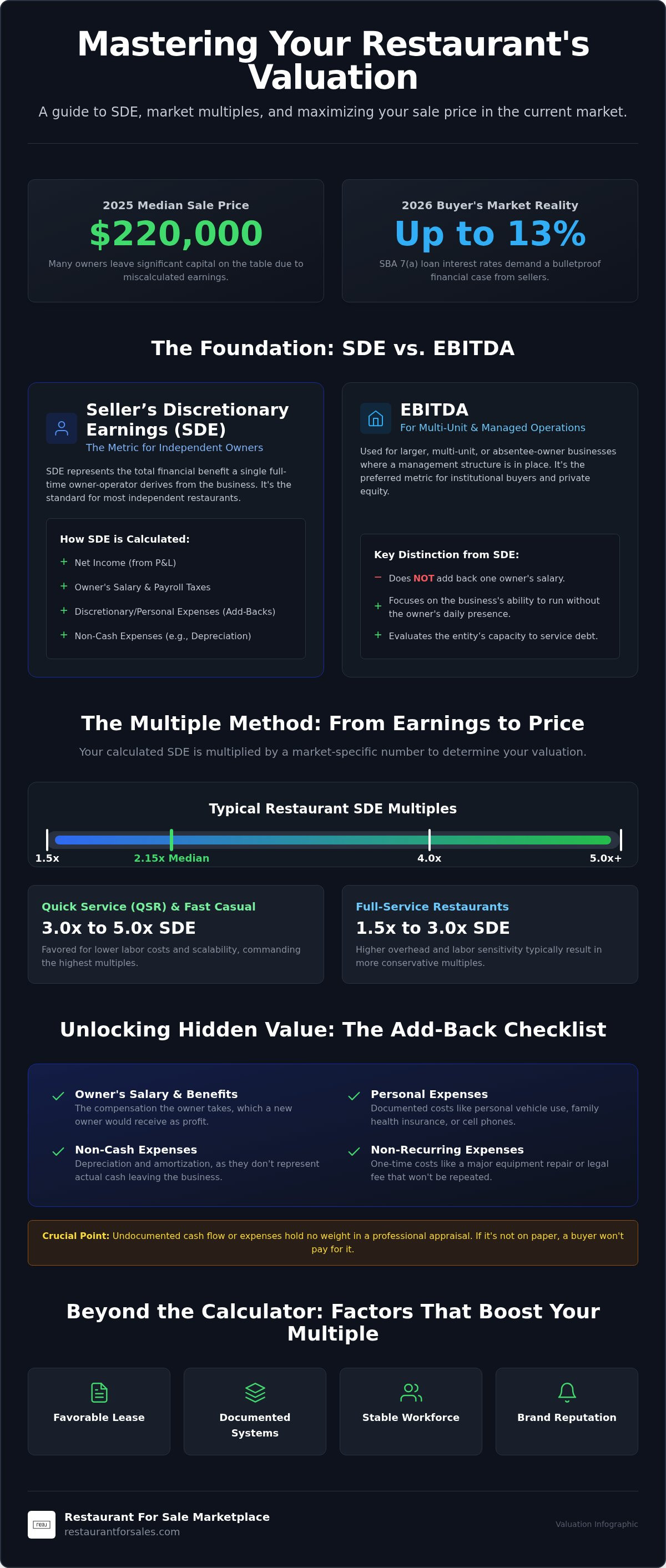
In 2025, the median sale price for a restaurant was $220,000; however, many owners leave significant capital on the table because they miscalculate their earnings. You likely feel uncertain about which financial metrics actually matter or fear that a lifetime of hard work will be undervalued by a skeptical buyer. While a restaurant valuation calculator is an essential diagnostic tool, your true market value exists at the intersection of Seller's Discretionary Earnings, concept-specific multiples, and leasehold interest. With SBA 7(a) loan interest rates reaching up to 13% in 2026, buyers are more disciplined than ever, making it essential to present a bulletproof financial case.
We recognize that "add-backs" and discretionary spending often feel like a maze of confusing jargon. This guide will help you master the financial formulas and market multiples used by professional brokers to accurately estimate your restaurant's market value. We will cover the differences between SDE and EBITDA appraisals, identify legitimate add-backs, and provide a checklist of documents required to establish a realistic valuation range before you list your business.
Key Takeaways
- Identify whether Seller’s Discretionary Earnings (SDE) or EBITDA is the appropriate metric for your specific business size and structure.
- Learn how to apply market multiples between 1.5x and 4x based on your restaurant’s category, from fast-casual to full-service establishments.
- Determine when an asset-based valuation is more advantageous than an income-based approach for struggling or equipment-heavy operations.
- Increase the accuracy of any restaurant valuation calculator by identifying non-recurring expenses and preparing a comprehensive add-back checklist.
- Recognize the intangible factors, such as leasehold interest and brand reputation, that professional brokers use to maximize a final sale price.
The Foundation: Understanding SDE and EBITDA in Restaurant Valuation
Most owners start their valuation journey by looking at their tax returns. However, those documents are designed to minimize tax liability rather than maximize sale price. To get an accurate result from a restaurant valuation calculator, you must first "normalize" your financial statements. This process involves adjusting your profit and loss statements to reflect the true earning potential of the business. Standard Business valuation approaches typically categorize these earnings into two primary buckets: SDE and EBITDA.
Normalizing your financials for the 2026 market requires a disciplined look at your "Owner Benefit." This is the total amount of money the business generates for the owner, regardless of how it's categorized for the IRS. In an environment where prime costs for healthy operations sit between 60% and 66%, showing a clean path to profitability is the only way to secure a premium multiple.
Calculating SDE: The Independent Owner’s Metric
For independent restaurants, Seller’s Discretionary Earnings (SDE) is the definitive metric. It represents the total financial benefit a single full-time owner derives from the business. You start with your bottom-line net income and work backwards. You add back the owner's salary, payroll taxes, and non-cash expenses like depreciation.
In 2026, buyers and lenders are incredibly cautious about discretionary spending. If you run personal expenses through the business, such as a personal vehicle or family health insurance, these must be documented meticulously. Undocumented cash flow no longer holds weight in a professional appraisal. If it isn't on paper, a restaurant valuation calculator won't count it, and a buyer won't pay for it.
When EBITDA Takes Precedence
EBITDA is the preferred language of institutional buyers and private equity firms. It's used primarily for multi-unit operations or absentee-owner models where a management structure is already in place. Unlike SDE, EBITDA does not add back the owner's salary because the buyer expects the business to run without their daily physical presence.
Institutional buyers look past individual owner benefits to evaluate the entity's ability to service debt. With SBA 7(a) loan interest rates currently between 10% and 13%, the impact of interest and depreciation is significant. A restaurant broker can help you determine if your operation has reached the scale where EBITDA becomes the more profitable metric to use during negotiations. This distinction is vital because using the wrong framework can lead to a valuation that is either laughably high or dangerously low.
The Multiple Method: How Market Trends Dictate Your Price
Once you've calculated your SDE, the next step involves applying a market multiple. Most independent restaurants sell between 1.5x and 4x their annual earnings. While a restaurant valuation calculator provides a baseline, the specific multiple is determined by the perceived risk and stability of your operation. Historical data from 2021 to 2025 shows a median SDE multiple of 2.15x. In 2026, this figure is heavily influenced by the cost of capital. With SBA 7(a) loan interest rates currently between 10% and 13%, buyers require higher cash flow to cover debt service, which often compresses multiples for businesses with inconsistent performance.
Transferable value is the true driver of a high multiple. A buyer isn't just purchasing your past profits; they're buying the certainty that those profits will continue under new ownership. This is why documented systems, a stable workforce, and a favorable lease are critical. If your business depends entirely on your personal presence to function, a buyer will likely apply a lower multiple to account for the "owner-operator risk."
Concept-Specific Multiples for 2026
Quick Service Restaurants (QSR) and Fast Casual concepts often command the highest multiples, sometimes reaching 3.0x to 5.0x SDE for highly profitable independent brands. These models are favored for their lower labor requirements and scalability, even as QSR traffic saw a slight 1.2% decline in early 2026. Full-service restaurants typically fall into the 1.5x to 3.0x range. Their higher overhead and sensitivity to rising labor costs make them a higher risk for many buyers. Bars and lounges often see their value bolstered by the fair market value of a transferable liquor license, which can act as a financial floor for the business price.
The Financial Weight of the Lease
A restaurant is only as valuable as its right to occupy the space. A short lease with no options can render a profitable business nearly worthless. Ideally, a buyer looks for a total remaining term of at least 10 years, including options. A critical component of this process is the restaurant lease assignment. If the landlord refuses to assign the lease or demands unreasonable changes to the terms, the sale can easily collapse.
We also evaluate the rent-to-sales ratio. If your occupancy costs exceed 10% of gross sales, it creates significant downward pressure on your valuation multiple. To ensure you're applying the correct multiple for your specific market, consider engaging our restaurant valuation services for a professional appraisal that goes beyond simple formulas.
Income vs. Asset-Based Valuation: Choosing the Right Framework
Selecting the correct valuation framework is the most critical decision an owner makes before listing a business. Most owners instinctively reach for a restaurant valuation calculator that relies on income multiples. However, that approach only works if the business is currently profitable. In 2025, 42% of restaurant operators reported they weren't profitable. For these businesses, an asset-based valuation often yields a higher price than an income-based one. Understanding which model fits your specific situation prevents you from underpricing your assets or overestimating your goodwill.
The choice between these frameworks depends on whether the buyer is purchasing a "job" (the income) or a "facility" (the assets and location). A profitable steakhouse with ten years of clean books is an income play. A struggling bistro in a prime downtown corner with a high-end kitchen is an asset play. Knowing the difference allows you to set a price that reflects the actual market demand.
The Income Approach (The Multiples Model)
This model is the gold standard for established, profitable restaurants. It assumes the buyer's primary motivation is the return on investment generated by annual cash flow. When using this framework, you'll rely heavily on your Seller’s Discretionary Earnings (SDE). To ensure your projections are grounded in current market reality, consult the 2026 restaurant valuation guide to see how recent traffic shifts impact future cash flow expectations.
Skeptical buyers in 2026 will scrutinize your growth rates. If your revenue increased because of menu price hikes rather than increased foot traffic, you must be prepared to defend those margins. A strong income-based valuation relies on showing that your profit is sustainable despite rising labor and food costs.
The Asset Approach (The Replacement Model)
The asset approach is used when a restaurant’s earnings don't justify a high multiple, but the physical components of the business hold significant value. This is often referred to as an "asset sale" or "key money" deal. You're essentially selling the "build-out value" of the space. Recreating a fully equipped commercial kitchen in 2026 is expensive. A buyer might pay a premium for your Furniture, Fixtures, and Equipment (FF&E) just to avoid the six-month delay and high costs of a new construction project.
Several factors can bolster an asset-based valuation:
- Liquor Licenses: In states with limited quotas, a transferable liquor license acts as a financial floor, often worth tens of thousands of dollars regardless of the restaurant's performance.
- Leasehold Improvements: High-quality HVAC systems, grease traps, and venting are invisible but essential assets that a restaurant valuation calculator might overlook.
- Strategic Location: A lease in a high-traffic area with a below-market rent rate is a tangible asset that can override poor financial performance.
Whether you choose an income or asset framework, the goal is to present a valuation that a lender can support. Professional restaurant valuation services can help you determine which approach will result in the highest possible exit price for your specific circumstances.
Maximizing Your Output: The Essential Add-Back Checklist
The fastest way to increase the result of a restaurant valuation calculator is to perform a thorough financial normalization. Many owners are surprised to learn that add-backs often represent 20% to 30% of their business's total market value. These are expenses currently recorded on your profit and loss statement that a new owner would not necessarily have to pay. By identifying these items, you move from a "tax-minimized" profit figure to a "value-maximized" earnings figure.
Clean books are non-negotiable in the 2026 market. Buyers and lenders now scrutinize every line item to ensure cash flow can support debt service at current SBA 7(a) rates. If your records are disorganized, buyers will apply a "risk discount" to your price. Professional restaurant valuation services specialize in identifying these hidden figures to ensure you don't leave money on the table during negotiations.
Standard Operational Add-Backs
The most common add-backs involve the owner’s direct compensation and personal benefits. Since SDE is designed to show the total benefit to one full-time owner, you must add back your base salary, health insurance premiums, and 401k contributions. If you employ family members who are paid above market rate or who don't work active shifts, the difference between their pay and a standard replacement’s wage is a legitimate add-back.
- Personal Technology: Cell phone plans and home office equipment used for business.
- Vehicle Expenses: Personal vehicle leases, fuel, and insurance run through the business.
- Non-Cash Items: Depreciation and amortization are accounting entries that reduce taxable income without costing actual cash. These must always be added back to reflect true liquidity.
One-Time and Non-Essential Costs
Non-recurring expenses often mask a restaurant's true profitability. If you spent $12,000 on a one-time rebranding project or replaced a walk-in cooler motor last year, those costs won't repeat annually for the buyer. These should be categorized as one-time capital expenditures rather than ongoing operational costs. Similarly, charitable donations and non-essential marketing tests are discretionary choices that a new owner might choose to eliminate.
Legal fees related to a specific, resolved dispute or initial startup costs from a previous expansion should also be added back. Documenting these items with invoices is essential. Without a paper trail, a buyer's accountant will likely reject the adjustment, lowering your final valuation multiple. If you need assistance documenting these adjustments, our restaurant brokerage services provide the expert oversight needed to validate your financial claims.
Beyond the Calculator: Why Professional Brokerage Valuation Wins
A restaurant valuation calculator provides a necessary baseline, yet it cannot account for the nuanced variables that drive a final sale price. Mathematical formulas excel at processing historical data, but they often fail to capture the "market pulse" of what buyers are actually paying this month. A professional restaurant broker bridges this gap by identifying hidden value drivers that don't appear on a standard profit and loss statement. This expertise is particularly vital in 2026, where high interest rates have made buyers more selective and risk-averse.
In 2025, the median time a restaurant spent on the market was 181 days. To beat this average, your valuation must be defensible under intense scrutiny. An accurate appraisal serves as your best defense during due diligence. When you can justify your price with hard market data and concept-specific trends, you reduce the likelihood of a buyer attempting to "chip" away at the price during the final stages of the transaction.
The Qualitative Value Drivers
While your earnings provide the foundation, your "intangibles" dictate whether you land at the high or low end of your valuation range. Buyers prioritize "turnkey" operations where the management team is expected to remain after the sale. If you have proprietary recipes, long-term staff longevity, or a stellar online reputation, you possess significant intellectual property. These factors reduce the buyer's transition risk, justifying a higher multiple. Favorable lease terms with multiple renewal options also provide the long-term stability that lenders require before they approve acquisition capital.
Taking the Next Step Toward a Sale
Moving from a rough estimate to a market-ready listing price requires a strategic shift in perspective. You must understand how buying a restaurant looks from the other side of the table. A buyer is looking for a return on investment that accounts for current debt service costs. If your restaurant valuation calculator result doesn't align with these lender requirements, the deal won't close.
A professional consultation with a national broker is the logical next step after performing your own preliminary research. We provide comprehensive Restaurant Valuation Services that analyze your specific concept, leasehold interest, and local market competition. This investment in a professional appraisal often results in a higher final sales price by positioning your business as a premium opportunity rather than a commodity. Our team understands the current buyer appetite for specific cuisines and service models, ensuring your listing price reflects the true maximum the market will bear.
Preparing Your Restaurant for a Successful 2026 Exit
Determining your business worth requires more than just looking at a bank statement. It involves a deep dive into your Seller's Discretionary Earnings and the careful application of market multiples that reflect current economic conditions. While a restaurant valuation calculator provides a helpful starting point, the most successful sellers are those who meticulously document their add-backs and leverage the intangible strengths of their brand and staff. In a market where buyers are increasingly selective, presenting clean, normalized financials is the most effective way to secure a premium price.
We offer national reach across all US markets with a specialized focus on restaurant and bar transactions. Our success-based brokerage model ensures that our goals are perfectly aligned with yours as we guide you through the complexities of lease assignments and professional appraisals. You've spent years building your business; don't leave its final valuation to chance. Get a Professional Restaurant Valuation from Our Expert Brokers today to ensure you capture every dollar of value you've created. We're ready to help you navigate this transition with confidence and precision.
Frequently Asked Questions
What is the standard multiple for a restaurant valuation in 2026?
The standard multiple for independent restaurants in 2026 typically ranges from 1.5x to 3.0x of Seller’s Discretionary Earnings (SDE). High-performing brands with verifiable systems can command multiples up to 5.0x SDE. For multi-unit groups, multiples often transition to EBITDA, ranging between 4.0x and 7.0x. These rates are currently influenced by higher borrowing costs, with SBA 7(a) loan interest rates reaching up to 13% for qualified borrowers.
How do I calculate Seller’s Discretionary Earnings (SDE)?
To calculate Seller’s Discretionary Earnings, start with the net income from your tax return and add back interest, taxes, depreciation, and amortization. You also add back the owner’s salary and personal expenses run through the business, such as health insurance or vehicle leases. This metric shows the total financial benefit a single owner-operator receives. It is the most common input used in a restaurant valuation calculator to determine a small business’s market price.
Can I value my restaurant based on gross sales alone?
Valuing a restaurant based on gross sales is a common "rule of thumb," typically ranging from 30% to 40% of annual revenue, but it is rarely the final sale price. Buyers and lenders prioritize profit over volume. A high-volume restaurant with poor cost controls is less valuable than a smaller, highly efficient operation. While sales volume indicates market demand, the income-based or asset-based approaches provide the financial accuracy required for a successful closing.
What are common "add-backs" that increase a restaurant’s value?
Common add-backs include owner compensation, personal health insurance, and discretionary travel or meals. You should also include non-recurring expenses like one-time equipment repairs, legal fees from a specific dispute, or initial rebranding costs. Adding back non-cash items like depreciation is also standard. These adjustments are critical because they can represent up to 30% of a restaurant's total value, significantly impacting the result of any restaurant valuation calculator or professional appraisal.
How does a commercial lease affect my business valuation?
A commercial lease is a primary value driver because it secures the restaurant's right to operate. Buyers look for a remaining term, including options, of at least 10 years. If the lease is not assignable or the rent exceeds 10% of gross sales, the business valuation will likely decrease. A favorable lease assignment can act as a tangible asset, while a short or expensive lease often acts as a deal-breaker for most buyers.
Is a restaurant valuation calculator accurate for franchise resales?
A standard restaurant valuation calculator may lack the specificity required for franchise resales. Franchise valuations must account for ongoing royalty fees, marketing fund contributions, and the cost of the transfer fee paid to the franchisor. Additionally, many franchises require specific capital expenditure updates upon transfer, known as a Property Improvement Plan (PIP). These unique financial obligations often require a more complex EBITDA-based multiple than a simple independent restaurant formula provides.
What is the difference between an asset sale and an entity sale?
An asset sale involves the buyer purchasing specific components like furniture, fixtures, equipment, and leasehold improvements, while the seller retains the legal entity. This is common for independent restaurants and protects the buyer from undisclosed liabilities. An entity sale involves purchasing the actual corporation or LLC, including all its history and debts. Entity sales are more frequent in large-scale transactions where maintaining existing contracts and permits is essential for business continuity.
How long does a professional restaurant appraisal take?
A professional restaurant appraisal typically takes between 7 and 14 business days once all financial documents are provided. The timeline depends on the complexity of the operation and the availability of clean profit and loss statements, tax returns, and lease agreements. For businesses with multiple units or real estate involved, the process may take longer. Speeding up this timeline requires having organized records ready for the broker to review at the start of the consultation.


