

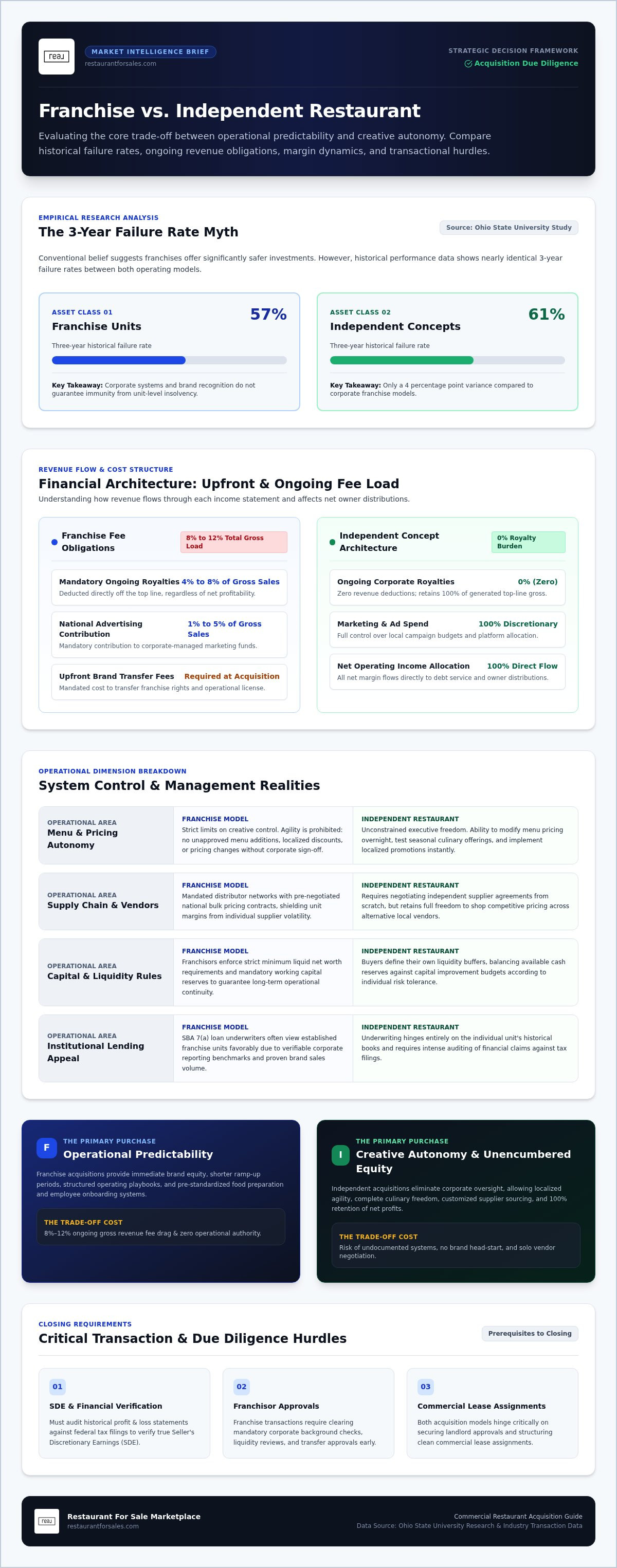
The conventional belief that a franchise is an inherently safer investment than an independent business does not hold up against historical performance data. Research from Ohio State University revealed nearly identical three-year failure rates: 57% for franchises versus 61% for independents. When evaluating the pros and cons of buying a franchise vs independent restaurant, the choice comes down to a core trade-off. Franchises buy operational predictability; independent restaurants buy creative autonomy and unencumbered equity.
Choosing the right path can be difficult when you are weighing an 8% to 12% combined royalty fee load against the risk of inheriting undocumented systems in an independent kitchen. This guide breaks down the operational margins, day-to-day management realities, risk profiles, and transactional hurdles behind each model. You will gain a practical framework to evaluate historical financial records, navigate franchise transfer approvals, and structure commercial lease assignments with total confidence.
Key Takeaways
- Weighing the pros and cons of buying a franchise vs independent restaurant requires balancing corporate operational guardrails against complete culinary and pricing autonomy.
- Franchise resales provide immediate brand equity and standardized operating manuals, but require ongoing royalty and marketing contributions deducted directly from gross revenue.
- Independent acquisitions eliminate corporate oversight and ongoing fee obligations, giving buyers full control over concept changes, localized vendor sourcing, and net margins.
- Accurate financial due diligence requires auditing historical profit and loss statements against federal tax filings to verify true Seller's Discretionary Earnings (SDE).
- Closing either transaction hinges on clearing critical hurdles early, including franchisor transfer approvals, operational background checks, and commercial lease assignments.
Franchise vs Independent Restaurant: Key Structural Differences
Weighing the pros and cons of buying a franchise vs independent restaurant requires a clear assessment of operational authority and asset governance. A restaurant acquisition is fundamentally an investment in an operating structure. While one path relies on institutionalized oversight and brand uniformity, the other prioritizes entrepreneurial autonomy and localized agility.
Operational Framework and Systems Control
Franchise locations function under rigid operational playbooks. When acquiring an existing unit governed by the traditional franchising business model, the buyer agrees to enforce corporate standard operating procedures, maintain approved equipment specifications, and purchase exclusively from mandated distributor networks. This structure protects enterprise value and brand consistency, but it limits direct operational intervention.
By contrast, an independent restaurant gives the buyer unconstrained executive freedom. Independent operators can modify menu pricing overnight, test seasonal culinary offerings, and negotiate terms with local purveyors without corporate oversight. Brand consistency ensures standardized operational execution across locations, whereas independent operational agility allows immediate menu and pricing adjustments without corporate approval.
Financial Architecture: Upfront Capital and Ongoing Fees
The financial architecture of each asset class dictates how revenue flows through the income statement:
- Fee structures: Franchise resale acquisitions involve upfront brand transfer fees, followed by mandatory ongoing royalties (typically 4% to 8% of gross sales) and national advertising contributions (1% to 5%). Independent acquisitions carry zero royalty obligations, directing all net operating income straight toward debt service and owner distributions.
- Supply chain leverage: Franchisees access pre-negotiated national bulk pricing contracts, shielding margins from supplier volatility. Independent operators must negotiate independent supplier agreements, though they retain the freedom to shop for competitive pricing across alternative vendors.
- Capital requirements: Franchisors impose strict liquid net worth requirements and mandatory working capital reserves to ensure operational continuity. Independent buyers define their own liquidity buffers, balancing cash reserves against capital improvement budgets based on individual risk tolerance.
Pros and Cons of Buying an Established Franchise Restaurant
Acquiring an existing franchise unit eliminates the uncertainty of opening a new restaurant from the ground up. Instead of developing recipes and designing workflows, the buyer inherits a turnkey operating engine. However, balancing the pros and cons of buying a franchise vs independent restaurant means recognizing that corporate stability comes with strict operational guardrails and non-negotiable overhead.
The Core Advantages of Franchise Ownership
Brand equity provides immediate top-line support. Customers recognize the menu, signage, and service model before you open the doors for your first shift. This baseline awareness significantly shortens the post-acquisition ramp-up period compared to unbranded concepts.
- Institutional lending appeal: Proven sales volume and brand longevity give lenders tangible benchmarks. Underwriters processing SBA 7(a) loan applications often view established franchise units favorably because historical performance data is backed by corporate reporting.
- Structured operational playbooks: Comprehensive manuals standardize food preparation, inventory control, and employee onboarding. This structured environment simplifies day-to-day management for operators transitioning into the food service industry.
Buyers exploring this path can review vetted franchise resale opportunities to evaluate established units with existing cash flow and verifiable customer volume.
The Strategic Drawbacks and Limitations of Franchises
Operational stability requires accepting strict limits on creative and executive control. The franchise agreement binds the buyer to standard operating mandates that cannot be negotiated away at the store level.
- Restricted business agility: Franchise agreements prohibit unapproved menu additions, localized discounting, or alternative packaging suppliers. Operators must execute the corporate playbook regardless of local market shifts.
- Mandatory capital expenditure: Franchise agreements often mandate periodic store refreshes and equipment upgrades through Property Improvement Plans (PIPs). These capital reinvestments are required on a corporate schedule, regardless of unit cash flow.
- Exit friction and transfer hurdles: Selling the business later requires franchisor approval. Corporate teams evaluate prospective buyers independently, which can complicate negotiations or delay closing timelines.
Executing thorough due diligence when buying a franchise requires auditing the Franchise Disclosure Document (FDD), particularly Item 7 investment estimates and Item 20 closure figures. If you are assessing prospective targets, exploring national transaction support through Restaurant For Sale Marketplace can help you verify historical unit metrics before making an offer.
Pros and Cons of Buying an Independent Restaurant
Purchasing an established independent restaurant offers unencumbered ownership. You acquire the equipment, leasehold rights, existing customer base, and goodwill without signing away decision-making power to a franchisor. When analyzing the pros and cons of buying a franchise vs independent restaurant, this route appeals directly to operators who want full control over their brand and balance sheet.
Key Benefits of Independent Restaurant Ownership
The primary advantage is complete financial and creative autonomy. Because independent operators have no contractual obligations to corporate headquarters, every operational decision remains entirely in their hands.
- Direct earnings retention: Independent operators do not pay ongoing royalty fees or corporate ad fund charges. That retained capital stays inside the business, available for debt service, facility upgrades, or direct distributions to the owner.
- Rapid menu and pricing adjustments: Market conditions shift quickly. Independent owners can update dish pricing, adjust portion sizes, or swap out seasonal ingredients instantly to protect food cost percentages against inflation.
- Bespoke community identity: Independent establishments build unique local connections. Guests often patronize neighborhood restaurants specifically because they provide distinct hospitality and culinary character that standardized national chains cannot duplicate.
Critical Operational Vulnerabilities to Consider
Total autonomy carries heightened operational exposure. Without a parent company providing field support, the buyer assumes full responsibility for establishing and maintaining business systems.
- Inconsistent or undocumented workflows: Many independent sellers operate through informal tribal knowledge rather than structured manuals. Incoming buyers frequently inherit undocumented recipes, uncalibrated portion standards, and fragmented employee training routines that take months to standardize.
- Higher supply and vendor costs: Independent restaurants lack the national buying contracts that reduce wholesale costs for franchise systems. Operators must independently manage distributors, monitor price sheets closely, and negotiate delivery terms without collective volume leverage.
- Fragile patron goodwill: Independent customer loyalty is often tied directly to the outgoing founder, the head chef, or long-tenured staff. If an ownership transition leads to sudden disruptions in food quality or service pacing, guest retention can drop sharply before the new operator stabilizes the room.
Financial and Due Diligence Comparison: Assessing Unit Economics
Evaluating historical financials is where the pros and cons of buying a franchise vs independent restaurant translate into real balance sheet numbers. Both business models require an audit of historical earnings, but the mechanics of verifying cash flow and securing transaction approvals differ substantially.
Valuation Metrics and True Earnings Normalization
Verifying cash flow begins with recasting the income statement. Buyers must audit internal Profit and Loss (P&L) statements directly against three years of federal business tax returns. For independent businesses, you will calculate Seller's Discretionary Earnings (SDE) by adding back non-operational owner perks, discretionary travel, and personal vehicle write-offs to uncover the true baseline profitability.
Evaluating a franchise resale requires reviewing Item 19 of the Franchise Disclosure Document alongside the unit-level records. While system averages provide a broad market baseline, the individual location's P&L reveals the operational reality after deductions for required royalties, ad fund assessments, and mandated software licenses. You can consult our comprehensive restaurant valuation guide to understand how capitalization rates and earnings multiples differ across franchise and independent assets.
Lease Assignments and Transfer Approvals
The purchase agreement is only binding if you can secure the physical space and the operational rights. A transaction can collapse during closing due to two distinct institutional bottlenecks:
- Franchisor qualification: Franchise buyers face an extensive corporate vetting process. Corporate approval committees review your personal financial statement, minimum liquid assets, background checks, and prior restaurant management experience before granting transfer consent.
- Commercial lease assignment: Whether acquiring an independent brand or a franchise, securing long-term occupancy is critical. Landlords scrutinize net worth and credit history before agreeing to assign the lease. Operators should inspect assignment clauses, personal guarantee language, and remaining option terms carefully. Review critical provisions using our guide on restaurant lease assignments before signing a letter of intent.
If you need expert guidance to audit seller books, navigate landlord assignments, or vet confidential listings, partner with the brokerage advisors at Restaurant For Sale Marketplace to safeguard your acquisition from offer to closing.
How to Choose the Right Restaurant Model for Your Goals
Selecting an acquisition target requires matching your operational background and financial objectives to the right business format. While reviewing the pros and cons of buying a franchise vs independent restaurant clarifies structural distinctions, your daily experience as an owner depends on how well the business model fits your personal risk profile and management style.
Matching Your Background to the Business Model
Your operating history often dictates which structure yields the highest probability of success:
- First-time restaurant buyers and corporate career changers: Buyers without extensive commercial kitchen management experience benefit substantially from franchise resales. Standardized training protocols, pre-selected equipment vendors, and built-in brand awareness provide a structured foundation that flattens the operational learning curve.
- Seasoned chefs and experienced hospitality operators: Culinary professionals who want to innovate with seasonal dishes, select specialty purveyors, and shape their brand identity will feel constrained by franchise rules. For these operators, an established independent restaurant offers immediate cash flow paired with complete conceptual agility.
Review our comprehensive step-by-step roadmap on how to buy a restaurant to structure your acquisition strategy and refine your search criteria.
Assessing Long-Term Exit Liquidity
Your acquisition decision must factor in eventual resale liquidity. Multi-unit franchise portfolios often attract institutional capital and multi-unit operators because the cash flow is supported by recognizable brand performance. Independent restaurants command strong multiples when their financial records are well documented, but their buyer pool consists primarily of individual operators seeking localized community presence. Understanding which buyer audience you want to target at exit helps clarify which model to buy today.
Acquiring Your Next Restaurant with Professional Guidance
Executing an acquisition without specialized guidance exposes buyers to overlooked operational liabilities, unassignable leases, and inaccurate financial representations. Partnering with professional restaurant brokers ensures you maintain strict confidentiality while reviewing fully vetted off-market listings across the country. Experienced advisors guide you through purchase negotiations, manage escrow timelines, coordinate landlord lease assignments, and facilitate franchisor transfer requirements.
Explore confidential, pre-screened acquisition listings and connect with specialized transaction advisors nationwide at Restaurant For Sale Marketplace.
Making the Strategic Choice for Your Restaurant Acquisition
Deciding between these operating formats comes down to whether you prioritize institutional corporate structure or complete conceptual independence. While franchise resales offer structured workflows, proven supplier networks, and established brand recognition, independent restaurants grant total authority over your menu, local pricing, and retained cash flow. Reviewing the pros and cons of buying a franchise vs independent restaurant provides strategic clarity, but closing a successful transaction requires disciplined financial due diligence, accurate valuation, and proactive lease transfer management.
Executing a smooth acquisition requires dedicated sector expertise. As a nationwide brokerage specialized exclusively in the restaurant and hospitality sector, our platform provides full-spectrum transaction advisory covering business valuation, commercial lease assignments, and closing due diligence. When you are ready to take the next step toward hospitality ownership, explore vetted independent and franchise restaurant listings on Restaurant For Sale Marketplace to find the ideal operational fit for your commercial investment goals.
Frequently Asked Questions
Is buying a franchise safer than buying an independent restaurant?
Long-term survival data shows that franchises are not inherently safer than well-run independent restaurants. While conventional wisdom assumes corporate backing guarantees security, research shows comparable multi-year closure rates across both models. Franchises offer predictable operating procedures and established customer recognition, which reduces early startup volatility. However, success still depends on unit-level labor control, site selection, and active executive management rather than the business format alone.
How do royalty fees impact the long-term profitability of a franchise?
Royalty and marketing fees directly reduce your gross margin because franchisors calculate them as a percentage of total sales rather than net profit. With ongoing royalties typically taking 4% to 8% and advertising funds claiming another 1% to 5%, a franchise operator surrenders 8% to 12% of gross revenue before covering cost of goods or payroll. In low-margin quarters, this mandatory fee load can turn an otherwise viable operation into a net loss.
Can I change the menu or pricing in an existing franchise restaurant?
Franchisees cannot alter core menu offerings, recipes, or branded ingredients without formal corporate authorization. Franchise agreements enforce strict culinary conformity to protect national brand equity across all operating units. While some franchisors allow minor regional pricing tiers within predetermined software bands, independent customization is contractually prohibited. If your operational business plan requires adjusting menus to match local ingredient costs or creative trends, an independent acquisition is the appropriate choice.
Why do independent restaurants usually cost less to buy than franchises?
Independent acquisitions often trade at lower entry multiples because they lack institutional brand recognition and documented corporate operating systems. When evaluating the pros and cons of buying a franchise vs independent restaurant, pricing differences reflect risk and infrastructure. Franchise resales include proprietary software, national marketing equity, and turnkey training manuals. Independent restaurants, while requiring lower upfront acquisition multiples, often require buyers to invest sweat equity into formalizing staff workflows, recipe cards, and local brand outreach.
What should I look for in a Franchise Disclosure Document (FDD)?
Focus your legal and financial audit on Item 7, Item 19, and Item 20 of the disclosure document. Item 7 outlines the complete estimated investment, including working capital mandates and mandatory equipment refreshes. Item 19 discloses historical unit financial performance and gross sales figures, showing whether reported returns support your debt service. Finally, Item 20 tracks system turnover, revealing the number of franchise units terminated, non-renewed, or reacquired by corporate headquarters over the preceding three years.
Can a commercial landlord reject my restaurant lease assignment request?
Yes, commercial landlords hold the legal right to reject a lease assignment if the prospective buyer fails to meet the criteria in the master lease. Most commercial lease agreements require the landlord's written consent prior to closing. Landlords typically evaluate the buyer's credit history, restaurant operational experience, and liquid net worth. If the incoming buyer exhibits weaker financial standing than the original tenant, the landlord can reject the assignment or demand additional security deposits and personal guarantees.
Which restaurant model offers a higher resale valuation multiple upon exit?
Multi-unit franchise portfolios typically command higher valuation multiples due to standardized financials and institutional investor demand. Single-unit exits depend heavily on clean bookkeeping. When weighing the pros and cons of buying a franchise vs independent restaurant, franchises trade on predictable system-wide earnings multiples. However, an independent restaurant generating verified, high-margin Seller's Discretionary Earnings (SDE) with transferable key employees can rival franchise valuations without being burdened by franchisor transfer fees or buyer qualification vetoes.


